

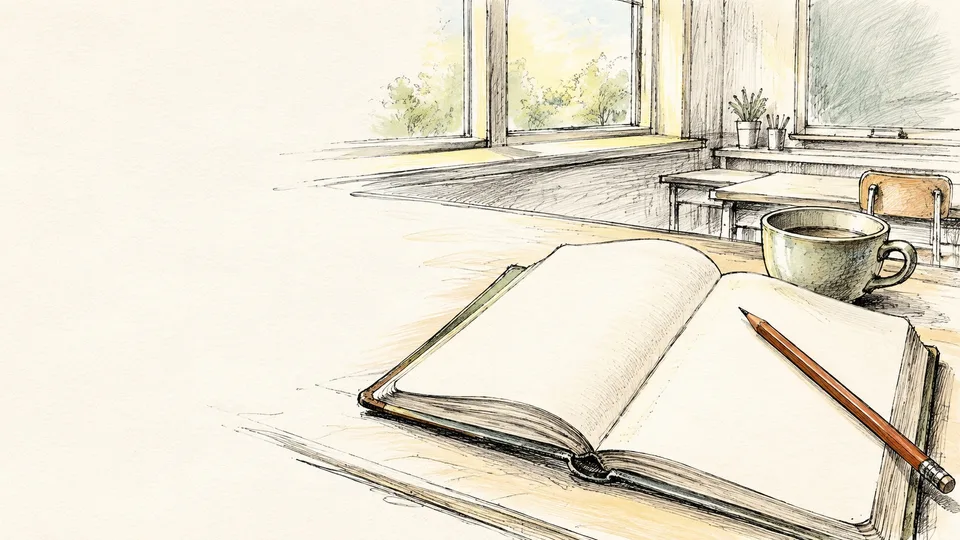
Writing begins in many different places. It may start with a question in the margin, a sentence that arrives while washing a cup, or an old notebook opened after years on a shelf. Sometimes the page feels welcoming. Sometimes it feels like a quiet room where we are not yet sure what to say.
These poems about writing are for beginners, teachers, lifelong writers, and anyone who has wanted to put a real feeling into words. The collection includes two sonnets, a ballad, free verse, and a haiku. Each poem stays close to the practice itself, including the hesitation, revision, surprise, and small joy of finding a line that sounds true.
I have kept writing because a page can hold a thought long enough for me to understand it. A classroom before the students arrive, a cedar pencil, a worn book spine, or a cup beside a draft can become an invitation. The objects do not write the poem, but they remind me to remain present while the poem is forming.
You do not need a perfect beginning to start. Write one image, one question, or one sentence you almost erased. These poems about encouragement may help when the work feels difficult, and these poems of gratitude for teachers and mentors may give you another path into the relationship between words and learning.
Poems About Writing and the Open Page
Before the Students Arrive
The quiet classroom in this ballad is a place of preparation rather than performance. I like the chalk dust and the open book because they show how teaching and writing both begin before anyone knows what the day will hold. This poem may comfort a reader who does important work in a quiet hour.
Ballad
Before the students came, the room was blue with early light,
A row of cedar pencils waited, sharpened clean and bright.
The chalk lay ready on the ledge, the lesson book was wide,
And one small question in the notes kept turning like a tide.The first bell rang, the voices rose, the careful pages turned,
A child found one good word to say, and every face was warmed.
The lesson changed, as lessons do, when living minds are near,
The written plan became a path made clearer by the cheer.At last the room grew quiet, and the evening settled down,
I found a line beside the notes and carried it through town.
A page can teach a teacher too, if there is time to see,
The sentence waiting in the day, the question asking me.
The First Sentence
This sonnet begins with the smallest possible act, placing one sentence on a blank page. I notice the permission in the middle, where the words do not need to know the ending yet. That is the part I value most for a reader who is waiting to feel ready before beginning.
Shakespearean sonnet
A blank page waits beside the morning cup,
The window holds a pale and patient sky,
I place one honest sentence softly up,
And let the restless questions wander by.
The first small line may tremble as it starts,
It does not need to know the ending yet,
A story grows from ordinary hearts,
When we allow the waiting words to set.
The pencil leaves a little mark of grace,
A thought once hidden finds a wider room,
The page becomes a listening place,
Where unfinished hopes can learn to bloom.
I write, then leave the window open wide,
For more of life to enter from outside.
Margin Note
The margin note is where many honest thoughts begin because it is small enough to feel safe. I like the poem’s movement from a mark at the edge to a voice finding room in the center. This may help someone who is writing privately and wants to honor an idea before deciding what it will become.
Free verse
In the margin I write:
remember the sound of rainthen forget it,
then find it again
in the way the sentence pauses.The page does not scold me
for arriving late.It keeps the little note,
turns it toward the light,
and waits for me
to understand why it matters.
Pencil on Paper
The haiku gives the writing life a small moment of calm. I enjoy the idea of pages breathing because it makes the act feel less like a test and more like attention. This could be a gentle line to share with a student, a new writer, or anyone opening a notebook after a long pause.
Haiku
Blue pencil rests still
Morning pages breathe softly
One word finds its place
The Page Stays Open
The second sonnet is about returning to a page that is not finished. I like the way doubt is allowed to knock without being allowed to take over the room. This poem may help a reader who needs permission to keep an unfinished line visible while the larger meaning grows.
Shakespearean sonnet
The page stays open after evening rain,
A sentence leans beside the lamp’s warm glow,
The old doubt knocks, then knocks its knock again,
I answer with a line that moves more slow.
The words are not a fence around the heart,
They are a path through rooms I could not name,
A little truth can give a fear a start,
And turn a hidden ember into flame.
I do not need to make the ending clear,
A living page can change beneath the hand,
The right next word may simply bring me near,
To what I meant before I understand.
So let the rough edge keep its honest place,
An open page can teach a soul its grace.
Let the Work Keep Growing
Writing is often described as a finished product, but the daily practice feels more like a conversation. We write a sentence, listen to it, change a word, and discover that the question has moved. The page gives us a place to notice that movement without demanding an immediate answer.
If you are beginning, choose a small container. Write for ten minutes, fill half a page, or describe one object without trying to sound wise. A cedar pencil and an old notebook are enough. The point is not to impress the page. The point is to meet it.
Teachers know that a first attempt can be valuable even when it needs work. A student who finds one right word has already made a beginning. The same is true for adults who return to writing after years of caring for everyone else.
When a line feels awkward, you can keep it nearby instead of throwing it away. Sometimes the rough edge shows where the real thought is trying to enter. These poems about life may offer another reminder that meaning often arrives through ordinary details.
I hope these poems make the open page feel a little less lonely. Write what you can see, what you remember, or what you are still learning to name. Then leave the window open for the next sentence.
Useful supplies for your writing time
An old notebook and a pencil are enough. Use what you have, and consider these only if you need fresh pages or small cards for loose ideas.
These are paid links. As an Amazon Associate I earn from qualifying purchases.
- View on Amazon
Essentials Dot Matrix Notebook
Keep the ten minute writing practice, unfinished lines, and observations together in one notebook.
One A5 hardcover notebook, 192 dot grid pages, 5¾ × 8¼ inches
- View on Amazon
Oxford Heavyweight Ruled Index Cards
Save one image or sentence on each card so you can rearrange ideas while revising.
100 white cards, 3 × 5 inches
- View on Amazon
A Poetry Handbook
Read about poetic sound and form when you are ready to develop or revise the lines from your writing practice.
One paperback book by Mary Oliver
- View on Amazon
PILOT G2 black gel pens
Keep a pen at your writing place or share the pack with a writing group. This is a twelve-pen pack, so use a pen you own if you only need one.
Twelve black gel pens, 0.7 mm fine point
Send a little poetry to someone you love.