

Encouragement is often quieter than applause. It may sound like a person saying, I am here, or feel like a hand that stays near while we decide what to do next. The best encouragement does not take over our work. It gives us enough steadiness to meet it ourselves.
These poems about encouragement include two sonnets, a haiku, a ballad, and free verse. They are for a friend beginning again, a child trying something difficult, a student waiting for confidence, or anyone who needs a few kind words without being rushed toward a cheerful answer. Each poem approaches support from a different angle, because people do not all receive care in the same way.
I have seen how one patient sentence can remain with a person for years. A teacher leaves a note in the margin, a neighbor carries a chair, or a family member remembers to ask how the work is going. Such acts may take only a minute, but they can make a lonely task feel shared.
Encouragement should leave room for honest feelings. We can offer hope without denying tiredness, and we can believe in someone without pretending the road will be easy. A small light beside the path is sometimes more useful than a bright speech from far away.
If you are looking for another collection about beginning with care, these poems about hope may be helpful. These poems about confidence offer a related look at finding a steadier voice. I hope the words below help you offer support that feels personal, patient, and true.
Poems About Encouragement and Steady Support
A Hand at the Gate
The open hand in this poem does not pull the speaker down a path. I appreciate that it waits and makes room for a choice, because good encouragement respects the person doing the work. This piece may be useful when you want to tell someone that they do not have to face a new step alone.
Shakespearean sonnet
I saw a hand held open at the gate,
Not pulling me, but making room to choose,
It waited while I gathered up my weight,
And stayed when I had nothing bright to use.
The road was not made easier by a sign,
The wind still pressed against my borrowed coat,
Yet someone said, “Take one more step, it’s fine,”
And steadied all the doubt inside my throat.
We think brave words must thunder through the room,
But sometimes courage sounds like, “I am here,”
A small lamp set beside another’s gloom,
A patient voice that makes the next step clear.
If I can offer what was offered me,
Another heart may find a way to be free.
Small Lantern
The lantern is modest, and that is why I trust it. It does not promise to erase the dark. It simply gives the next step a little shape, which may be exactly what a tired person can use.
Haiku
Lantern by the door
It leaves a small light nearby
Light for one more step
The Seedling and the Storm
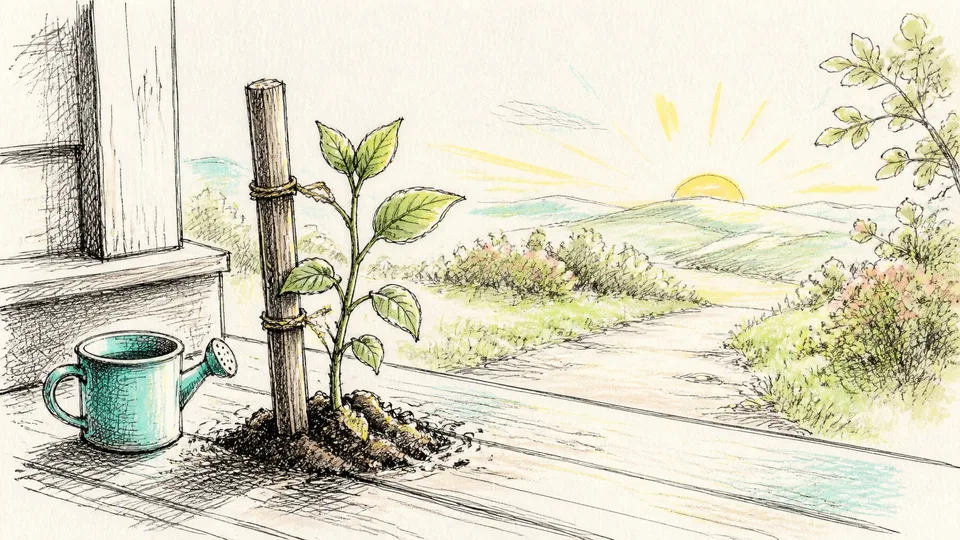
I like the way this ballad lets the seedling remain small while the story moves around it. The gardener protects what can be protected, waits through the weather, and does not demand instant proof of growth. Read it to someone who is learning that being unfinished does not mean being without promise.
Ballad
A seedling leaned beside the wall,
Its first leaves thin and wide,
The gardener set a little stake
And tied the stem beside.The rain arrived across the yard,
The porch light shook with drops,
She placed a cup beneath the eave
And watched until it stopped.At dawn one leaf was bent with care,
Another faced the sun,
She loosened up the patient tie
And said, “You have begun.”The garden did not cheer aloud,
The morning simply grew,
Yet every day the little stem
Found one more thing to do.
What I Say Before You Go
This free verse poem stays close to the moment before someone leaves to try again. I notice that the speaker offers presence, not instructions, and I value that kind of care. It could be shared with a friend, a graduate, or a family member who needs to know that their effort has been seen.
Free verse
Take the coat that fits,
the one with the patient button.Take water.
Take the note you wrote at midnight.You do not need to carry
every possible answer.I will be here when you return,
and proud of the step you chose.
The Work Beneath the Work
The roots in this poem are doing their work before the green proof appears. I love that image for anyone who feels behind or unseen, because it gives hidden effort its proper dignity. Sometimes the most encouraging sentence is a reminder that the beginning is already part of the growing.
Petrarchan sonnet
Beneath the soil, the quiet roots extend,
Though no green proof is visible above,
They make a place for water, air, and love,
And hold the seed through every unseen bend.
We call it waiting, but the roots attend,
They practice reaching where the dark is wide,
Then lift a stem when strength has multiplied,
Because a life can grow before its friend.
So if your hands feel empty at the start,
Remember work may happen out of sight,
A patient breath can tend a tired heart,
A faithful step can gather hidden light.
The day will ask for more than you can see,
Yet small beginnings still know how to be.
Offering Words That Leave Room
Encouragement is not the same as fixing. A person may need rest, practical help, a listening ear, or time to decide what comes next. Kind words become more useful when they honor the person’s actual situation instead of asking them to perform hope for our comfort.
“A Hand at the Gate” is for a new choice that feels uncertain. “Small Lantern” fits inside a short note, while “The Seedling and the Storm” offers a longer picture of patient care. “What I Say Before You Go” is a simple send off, and “The Work Beneath the Work” can reassure someone whose progress is mostly hidden.
When you write to encourage someone, use their name and mention one true thing you have noticed. You might say that they kept showing up, asked a thoughtful question, practiced again, or made room for another person while they were tired. Specific attention feels warmer than a collection of bright phrases.
We also need encouragement for ourselves. A notebook page, a walk, a glass of water, or a small task completed can be a way of saying that our own lives deserve patient care. Progress does not become more real only when someone else applauds it.
May these poems help you stay near without crowding the person you love. Offer the lamp, leave the gate open, and trust the next small step to belong to the one who takes it. A little faith, given gently, can travel a long way.
Send a little poetry to someone you love.