
Life is too large for one lesson and too particular for a tidy definition. It arrives as weather, work, appetite, mistake, recovery, laughter, and the sudden sight of light moving across a familiar floor. Meaning does not always announce itself while it is happening.
These poems about life include two sonnets, a haiku, a ballad, and a villanelle. They consider beginnings, routine, change, courage, and the way ordinary attention can make a day feel inhabited rather than merely spent.
I used to imagine that wisdom would feel like reaching a clear hilltop. Now it seems more like learning how to walk with questions. Some seasons offer a wide view, while others ask us to watch the next few feet of road and trust that careful steps still count.
For a closer look at passing years, visit these poems about time. If you need words for a fresh chapter, these poems for new beginnings and life transitions may meet you there.
Read these poems slowly and notice which image stays. It may be a seed, a kitchen light, a river bend, or a repeated road. Often the line we need is the one that gives our own experience enough room to answer back.
Poems About Life
The Road Is Made of Mornings
This Shakespearean sonnet follows an ABAB CDCD EFEF GG rhyme pattern. It finds a whole life not in one grand destination, but in mornings chosen and traveled one by one.
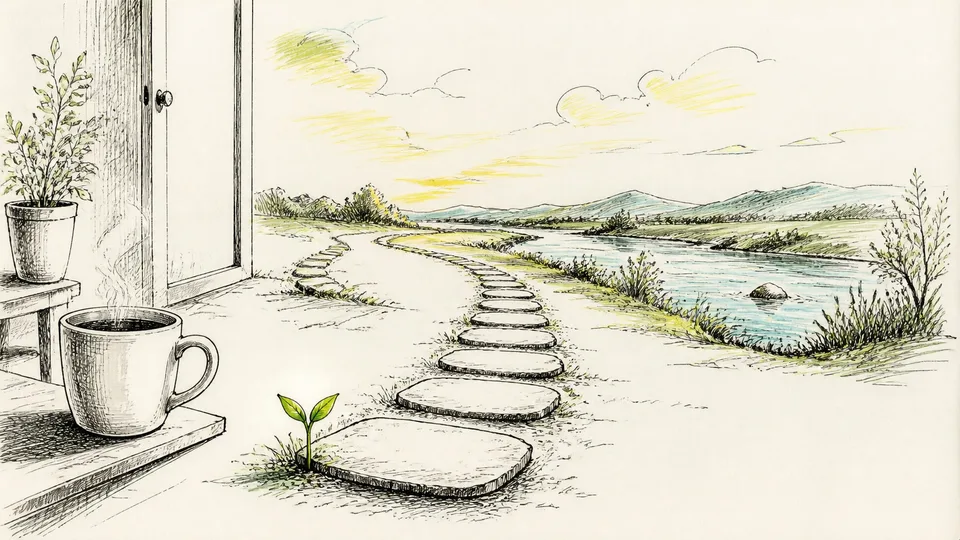
The road is made of mornings, not one mile,
Of doors unlatched and shoes set on the floor,
Of learning how to rest a little while,
Then finding strength to try the path once more.We dream of distant peaks against the blue,
Yet life is also breakfast, work, and rain,
The common task we patiently renew,
The hand we offer through another's pain.No single turn explains the way we came,
No one mistake can own the road ahead,
Each dawn returns and softly speaks our name,
Then lays another patch of light to tread.The journey grows wherever care is found,
One morning, one true step, one piece of ground.
Green Answer
This haiku uses a five, seven, five syllable pattern. A seed lifting after rain offers a small image of persistence without turning struggle into a simple promise.
Seed stirs after rain
One green answer lifts the soil
Day begins again
The Ballad of the Ordinary Day
This ballad uses song like four line stanzas to follow a day that seems uneventful until the speaker notices how much it contained. Its lesson is attention, not forced gratitude.
I washed a cup at half past eight,
And watched the window steam,
The morning did not call me great,
Or offer any dream.I answered mail, I swept the floor,
I heard a neighbor sing,
A child held open one blue door,
A sparrow shook its wing.By dusk I thought the day had passed
Without a worthy sign,
Then counted all the moments cast
Like beads along a line.No trumpet marked the life I led,
No crowd pronounced it true,
Yet kindness moved, and I was fed,
And evening opened blue.
What the River Keeps
This Petrarchan sonnet uses an ABBA ABBA octave and a six line resolution. A river becomes an image for a life that changes while carrying traces of where it has been.
The river keeps no photograph of spring,
Yet carries mountain shadow in its flow,
And turns around the stones it used to know,
While swallows write their circles on the wing.It does not clutch the branch or broken string,
It takes what rain and thawing valleys show,
Then meets the wider country far below,
Still river through the change that seasons bring.I too can honor what has shaped my course,
Without remaining where the water stood,
The past may lend its depth and gentle force,
While present currents carry what they should.A living path is faithful as it bends,
It holds its source, yet travels where it tends.
Begin Where Your Feet Are
This villanelle uses nineteen lines, two repeating refrains, and two rhyming sounds. The repetition steadies a speaker who cannot see the entire path but can still meet the present place.
Begin where your feet are, begin right here.
The road does not reveal its every mile.
One honest step can make the next grow clear.You need not silence every inward fear,
Or turn a heavy season to a smile.
Begin where your feet are, begin right here.A trusted hand may help you persevere,
A chair may offer rest a little while.
One honest step can make the next grow clear.Let distant praise grow quiet in your ear,
Your life is more than any public trial.
Begin where your feet are, begin right here.The smallest faithful action can endear
The day to hope through one unguarded smile.
One honest step can make the next grow clear.Tomorrow's bend may bring a wider sphere,
But now is where you practice your own style.
Begin where your feet are, begin right here.
One honest step can make the next grow clear.
Letting a Life Be Particular
Broad questions about life become more manageable when we bring them close. Instead of asking what every life means, we can ask what this morning needs, what this relationship deserves, or what one neglected hope is asking us to notice. A particular answer gives the hands somewhere to begin.
The Road Is Made of Mornings suits a graduation, birthday, or private reset. Green Answer can accompany a small note of encouragement. The Ballad of the Ordinary Day is for anyone who fears that routine has no value, while What the River Keeps speaks to change. Begin Where Your Feet Are offers steadiness when the future feels unclear.
None of these poems promises that attention will remove pain or make every choice obvious. Some seasons require help, rest, professional care, or a change we cannot accomplish alone. Poetry can sit beside that work, but it should not pretend to replace it.
What a poem can do is give shape to a moment. It can name the cup, the rain, the river, or the patch of ground beneath us. Once named, the present may feel a little less like empty time and a little more like a place where we are allowed to live.
A life is not only the milestones other people can see. It is also the patient accumulation of mornings, repairs, meals, apologies, questions, and small brave steps. We do not have to solve the whole journey today. We can begin where our feet are, pay attention, and let the next honest step become enough.
Send a little poetry to someone you love.