

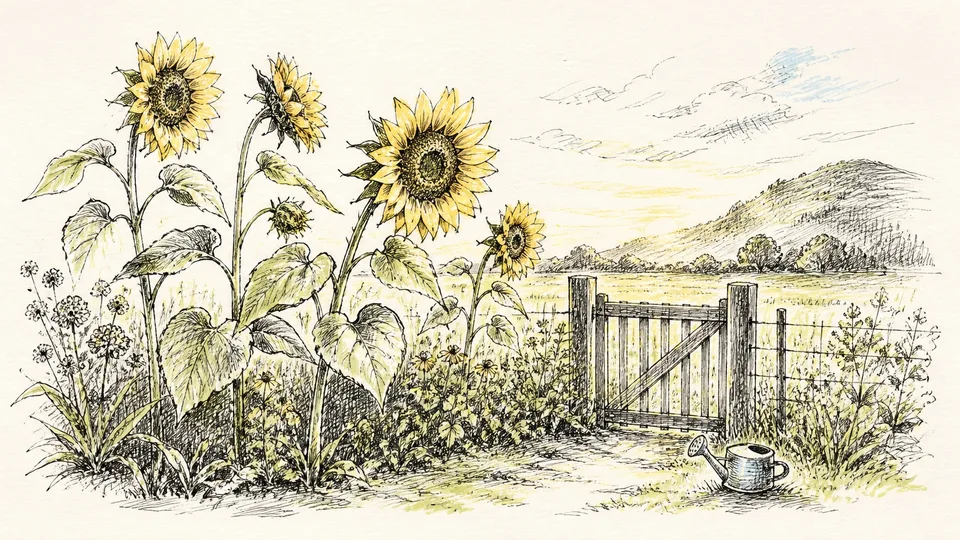
Sunflowers have a way of making attention feel easy. Their faces are large, their stems are brave enough to lean, and their yellow petals seem to hold a little piece of the afternoon. Yet the longer I watch them, the more I notice the quieter work beneath that brightness: roots taking hold, leaves collecting rain, and a flower turning again when the light moves.
These poems about sunflowers are for anyone who loves a garden, a field, or a small reminder to keep looking toward what is good. The collection includes two sonnets, a haiku, a ballad, and free verse. Some poems celebrate the flower itself, while others use its steady posture to think about patience, memory, and the courage to begin again.
I have seen gardens in East Tennessee that seemed to gather the whole sky into their leaves. A row of flowers beside a fence can make a plain path feel like an occasion. In Montana, the same kind of brightness meets a wider horizon, and I find myself thinking about how beauty can belong to both a remembered place and a new one.
You may be looking for a poem to share with a gardener, add to a card, or keep in a journal beside a pressed leaf. You may simply want a few quiet minutes with an image that does not demand an answer. Let the poems meet you at the pace of a garden, where much of the important work happens before anyone sees it.
For more words about growing things, you may enjoy these poems about flowers and these poems about nature. Then settle in and notice which sunflower image stays with you. Sometimes a bright face in a field can remind us that turning toward the light is a daily practice, not a single grand decision.
Poems About Sunflowers and the Lessons of Light
Facing the Morning
The first image I see here is the tall flower making its slow turn beside the fence. I like that it does not pretend the clouds are not there, because its patience feels more useful than a promise that every day will be clear. This poem may help anyone who needs a gentle picture of choosing a direction without needing to hurry.
Shakespearean sonnet
The tallest stalk turns slowly toward the sun,
Its leaves hold little cups of silver rain,
It lifts a gold face when the day’s begun,
And waits through clouds, then brightens once again.
Beside the fence, it leans above the gate,
A patient neighbor to the path and bee,
The afternoon may linger, warm and late,
While wings make brief appointments by the tree.
I used to think that brightness had to shout,
Now I have watched one stem grow tall and stand,
Then learned that turning toward can sort things out,
Without a map, a bell, a guiding hand.
A field of gold can teach the heart what’s right,
Look where you are, and lean into the light.
A Yellow Compass
The short lines give me the feeling of standing still long enough to see the garden arrange itself. I especially love the bees moving through the gold, since their small hum keeps the poem connected to work and welcome. It is a simple piece to tuck into a note for someone who needs a bright thought without a long speech.
Haiku
Yellow heads face dawn
Tall stems hold the waking field
Bees hum through the gold
The Sunflower at the Gate
This little story begins with a flower that seems to belong to the whole neighborhood. I notice the way a child, a bee, and an older gardener each receive something different from the same patch of color. That shared feeling is why I think the poem would be sweet for a family garden journal or a summer gathering.
Ballad
A sunflower stood beside the gate,
Its leaves were broad and bright,
It leaned above the garden path
To greet the morning light.A child came out with dusty shoes,
A watering can held near,
She whispered all her secret plans
Into the flower’s ear.A bee arrived at half past ten,
A sparrow hopped below,
The gardener tied the leaning stem
And watched the green leaves grow.By evening, everyone had passed,
Yet no one left alone,
The flower kept the little gate
Like kindness keeps a home.
What the Seeds Remember
Seeds make me think about the hidden seasons of a life. I like the turn from dark soil to green steps, because it honors the work we cannot measure while still leaving room for hope. Someone beginning a new habit or waiting for a long answer may find comfort in its quiet confidence.
Petrarchan sonnet
Within each seed a patient dark is kept,
A map of rain and summer folded small,
A quiet promise waiting through the fall,
A golden shape the dreaming earth has kept.
I cannot see the work beneath the ground,
Yet roots are making room in hidden ways,
And small green hands will find the lengthening days,
Before the first leaf lifts above the ground.
So when a season asks me to begin,
I think of seeds that trusted unseen rain,
Of roots that worked beneath the winter’s reign,
Of light that enters where the dark has been.
The heart may start before it knows the when,
And rise by faith in small green steps again.
At the Garden Gate
The open gate gives this poem its feeling of invitation. I can almost hear the hinge and feel the warm soil under a hand, and I like how the speaker discovers that a garden is also a place for memory to enter. Keep this one for a quiet morning when you want to remember that beauty can be made of ordinary care.
Free verse
At the garden gate,
the latch is warm from the sun.I find a fallen petal,
a curled leaf,
three seeds waiting in my palm.Nothing asks me to solve the season.
The flowers simply face the field,
and the field receives their color.I step inside,
carrying less than I brought.
Letting Brightness Be Patient
Sunflowers are cheerful, but they are not hurried. They spend weeks building stems, leaves, and roots before the flowers open wide enough for us to admire them. That is one reason I return to them when I am tempted to judge a season only by what can already be seen.
“Facing the Morning” may fit a note for someone beginning again. “A Yellow Compass” is small enough for a card or a garden marker, while “The Sunflower at the Gate” could be read aloud at a family gathering. “What the Seeds Remember” is for the hidden work of waiting, and “At the Garden Gate” leaves space for a reader’s own memory.
If you share one of these poems, add a detail that belongs to your person. Mention the sunflower row beside a driveway, the child who carried water, or the particular gate that always squeaks. A specific image makes a simple message feel received rather than copied.
The flower also reminds me that turning toward light does not mean turning away from every cloud. Rain has its work, shade has its place, and a leaning stem may need a little support. We can be hopeful while still admitting that growth takes weather, time, and help from other hands.
When you finish reading, look for one small bright thing near you. It might be a leaf, a window, a yellow dish, or a person who has made room for you. The world is full of such quiet guides, and sometimes the heart only needs permission to notice them.
Useful supplies for sunflower notes and seeds
Use an old notebook and clean paper envelopes first. If you are keeping seeds from your own garden, these supplies can help you label the harvest.
These are paid links. As an Amazon Associate I earn from qualifying purchases.
- View on Amazon
Homtable Kraft Seed Envelopes
Store dry sunflower seeds you have collected for planting, labeling the variety and collection year.
100 envelopes, 2.25 × 3.5 inches, self adhesive
- View on Amazon
Essentials Dot Matrix Notebook
Note the flower’s height, changing light, and small garden details that could become a poem.
One A5 hardcover notebook, 192 dot grid pages, 5¾ × 8¼ inches
Send a little poetry to someone you love.