
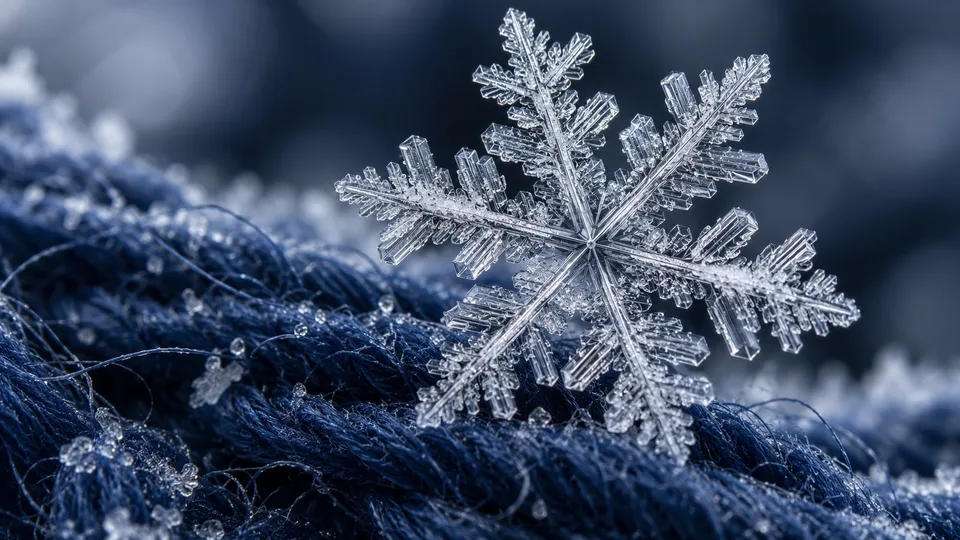
A snowflake can change the scale of an afternoon. Instead of looking across the whole yard, we lean toward one small shape at the window. The pleasure is in looking closely, even when there is little time to keep what we see.
These five original snowflake poems stay with that smaller view. There are winter windows, a brief visitor, and paper snowflakes that bring the idea indoors. They can be read quietly or shared beside a child's winter drawing. The paper poems celebrate making something imperfect rather than asking every cut to produce a perfect pattern.
I like the contrast between a real flake, which cannot be persuaded to stay, and a paper one, which may hang crookedly for weeks. Both give us a reason to stop. For snow days, snowmen, and a wider winter scene, the poems about snow offer another collection. Here, a small shape gets the whole page for a moment.
Five Poems about Snowflakes
A Pattern at the Window
The warm room and the cold glass hold two different kinds of shelter. I enjoy the person in this poem paying attention without trying to make the fleeting shape belong indoors.
A little shape has settled on the pane,
A pale design against the garden wall.
I lean to trace each narrow silver vein,
Afraid my breath will hurry on its fall.The room behind me holds its steady heat;
A kettle clicks, a chair is drawn aside.
Outside, the flakes have found the narrow street;
The window keeps one visitor outside.I cannot ask the little thing to stay,
Or hold its bright arrangement in my hand.
But I can give a minute of the day
To something I need never understand.Before it slips beyond the place I see,
Its briefness has made room enough for me.
The Smallest Guest
A dark twig makes a small pale arrival easier to notice. I like this little verse leaving the reader with a place to look rather than a lesson to repeat.
One flake on the twig.
The dark branch lends it a stage.
No one speaks just yet.
The Paper Winter
The accidental fold is the part of this craft story I trust most. A child can make something worth keeping without having to make it look like the example.
We folded paper on the floor
And made a careful start.
One corner came away too soon
And left an open heart.We held it up against the glass;
The winter light came through.
"That was not what I meant," you said.
"But look at what it grew."We hung it where the draft could turn
The little shape around.
Our paper winter filled the room
Without a single sound.
The Shape before the Thaw
The person at the window is allowed to lose the exact picture. I find the ending tender because attention can matter even when it does not become a perfect memory.
I thought that I could keep the shape in mind,
Each tiny opening, each slender ray.
But when I turned, the image left behind
Was not the thing that brightened up the day.I had a sense of branching into air,
A little light against a darker blue.
The rest was gone before I left the chair,
The smallest lines already passing through.Perhaps I need not make a thing remain
To say it briefly altered how I saw.
The empty place upon the windowpane
Still holds a little wonder in its thaw.A moment need not last to have been dear;
I looked, and for a moment, it was here.
What the Scissors Leave
I am fond of the scraps beside a finished paper shape. They make the afternoon feel lived rather than displayed, and they keep the making in the picture.
The snowflake hangs in the window.
Beneath it,
small white triangles
gather around your knees.We keep the thing we made.
For a little while,
I also like the evidence
of how we made it.
Leave a Little Time for Looking
Choose a short poem if you are reading with a child, then allow time to notice a window, a twig, or a paper shape. A question such as "Which part do you like?" can open a conversation without requiring a right answer. The longer pieces may suit an adult reader who wants a quieter winter pause.
If paper snowflakes become part of the afternoon, let the finished shapes differ. One may have a wide opening, another a surprising corner. The poems do not ask the real winter or the handmade version to meet a standard of perfection. They invite attention to what has actually appeared.
For another view of the season, the poems about winter include warmth, stillness, and the life of a house on a cold day. I would carry one small habit from these snowflake poems: let something brief be worth your time. Not everything beautiful has to become a possession before it can become part of your day.
Send a little poetry to someone you love.