

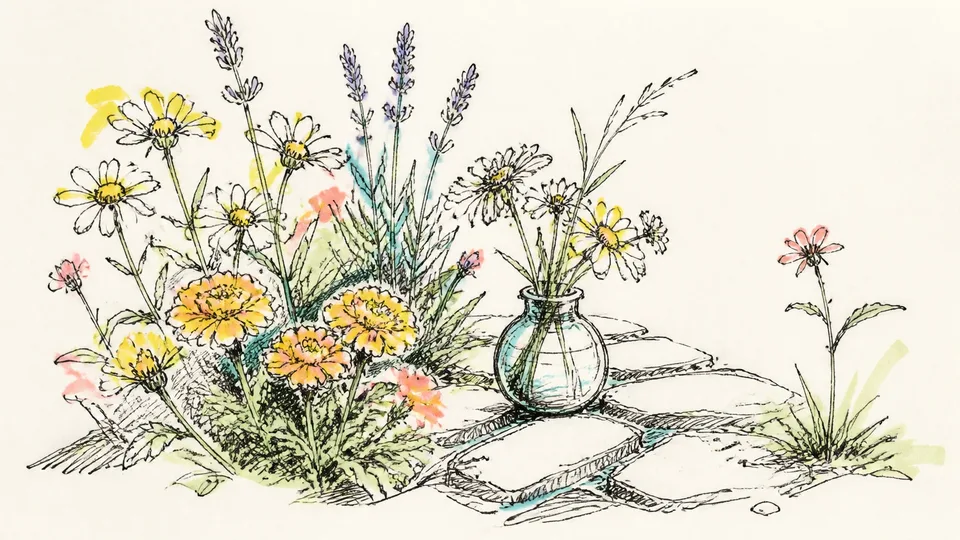
Flowers speak in more than one season. A bright bloom can celebrate a beginning, while a dry stem can remind us that beauty is not diminished by change. Even a flower growing beside a crack in the pavement has a story about making room.
This collection of poems about flowers includes two sonnets, a villanelle, blank verse, and a haiku. The forms move from the careful order of a garden bed to the surprising color of a roadside bloom. These poems can be used for a card, a memorial table, a garden journal, or a quiet thank you.
I like the way flowers ask for attention without demanding an answer. They offer color, scent, and shape, then return to the earth in their own time. If you enjoy the wider natural world, you may also like these poems about a tree and these poems about the elements.
Poems About Flowers
The Garden Opens
This Petrarchan sonnet begins with an ABBA ABBA octave and turns toward a six line resolution. The garden becomes a place where beauty is welcomed without being asked to stay forever.
The garden opens slowly after rain,
Its petals hold the beads of silver weather,
A bee moves through the lavender like leather,
And sunlight lays a ladder on the pane.I kneel beside the marigold and gain
A lesson no bright lecture could deliver,
The roots work quietly beneath the river
Of soil, accepting loss as well as gain.A bloom can keep its promise by release,
Its color travels onward through the seed,
Its falling is not failure, but a peace,
A doorway for the next small living need.I leave the garden lighter than I came,
With dirt on both my hands and heart and name.
Let Every Flower Keep Its Name
This villanelle uses nineteen lines, two repeating refrains, and two rhyming sounds. The returning lines honor the particular character of each flower instead of treating the garden as one undifferentiated color.
Let every flower keep its name.
Let every stem lean toward the sun.
No garden needs to bloom the same.The rose has thorns, the lily flame,
The violet hides when day is done.
Let every flower keep its name.A child may choose a crooked frame
And call the smallest petal one.
No garden needs to bloom the same.The wind may scatter seed like rain,
Then leave a field where wild things run.
Let every flower keep its name.We praise the tall, the bright, the tame,
Yet miss the green beneath the sun.
No garden needs to bloom the same.So let the late and early claim
Their place beneath the morning sun.
Let every flower keep its name.
No garden needs to bloom the same.
A Bouquet on the Table
This Shakespearean sonnet uses an ABAB CDCD EFEF GG pattern. The bouquet is not presented as a perfect arrangement, but as a small act of care that changes the feeling of an ordinary room.
A bouquet leans beside the kitchen chair,
Its stems are tied with ribbon, not with pride,
One yellow bloom has lost a petal there,
Yet all the colors gather side by side.The vase remembers hands that filled it first,
A little water, then a window's glow,
The flowers do not mind the morning's thirst,
They simply teach the room to soften slow.I think of every kindness left unseen,
A cup set down, a door held open wide,
The small arrangements keeping days serene,
The quiet gifts that ask for naught beside.A bloom will fade, but still the room will know
That someone chose to bring a little glow.
The Field Behind the House
This blank verse poem follows a walk through a field where flowers grow without a plan. Its unrhymed, measured lines give the speaker room to notice weeds, wind, and the dignity of an untidy place.
The field behind the house has no straight rows.
Blue asters lean beside the stubborn grass.
A thistle holds a bead of morning rain.
I walk where rabbits leave their narrow marks.
No gardener comes to count what should be saved.
The flowers rise according to their light.
I think of all the lives that grow this way.
Not every beauty needs a careful fence.
The wind moves on, and I move with it too.
The field keeps making room for one more bloom.
One Red Petal
This haiku keeps one fallen petal at the center of attention. It uses five, seven, and five syllables to show how a small detail can hold a whole garden.
One red petal falls
Still the green stem lifts its face
Morning holds the scent
What Flowers Teach Us
Flowers are generous teachers because they do not pretend that blooming is permanent. They give us color while they have it, seed when the season asks, and quiet beauty even when the petals begin to loosen.
Use The Garden Opens for a note about new growth or a patient beginning. The villanelle works well when you want to celebrate individuality, while A Bouquet on the Table belongs to a thank you or a small domestic kindness. The field poem suits a garden lover who prefers wild edges, and the haiku can fit inside a short message.
If you share one of these poems, pair it with a flower that is truly present in your life. Name the color, the scent, or the place where it grows. A real detail lets the reader feel the ground beneath the verse.
The garden will keep changing after we leave it. That is not a reason to hurry past it. It is an invitation to notice what is blooming now, to offer care where we can, and to trust that the next season has its own kind of grace.
Useful supplies for a flower garden
Borrow tools or use the garden supplies you own. For adults taking up the planting described here, a small hand tool can be enough to begin.
These are paid links. As an Amazon Associate I earn from qualifying purchases.
- View on Amazon
Fiskars Ergo Garden Trowel
Plant a flower in a pot or prepared bed, using the hand trowel for small digging jobs.
One garden hand trowel
Send a little poetry to someone you love.