

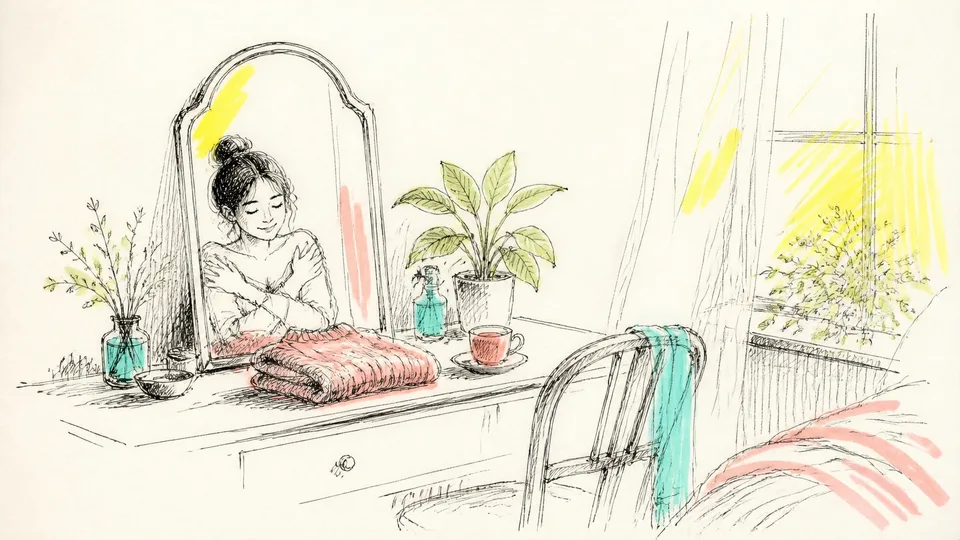
Self love is often described as a grand feeling, but it can begin much more quietly. It may look like eating lunch, saying no without an apology, resting before you are exhausted, or speaking to yourself with the patience you would offer a child.
These poems about self love include two sonnets, free verse, a haiku, and a limerick. They do not promise that one poem can settle every doubt. They offer small, usable words for a person learning to stay on their own side.
I have taught enough years to know that encouragement works best when it is specific. “You kept going through that hard hour” can reach farther than a bright slogan. If you are writing toward a new beginning, you may also enjoy these poems about strength and these poems about confidence.
Poems About Self Love
A Place at My Own Table
This Shakespearean sonnet uses an ABAB CDCD EFEF GG rhyme pattern. The speaker learns that self love is not self praise, but the practical decision to make a place for their own needs.
I set one place beside the window's light,
A plate for hunger, not a test to pass,
I let the tired body rest tonight,
And see my face reflected in the glass.I have been quick to serve the waiting room,
To give away the chair I needed most,
Yet kindness cannot flourish in a tomb,
And care should not require a vanishing ghost.I keep the boundary gentle, clear, and true,
I answer no when no is what I mean,
I learn that rest can still be work to do,
And leave a little air in every scene.The heart grows strong through ordinary art,
By giving its own life a welcome heart.
Note to the Mirror
This free verse poem turns a mirror into a place for recognition rather than judgment. The short lines make room for a person to name what they have survived and what they are still learning.
I see the face
that carried the groceries,
answered the phone,
and stayed awake.I see the face
that did not know what to do.Both faces belong here.
I will not make one disappear
to make the other easier to love.
The Kindness I Once Withheld
This Petrarchan sonnet follows an ABBA ABBA octave and a six line resolution. It asks the speaker to turn inward with honesty without turning regret into another punishment.
I kept a list of every small mistake,
Each line a stone I carried in my coat,
Each name a lesson written in a note,
Each sleepless hour I would not let awake.At last I saw the list was mine to make,
And mine to fold before it filled my throat,
The past can teach without becoming a boat
That drags a living body in its wake.I speak to all the selves I could not save,
The hurried one, the frightened, and the proud,
I give them room to grieve, to rest, to brave,
Then let the morning find me less bowed.Forgiveness is not saying nothing changed,
It is the door through which the heart is rearranged.
The Lopsided Crown
This limerick uses five lines and an AABBA rhyme pattern. Its playful crown is a reminder that self regard does not need to look polished before it becomes useful.
I wore a lopsided crown,
And marched through the middle of town.
It slipped to my ear,
But I kept it right here,
And refused to put my bright head down.
A Kind Voice in the Morning
This haiku offers a small practice for the start of a day. Its five, seven, five syllable pattern makes the poem easy to remember without making care feel like a command.
Soft light on my hands
I speak kindly to this heart
Morning lets me start
Care That Can Be Practiced
Self love is not a refusal of responsibility or a reason to ignore other people. It is the ground that lets care continue without turning one person into an endless resource. A rested heart can make clearer choices.
Choose A Place at My Own Table for someone learning to set a boundary. Note to the Mirror can accompany a private journal, while The Kindness I Once Withheld suits a season of forgiveness. The limerick may make a friend smile, and A Kind Voice in the Morning fits a small daily reminder.
If you share one of these poems, add a practice that is real for you. Name the meal, the walk, the rest, or the conversation that helps you return to yourself. Specific care is easier to believe than a general promise.
You do not have to become a different person before you deserve tenderness. Begin with the next honest need, answer it as kindly as you can, and let that small answer count. A life can be rebuilt through ordinary welcomes.
Send a little poetry to someone you love.