

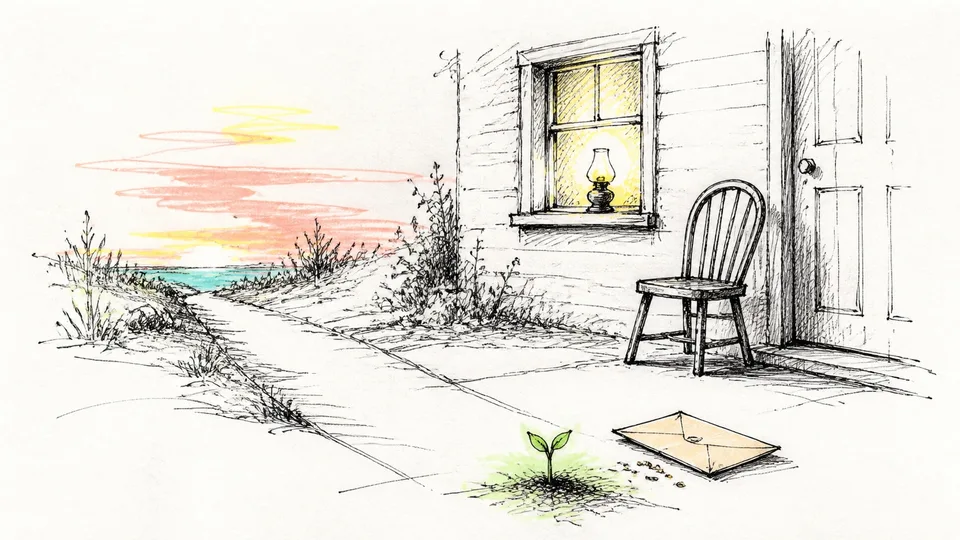
Hope is sometimes mistaken for certainty. It is often something humbler, a hand reaching for the lamp, a seed kept in a paper envelope, or a person deciding to try one honest thing before the day ends.
These poems about hope include two sonnets, blank verse, a limerick, and free verse. They are for a card, a journal, a classroom, or anyone who needs encouragement that does not pretend a hard season is easy.
I have trusted hope most when it has been practical. A neighbor brings soup, a teacher leaves the light on, or a tired person answers one more call. If you want another collection about beginning again, you may enjoy these poems about new beginnings and these poems about strength.
Poems About Hope
The Lamp in the Window
This Shakespearean sonnet uses an ABAB CDCD EFEF GG rhyme pattern. The lamp is not a promise that every road is safe. It is a small sign that someone is still making a place for return.
A lamp remains beside the window glass,
Its circle holds the porch against the night,
The late wind moves, the waiting hours pass,
Yet someone keeps a little place alight.I have not solved the questions at the door,
Nor found a map that settles every fear,
But I can set one chair upon the floor,
And let the next small kindness bring me near.Hope is not loud enough to end the rain,
It is the hand that clears the steps of leaves,
The breath that tries a simple word again,
The seed a careful gardener still believes.The lamp shines on, a quiet work of grace,
It says that love can keep a little place.
The Next Small Thing
This blank verse poem follows a person through a difficult morning. Its unrhymed, measured lines make hope a sequence of manageable actions rather than a distant mood.
I wash the cup and open up the blind.
The room is not transformed, but it can breathe.
I write one name beside the telephone.
I take the medicine of morning air.
A sparrow lands, then lifts beyond the fence.
I do not need to follow where it goes.
The next small thing is waiting near my hand.
I choose it, then I choose another one.
By noon, the day has not become a song.
Still, I am here, and that is something true.
A Seed in the Envelope
This second sonnet uses an ABBA ABBA octave and a six line resolution. The seed stands for a future that cannot be forced, only protected and given a chance.
A seed rests in an envelope of white,
So small it seems to carry nothing more
Than dust and one unspoken shape in store,
Yet holds a green idea against the night.I keep it near the window's patient light,
Not asking it to hurry through the door,
I know that roots must learn the hidden floor,
And dark can be a part of growing right.
The future is not promised by the seed,
But neither is the seed a useless thing,
It asks for soil, a season, and a need,
Then waits to find what careful hands can bring.I place it where the rain can do its part,
And guard one little opening in the heart.
The Hopeful Goose
This limerick follows five lines and an AABBA rhyme pattern. Its goose keeps trying to fly from a puddle, offering a light laugh about persistence without making effort look effortless.
A goose practiced flight by the lake,
And flapped for the whole morning's sake.
It rose one inch high,
Then sat with a sigh,
And called that a wonderful break.
A Chair for Tomorrow
This free verse poem leaves a chair ready for a future conversation. The spare lines make hope feel like a practical welcome rather than an announcement.
I set a chair by the door.
Not because I know
who will come,
or when.Because a room feels different
when it has space
for a possible hello.
Hope Without Pretending
Hope can be honest about weather, grief, fatigue, and uncertainty. It does not need to decorate a difficult truth. It can sit beside the truth and still offer one useful next step.
Use The Lamp in the Window for a note of welcome or encouragement. The Next Small Thing fits a hard morning, while A Seed in the Envelope belongs to a new beginning. The limerick can make a child smile, and A Chair for Tomorrow is a quiet message to someone who feels alone.
If you share one of these poems, add the practical hope that is real for you. Name the chair, lamp, seed, phone call, or small task. Specific hope is easier to carry.
The light may be modest, but modest light still changes a room. Keep one place open, do the next kind thing, and let tomorrow arrive without asking it to be perfect.
Send a little poetry to someone you love.