

Remembering a grandfather can begin with the pace of a walk, the shape of his handwriting, or the way he settled into a familiar story. A small detail may bring him closer than a long list of accomplishments. It can also give a reader something steady to hold when speaking before other people feels difficult.
These seven original funeral poems for Grandpa include short program verses, memories from grandchildren, a reading for the whole family, and one optional Christian prayer. The other poems use no religious language. Some are brief enough to read in a few breaths, while the longer pieces give a memory room to unfold.
I wanted the collection to honor a particular person without pretending every grandfather was the same. He may have been talkative or reserved, practical or imaginative, happiest outdoors or deeply attached to a favorite book. Choose the poem that resembles the relationship you knew, and leave aside any image that does not belong to it.
There is no requirement to make a funeral reading into a complete account of his life. A grandchild can offer one memory, another relative can offer a different one, and something of the person can appear between them. Nor does a loving tribute need to end with a lesson about what everyone should feel next.
These poems for funerals and celebration of life services offer broader family readings. For everyday memories and gratitude outside the service, these poems about Grandpa celebrate the small adventures and familiar company of a grandfather.
Choose a Reading for Grandpa
| Poem | Voice and use | Approximate reading time |
|---|---|---|
| The Path Beyond the Step | A short printed remembrance | 10 seconds |
| The Pace You Chose | A grown grandchild's tribute | 50 seconds |
| His Handwriting | A brief reading beside a photograph | 20 seconds |
| Not Every Story Needs an Ending | A quiet family reading | 30 seconds |
| A Prayer for Our Grandfather | An optional Christian prayer | 50 seconds |
| The Name of Every Star | A grandson's childhood memory | 40 seconds |
| We Gather What We Know of You | A shared closing reading | 60 seconds |
Times are approximate and may grow with pauses. A family member can read on your behalf, or stand beside you with another copy if you would like that support.
Seven Funeral Poems for Grandpa
The Path Beyond the Step
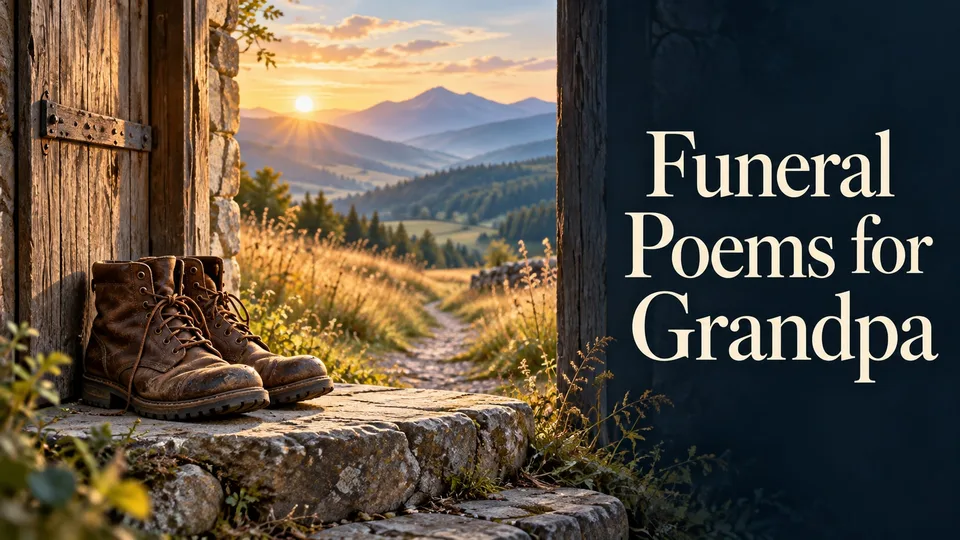
The grass continuing beyond a familiar step feels very quiet to me. These lines do not turn the path into a claim about where someone has gone. They leave the reader with a place that can hold both a memory and an absence.
Boots beside the step.
Grass leans over the old path.
The hills keep their shape.
The Pace You Chose
A child's shorter stride can tell a story about being cared for. I like the grandfather's willingness to let the journey take the time it takes. This tribute may suit a grandchild remembering walks, outings, or someone who never made them feel like an inconvenience.
You slowed your steps so mine could keep the beat
Beside your boots along the gravel lane.
You did not mind the pauses in the street,
But stood beside me through a little rain.You did not say each hour must prove its worth
Or hurry past the things I stopped to find.
A feather, or a footprint in the earth,
Could hold the whole attention of your mind.Today the road is longer than I knew,
And there are turns I do not want to take.
I miss the easy walk I had with you,
The room your patient footsteps used to make.I cannot bring that afternoon to stay,
But love has left its measure on the way.
His Handwriting
I am moved by the ordinary unevenness of a familiar hand. A note does not need to contain a grand message for its letters to become precious. This short piece can sit beside a photograph or introduce a family memory about something he wrote.
The letters lean
as if the next thought
has already called them forward.A list.
A date.
A few directions
to a place he knew.I keep the paper
because his hand
was here.
Not Every Story Needs an Ending
The unfinished story in this poem is allowed to remain unfinished. I value that space, because a public farewell cannot answer every private question. These lines may suit a family that wants a reading without a declaration that everything now feels resolved.
We have not heard each story he could tell.
A question waits beside an empty page.
The afternoon goes on beyond this room.
A neighbor shuts a window down the street.
We need not make an ending out of love
Or find the proper words for every loss.
We bring the little portion we can hold
And leave a quiet place for all the rest.
A Prayer for Our Grandfather
This optional Christian prayer keeps the speaker's uncertainty visible. I wanted gratitude to be possible without turning questions into something unwelcome. Choose it if placing him in God's care is a natural part of your family's farewell.
O God, we bring the name we love to say,
The man whose life has met and shaped our own.
We place our grandfather with You today,
With all the parts of him we have not known.The years of work, the friends who shared his bread,
The private hope he carried through the rain,
The useful words he found, the love unsaid,
Receive them in a peace beyond our pain.Give room for questions when the prayers are done,
For voices that can hardly find their sound.
Let no one feel they have to be the one
Who keeps the grief from touching those around.We leave our love within Your wider care,
And trust that even silence has its prayer.
The Name of Every Star
The grandfather here is willing to admit he does not know every answer. I like the shared pleasure that remains when the lesson gives way to looking. The grandson's memory can introduce a real story about an evening, a hobby, or a question they explored together.
I asked the name of every star,
He pointed out a few.
Then said, The rest can keep their names.
Tonight they have a view.We sat beside the garden wall,
The house a square of light.
He told a story, then grew still
To listen to the night.I never learned each star by name,
Nor needed that to stay.
I had his shoulder near my own,
The dark, the Milky Way.
We Gather What We Know of You
Different readers can bring different memories to this poem's repeated lines. What I like is the absence of a contest over who knew him best. Relatives may alternate stanzas, with everyone joining the last two lines, or one person can carry the whole reading for the family.
We gather what we know of you today.
A little light can fall on something small.
Each loving voice has something true to say.The walk, the joke, the patient game of play,
The way you knew a neighbor by their call.
We gather what we know of you today.A folded map you never put away,
A row of useful hooks along the wall.
Each loving voice has something true to say.The parts of life no picture can display,
The quiet work no list can hold at all.
We gather what we know of you today.Some memories arrive, and others stay
Beyond the words our voices can recall.
Each loving voice has something true to say.There is no perfect ending we must play.
We leave a little silence in the hall.
We gather what we know of you today.
Each loving voice has something true to say.
One Memory Can Be Enough
When you choose a reading, let the memory guide its size. A brief poem may be right for a small program, a child who wants to participate, or someone whose voice is already carrying a great deal. A longer reading may help another person give shape to the things they wish to remember. Neither choice measures how much someone loved him.
You can introduce the poem with a single true detail: where you walked, the way he wrote your name, or a story he enjoyed telling. If relatives are sharing the reading, agree on the order and give everyone a clear copy. There is no need for the transitions to sound polished. A simple pause can do the work.
If a child wants to join, offer a short passage without making participation an expectation. A trusted adult can stand with them, or read what they wanted to share. Their connection to their grandfather does not depend on being able to speak before an audience.
Afterward, keep room for the memories that arrive late. You may think of a laugh on the drive home, or a question weeks later. The reading was one loving act in a larger relationship. It does not have to be the last place where his name is spoken.
Send a little poetry to someone you love.