Choices do not always arrive with a clear sign. Sometimes there are two good roads, two difficult answers, or one question that needs more time before it can be spoken aloud. We may want certainty, but often we are given only the next small step.
These poems about choices are for anyone standing at a doorway, a crossroads, a new school year, a changed routine, or a private decision. The collection includes two sonnets, free verse, a haiku, and a ballad. The poems do not promise that every choice will be easy. They offer company for the listening that comes before movement.
I have come to trust the wisdom of a pause. A cup left on the counter, a path after rain, or a hand resting on a gate can give the mind enough quiet to hear what hurry has covered. Waiting is not always avoidance. Sometimes it is the careful work of making a choice that belongs to the whole heart.
If you are writing for someone beginning again, choose the poem that respects the uncertainty rather than erasing it. These poems about change may help with a new season, and these poems about timing offer another way to think about patience. I hope the collection gives you a little steadiness for whatever comes next.
Poems About Choices and Quiet Courage
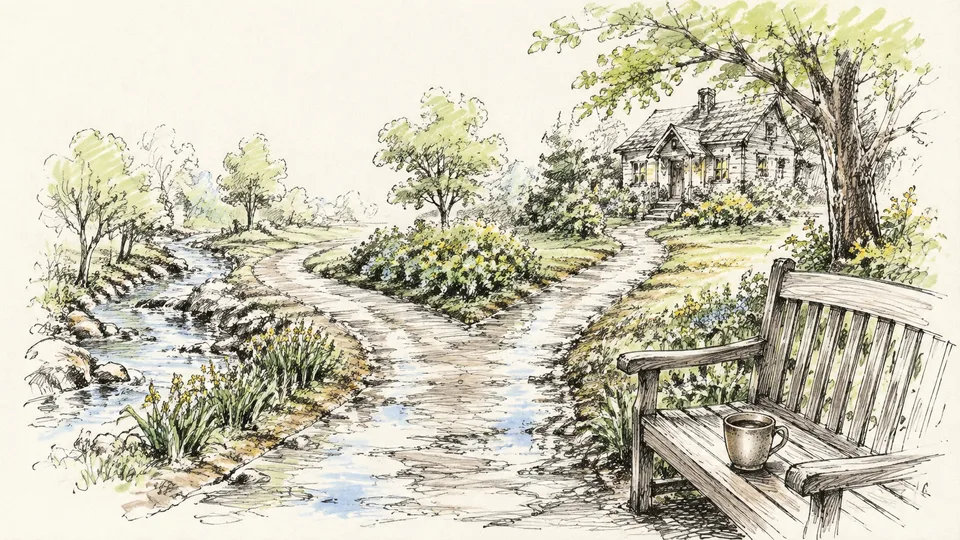
At the Fork in the Road
The first sonnet keeps both roads visible for as long as possible. I like that the speaker chooses without claiming to know the future, because real decisions often require faith in the next step rather than a full map. This may help a reader who is ready to move but still feels the pull of the road not taken.
Shakespearean sonnet
Two roads divide beneath the leaning pine,
The morning leaves a question in the air,
One path goes east where distant fence posts shine,
One turns toward home and finds the garden there.
I cannot know what waits beyond the bend,
The map is small, the weather may be new,
Yet every choice can teach me how to tend
The ground beneath the next step into view.
A heart can listen without being sure,
A hand can loosen what it cannot hold,
The patient road may make the spirit pure,
By giving time for hidden things to unfold.
I choose the path that lets me answer true,
Then walk, and let the walking shape me too.
The Cupboard Door
The free verse poem makes a decision out of a small household moment. I notice how the speaker stops looking for a perfect answer and simply chooses what will nourish the day. That image may help when a reader needs permission to make a modest, practical choice instead of solving everything at once.
Free verse
The cupboard door stands open.
There is rice,
one apple,
and the jar of tea
saved for a quieter evening.I do not need a grand answer
to begin.I choose the tea,
warm the water,
and let the next question
wait beside the cup.
Two Paths After Rain
The haiku gives choice a landscape without turning it into a contest. I love the idea that both paths carry morning, because different choices can still lead toward light. This could be a small note for a friend who is comparing two good possibilities.
Haiku
Two paths after rain
A path bends down to the creek
Both carry morning
The Choice to Wait
Waiting can be a difficult choice when everyone else seems to be moving. This ballad gives the pause a place beside the window and lets time reveal a little more of the road. I value its gentle rhythm because it may comfort someone who needs to wait without feeling forgotten.
Ballad
She held the letter by the lamp and watched the evening fall,
The answer waited in her hand, but not the whole of all.
Outside, the rain moved down the glass, the maple leaves grew bright,
And every drop kept saying, wait, there is still more light.She made a list, then crossed it out, then brewed a cup of tea,
She heard the question underneath the words she thought must be.
The room grew still, the clock grew kind, the dark began to clear,
And what had felt like empty time became a listening ear.At dawn she chose the step that fit the truth she could now see,
Not because fear had disappeared, but because she could be free.
A choice can grow in patient ground before it leaves the hand,
And sometimes waiting is the way we learn to understand.
A Door We Do Not See
The second sonnet is about changing the question when the first set of choices feels too narrow. I notice how it allows both yes and no to protect something valuable, which feels kinder than treating one answer as brave and the other as weak. This may help a reader who is learning that a new possibility can appear after a pause.
Shakespearean sonnet
A door we do not see may still be near,
Behind the one we thought we had to choose,
The quiet voice we trust can make it clear,
That we can change the question, not just lose.
A yes may grow from patience with the no,
A no may guard the room where dreams can rest,
The heart has ways of knowing when to go,
And ways of keeping kindness at its best.
No choice can make a life untouched by rain,
The clouds will come, the fields will need the sun,
But careful feet can learn the road again,
And find that change is not the only one.
We choose, then learn the shape of what is true,
And make a little room for something new.
After the Choice Is Made
A choice does not end all uncertainty. Often it begins a new kind of attention. We notice what the decision asks of us, what it makes possible, and what we may need to release with care.
If you are helping someone through a decision, resist the urge to make the answer for them. You can ask what feels honest, what needs more time, and what small action would make the next hour gentler. Support does not always sound like advice. Sometimes it sounds like a patient question and a cup placed within reach.
You may also discover that a choice can be revised. A road can turn, a plan can change, and a person can learn something new about the life he or she is building. Changing direction is not proof that the first step was foolish. It may be proof that attention is still alive.
These poems about encouragement may help if the person you love needs courage more than an answer. Read one poem aloud, copy a line into a note, or keep the page nearby while the next step becomes clearer.
I hope these poems remind you that choices are made by people who are still growing. You do not need to see the whole road to take one honest step. The path can teach you as you walk it.
Send a little poetry to someone you love.