
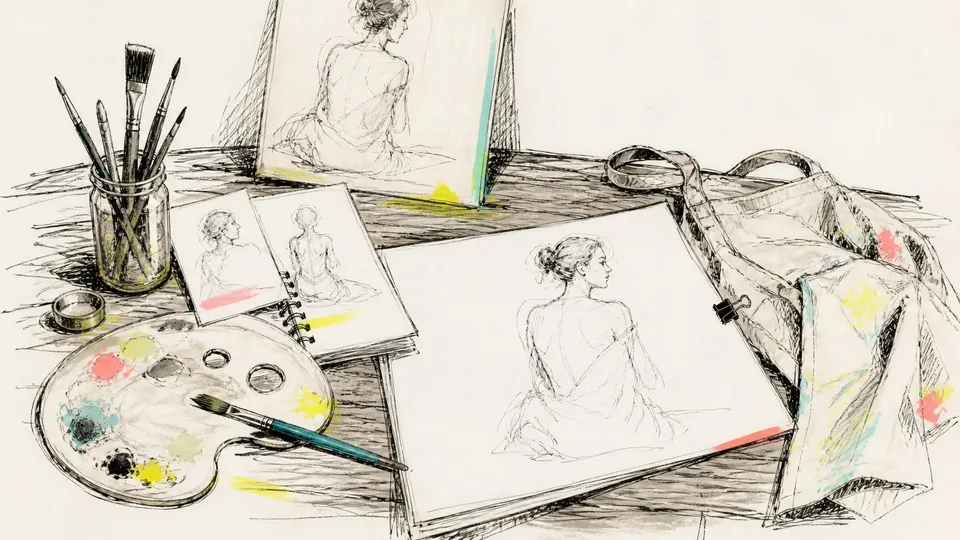
Artists are often described by their finished work, but the deeper story lives in the attempt. It is in the pencil rubbed away, the color mixed again, the studio swept at the end of a long day, and the decision to return tomorrow.
These poems about artists include two sonnets, free verse, a limerick, and a haiku. They are for painters, makers, teachers, children, writers, and anyone who wants encouragement for the part of creativity no audience sees.
I have always trusted the unfinished page. A rough edge can show attention more honestly than a polished surface. If you are thinking about starting a new piece, you may also enjoy these poems about inspiration and these poems about reading.
Poems About Artists
The Artist Returns to the Table
This Shakespearean sonnet uses an ABAB CDCD EFEF GG rhyme pattern. The artist returns to a work that is not finished and discovers that practice itself can be a form of faith.
The artist returns to the wooden table,
A line remains where yesterday went wrong,
The paper waits, imperfect but still able,
To hold another color, shape, or song.No muse arrives with answers neatly tied,
No hand is certain where the next mark goes,
Yet something patient gathers at the side,
A willingness to learn what making knows.The work grows slowly, not because it fails,
But because the eye is learning how to see,
The roughest edge can open hidden trails,
The empty space can make a person free.An artist is the one who comes again,
And gives the unfinished room to mend.
A Sketch on the Grocery List
This free verse poem finds art in an ordinary list. Its loose lines celebrate attention that appears without a special room or perfect materials.
Between the bread
and the soap,
a little house.One window,
one tree,
smoke leaning from the roof.The list still needs milk.
The drawing does not need anything
except the hand
that noticed the margin.
The Color That Would Not Stay
This second sonnet follows an ABBA ABBA octave and a six line resolution. A stubborn color becomes a teacher, showing that revision can reveal a better direction rather than erase the first attempt.
The color would not stay where I had planned,
It spread beyond the edge and changed the sky,
I tried to make it quiet, pale, and shy,
But found a deeper weather in my hand.
The brush resisted every firm command,
Then made a field I could not justify,
A blue that held the question of a why,
A shade that asked the picture to expand.
I let the first mistake remain in place,
Then built a softer line around its fire,
The work became more honest in its trace,
The wrong turn found a different kind of desire.
A painting grows by listening to surprise,
And lets the eye revise what it would prize.
The Sculptor's Apron
This limerick uses five lines and an AABBA rhyme pattern. The sculptor's dusty apron keeps its own opinion about the seriousness of art.
A sculptor wore dust on her gown,
And carried a chisel to town.
She shaped a small pear,
Then left it midair,
And called that a sculpture of brown.
The First Mark
This haiku gives the beginning of a drawing three quiet lines. Its five, seven, five syllable pattern makes the first mark feel both modest and important.
Pencil meets white page
One small line opens a field
The hand learns to see
The Work Before the Applause
Artists need encouragement, but they also need honest room to experiment. A piece can be unfinished, strange, or private and still be part of a meaningful practice.
Choose The Artist Returns to the Table for a maker beginning again. A Sketch on the Grocery List celebrates everyday creativity, while The Color That Would Not Stay suits a reflection on revision. The limerick brings humor, and The First Mark belongs to a child or beginner.
If you share one of these poems, name the material and place that belong to your making. Mention the pencil, apron, brush, table, or margin. Specific tools keep creativity grounded.
The finished work matters, but so does the return. Sit down, make one mark, and let the next mark answer it. An artist grows wherever attention is willing to begin.
Useful supplies for making the first mark
A pencil and an old grocery list are enough to begin. Use the materials already on your table before adding anything new.
These are paid links. As an Amazon Associate I earn from qualifying purchases.
- View on Amazon
Prismacolor Premier Colored Pencils
Try a small color study or sketch when you return to an unfinished piece. This is one set of 24 colored pencils.
One set of 24 soft core colored pencils
Send a little poetry to someone you love.