

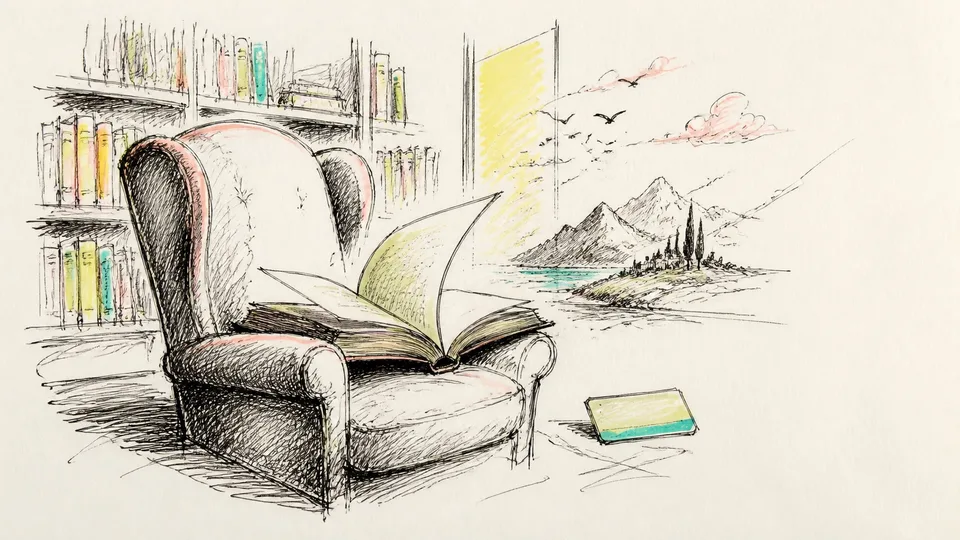
Reading can be a doorway, a resting place, a way to learn, or a way to sit beside someone else's question. A book does not need to be new to be alive. A page becomes part of a reader's day when attention settles there.
These poems about reading include two sonnets, a haiku, blank verse, and free verse. They are for librarians, teachers, children, writers, lifelong readers, and anyone who has ever carried a book from one room to another because the story was not finished.
I still like the sound of a page turning in a quiet room. It feels like a small agreement between the reader and the words. For another collection about literary life, you may enjoy these poems about books and these poems about a book.
Poems About Reading
The Book Beside the Chair
This Shakespearean sonnet uses an ABAB CDCD EFEF GG rhyme pattern. The book becomes a companion that does not demand constant attention, yet is ready to open whenever the reader returns.
The book beside the chair has learned my hand,
Its cover holds the warmth of afternoon,
I leave it open where the pages stand,
And find a different weather in each room.A sentence waits beside the folded light,
A character has traveled through the rain,
The story keeps a chair for me at night,
And does not mind when I begin again.I read to learn, to rest, to hear a voice,
To enter lives I cannot otherwise know,
The page can give the lonely heart a choice,
A wider world, a slower way to go.When I close the cover, still I see
A little more of what the world can be.
Three Lines of Light
This haiku notices reading in a pool of window light. Its five, seven, five syllable pattern is brief enough for a library card or a quiet journal.
Page warm in my hands
Dust turns slowly above words
Afternoon reads on
The Reader Before the Bell
This second sonnet uses an ABBA ABBA octave and a six line resolution. The classroom reader gets a few quiet minutes before the day begins, and the poem honors that private attention.
Before the bell, the classroom windows shine,
A book lies open near the teacher's desk,
The morning asks no question or request,
It gives the reader one small hour of time.The printed page becomes a steady line,
A place where difficult ideas can rest,
A child may find a word that fits the chest,
A teacher may remember how to climb.The chairs will fill, the voices will grow loud,
Yet this first silence will remain nearby,
A private room beneath the moving crowd,
A way to let a careful question fly.The bell can call us from the page to see,
But reading keeps a door unlocked in me.
Reading Is a Kind of Travel
This blank verse poem follows a reader crossing several landscapes without leaving a chair. Its unrhymed, measured lines keep the movement calm and observant.
I turn a page and leave the kitchen light.
A road appears beneath a foreign rain.
The people there are strangers, then they speak.
I carry their decisions down the hall.
A mountain rises where the laundry waits.
A river enters quietly through ink.
I travel far, yet know the chair is here.
The book closes, and both worlds remain near.
I wash a cup and think about the road.
The ordinary has learned another name.
The Library Card
This free verse poem treats a library card as a small promise of access. The line breaks make the reader's belonging feel practical and open.
My name fits on one little card.
I can borrow a storm,
a recipe,
a rabbit,
a whole city at night.The librarian says,
“Bring it back when you are done.”I like that.
A story can travel
and still have a home.
Letting a Story Stay with You
Reading is not always a race toward the last page. Sometimes a person reads one paragraph twice, sets a book down, or carries a sentence into the next day's work. The pause is part of the reading too.
Use The Book Beside the Chair for a note to a reader or writer. Three Lines of Light is small enough for a bookmark, while The Reader Before the Bell fits a teacher or classroom. Reading Is a Kind of Travel belongs to anyone who finds wide places in a small room, and The Library Card celebrates access.
If you share one of these poems, name the book object that is real for you. It might be a card, a chair, a margin, or a page softened by many hands. Details make a reading life visible.
The next story may be waiting on a shelf, in a box, or beside your bed. Open it when you can. A book cannot choose the hour for you, but it can be ready when your attention arrives.
A poetry book for shared reading
A borrowed book or an old favorite is a lovely place to start. If you want another collection for reading together, this is one option.
These are paid links. As an Amazon Associate I earn from qualifying purchases.
- View on Amazon
Where the Sidewalk Ends: Poems and Drawings
Take turns choosing a poem and reading it aloud during the shared reading described in this collection.
One hardcover book
Send a little poetry to someone you love.