

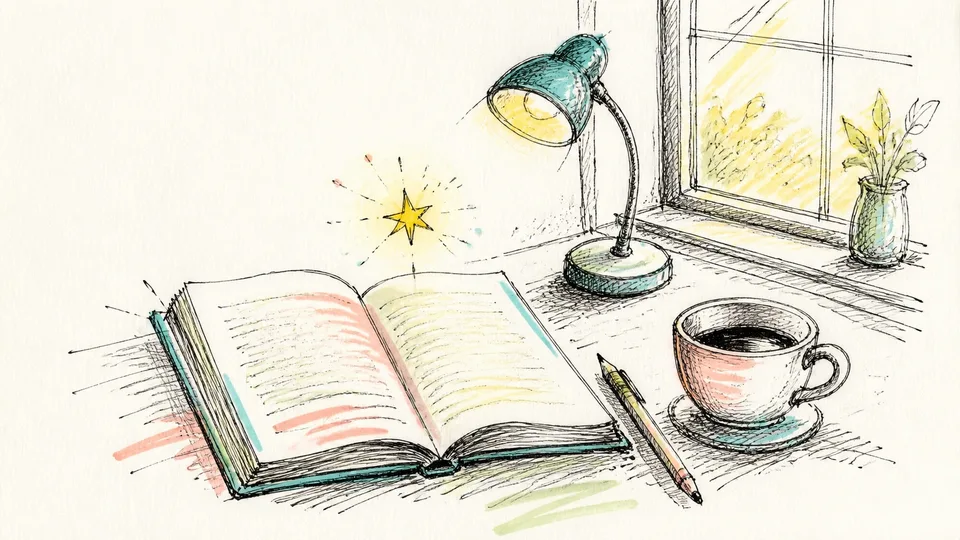
Inspiration is not always a lightning bolt. It may be a sentence heard at the right time, a color on the kitchen wall, or the quiet decision to open a notebook after a long day. The spark can be small and still be enough to begin.
These poems about inspiration include two sonnets, free verse, a limerick, and a haiku. They are for writers, teachers, artists, caregivers, and anyone who has felt a good idea waiting just beyond the edge of attention. Each poem treats inspiration as a practice of noticing rather than a performance.
My favorite ideas often arrive while I am doing something ordinary. A cup of coffee, a worn pencil, or a question from a child can open a door that was not visible a moment before. If you are gathering courage for a new page, you may also enjoy these poems about today and these poems about books.
Poems About Inspiration
The Match in the Notebook
This Shakespearean sonnet uses an ABAB CDCD EFEF GG rhyme pattern. The notebook holds a tiny spark that becomes useful only when the speaker gives it time, care, and a place to grow.
A little match lies quiet in the page,
A thought that waits beneath the ordinary,
It does not shout or hurry to be sage,
It warms the hand that finds it in a diary.I turn the page, and see a window made
Of words I nearly left beside the tea,
A question asks me not to be afraid,
A line becomes a path I could not see.The spark is not a promise to be grand,
It is a start, a place to set the pen,
A little light held gently in the hand,
Then carried through the dark and back again.An idea grows by being given room,
Like morning finding space where shadows loom.
A Small Permission
This free verse poem offers permission to make a beginning that is unfinished. Its open spacing lets each image feel like a note written in the margin of a busy day.
You may begin
with the sentence that shakes.You may leave a blank space
and come back tomorrow.The idea does not need a trumpet.
It needs a chair,
a little time,
and one person willing to listen.
When the Line Arrives
This Petrarchan sonnet begins with an ABBA ABBA octave and resolves through a six line sestet. It describes inspiration as something welcomed through patience rather than demanded by force.
The line arrives when all the rooms are still,
When cups are rinsed and evening starts to close,
It rests beside the question no one knows,
Then waits until the heart can choose its will.I used to chase it up the narrow hill,
With lists of clever words and borrowed prose,
But now I let the quiet window show
A slower path that asks me to sit still.One phrase can hold the weight of someone's day,
One image can make loneliness less wide,
A patient page can teach the fear to stay,
Then loosen when the honest words arrive.The line is not a prize that makes me whole,
It is a small lamp carried by the soul.
The Muse Who Lost Her Shoe
This limerick is the playful form in the collection. It follows five lines and an AABBA rhyme pattern, making inspiration a little mischievous and less interested in perfect entrances.
A muse who was late for the train,
Lost one of her shoes in the rain.
She limped to the door,
Found three words on the floor,
And called that a poem again.
Morning Page
This haiku treats a blank page as an invitation rather than a test. Its checked five, seven, five rhythm keeps the first spark modest and reachable.
Blank page waits for me
One warm cup beside the ink
First word opens doors
Keeping the Spark Warm
Inspiration becomes more dependable when we stop asking it to arrive dramatically. A regular chair, a small notebook, or ten quiet minutes can make a welcome place for an idea. The work may still feel uncertain, but uncertainty is not proof that the spark is wrong.
Choose The Match in the Notebook for a writer who is beginning again. A Small Permission can comfort someone who is afraid of an imperfect first step, while When the Line Arrives is suited to a slower reading about creative patience. The limerick is a cheerful note for a friend, and Morning Page fits a journal or classroom prompt.
If you share one of these poems, add the ordinary object that helps you begin. It might be a pencil, a recipe card, a window, or a question written in the margin. Inspiration becomes more generous when it is connected to a real life.
The next idea may be waiting in a very quiet place. Open the notebook, make a little room, and let the first word arrive without asking it to prove its worth. A small spark can still show the way.
Useful reading and supplies for a poetry draft
Begin with any paper and pen, and borrow the book if your library has it. These are optional companions for the practice of noticing and writing described here.
These are paid links. As an Amazon Associate I earn from qualifying purchases.
- View on Amazon
A Poetry Handbook
Explore poetic sound and form when you want to work a first idea into a draft.
One paperback book by Mary Oliver
- View on Amazon
Essentials Dot Matrix Notebook
Keep small observations and unfinished lines together, without needing every idea to become a finished poem.
One A5 hardcover notebook, 192 dot grid pages, 5¾ × 8¼ inches
Send a little poetry to someone you love.