
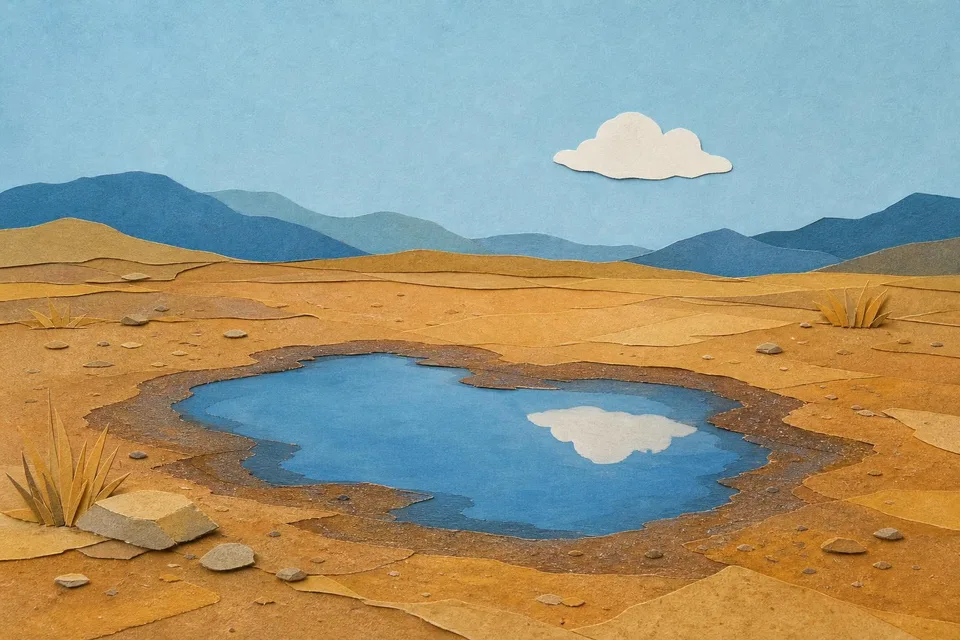
A puddle can grow smaller without a single splash leaving its edge. That quiet change is a good place to begin with water cycle poems. Something familiar is happening beside our shoes, yet part of the journey slips beyond what our eyes can follow. Poetry gives us a way to stay curious about it.
These five original poems follow water through warming puddles, clouds, rainfall, soil, and streams. Two sonnets make room for a longer look, a haiku holds one small moment, a ballad follows a child's chalk drawing, and a repeating poem circles back to its opening thought. They can be read at home or alongside a lesson.
I like approaching this subject through a stone, a garden gate, or a wet leaf before reaching for a diagram. The scientific words matter, but they become easier to hold when there is something concrete beside them. Evaporation belongs to the puddle as surely as it belongs to the page.
For learning, keep a few distinctions clear: water vapor is invisible, while clouds contain tiny water droplets or ice crystals. Water can take many routes and spend different amounts of time along them. These poems offer selected journeys rather than one fixed timetable or a complete account of every process.
You might invite a young reader to listen for where the water changes, where it gathers, and where it disappears from view. There is no need to identify every process on the first reading. Sometimes the useful beginning is simply noticing that a shrinking puddle leaves us with a question.
Five Water Cycle Poems for Following the Water
The Puddle Grows Smaller
The twig stays behind while the water changes, and that difference catches my attention. I like having an ordinary object to watch beside an invisible process. For a reader learning about evaporation, the absence of a visible thread rising from the pool is worth noticing.
The sun lays warmth across the shallow pool;
The stones grow pale beside its shrinking rim.
The shaded patch beneath the fence stays cool;
A cloud goes by; the scattered sparkles dim.No silver thread is lifted to the blue
No tiny drops go climbing into light.
As vapor, water leaves our common view;
The change can happen softly, out of sight.Where moist air cools, small drops can start to grow;
They gather into clouds above the plain.
Those clouds may drift where distant grasses grow
Then send their gathered water down as rain.The puddle thins beneath the warming day;
Unseen does not mean water's gone away.
Chalk Arrows
I am fond of the child bringing the chalk back after the shower has washed her drawing away. Her second picture has more paths because she has stopped to look at what the water actually does. That feels like a generous way to approach learning: a drawing can change without the first attempt being wasted.
A child drew arrows on the walk
From sea to cloud to rain.
Then sketched a river winding home
To meet the sea again.She left a space beside the tree
And asked, 'What happens there?'
The roots were drinking from the soil;
Leaves sent some to the air.A shower washed the chalk away
And filled a shallow crack.
She watched some sink beneath the path
And brought the chalk box back.She drew more arrows underground
And branches on her tree.
'There isn't just one road,' she said
'For water, is there? See!'
Rain on the Leaves
The trembling beads on a leaf give me a small place to rest after following water across a whole landscape. I like the movement from cloud to leaf to soil, with the roots doing their quiet work below. This is a short reading to pair with a drawing of what can and cannot be seen.
Cloud drops gather close.
Rain beads tremble on green leaves.
Roots drink from the soil.
Past the Garden Gate
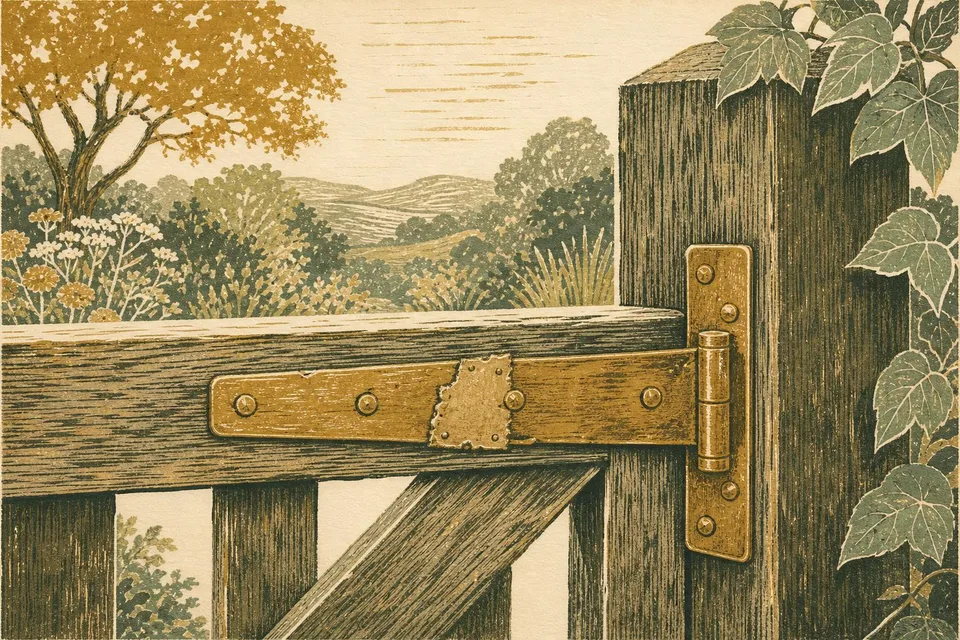
The little channel beside the gate interests me because it sits next to another route we cannot watch. Some water runs across the surface while some enters the ground. I value that contrast here, especially for readers whose first picture of the cycle has only one arrow between each stage.
The rain runs down the slanting garden bed;
It finds a narrow channel by the gate.
One little stream goes where the others led;
Another sinks into the soil to wait.Beneath the ground, more water finds a way
Through cracks in rock and spaces out of sight.
Some feeds a spring that meets the open day;
Some stays below through many turns of light.The creek runs on to join a wider stream;
The river takes its waters to the sea.
And sunlight warms the waves that catch its gleam;
As vapor, water leaves unseen and free.One shower starts more paths than we can know:
Across the earth, above it, and below.
Beyond the Rain
The clock near the end is the image that stays with me, though it cannot set the water's pace. I like the returning lines because they suggest a cycle without making every journey equally quick. Read aloud, those repetitions give listeners a familiar place to join in.
The water travels on beyond the rain.
The sun warms pools with early morning light.
What leaves the soil may reach the roots again.No vapor draws a stripe across the plain.
It joins the air and passes out of sight.
The water travels on beyond the rain.Small cloud drops form where cooler airs remain.
A wind can bear them far before the night.
What leaves the soil may reach the roots again.Some water waits beneath a field of grain.
Some threads through rock without a gleam of light.
The water travels on beyond the rain.A spring gives what the ground could not retain.
The current curls around a stone worn white.
What leaves the soil may reach the roots again.No arrow shows how long it might remain.
No clock can make its many paths unite.
The water travels on beyond the rain.
What leaves the soil may reach the roots again.
Leave Room for Another Arrow
What stays with me across these poems is how much happens outside our immediate view. We can watch rain strike a leaf or follow a stream beside a path. Water vapor and movement underground ask for another kind of attention, one that makes room for what a glance cannot explain.
If you are choosing a poem for a younger reader, the haiku offers a manageable starting point. Read its three lines, then draw the cloud, leaves, soil, and roots. The chalk story gives a little more room for conversation, especially around the moment when the child discovers that her picture needs additional arrows.
For older readers, the two sonnets can sit beside a water cycle diagram. Ask which lines describe evaporation, condensation, precipitation, or water moving across and into the ground. Not every line needs a label. A stone, a patch of shade, or a garden gate can help make the setting imaginable while the scientific ideas remain clear.
The final poem works especially well with two voices. One reader can take the changing lines while another reads the refrains. Afterward, consider why the poem mentions both a clock and an arrow. A cycle describes returning movement, but a simple circle cannot show every route or how long water stays in one place.
There is also room to put the page aside and look outdoors. Notice a damp patch drying, drops held on a leaf, or rain finding a low place in the path. I like a poem that sends the reader back to something ordinary with a better question. The water was already moving; now we may be more ready to notice.
For another collection, visit Poems About Nature: Original Verses for Earth, Weather, and Wonder or Poems About Rain: Original Verses for Weather, Renewal, and Shelter.
Simple supplies for drawing and reading the water cycle
Paper and a pencil you already have are enough to use these poems. A notebook or colored pencils can also give a reader room to draw the water's different paths.
These are paid links. As an Amazon Associate I earn from qualifying purchases.
- View on Amazon
Essentials Dot Matrix Notebook
Use the dot grid notebook to copy a favorite poem and sketch the water's visible and hidden routes beside it.
One A5 hardcover notebook, 192 dot grid pages, 5¾ × 8¼ inches
- View on Amazon
Prismacolor Premier Colored Pencils
Use the colored pencils to distinguish clouds, streams, soil, and underground water in a drawing inspired by the poems.
One set of 24 soft core colored pencils
Send a little poetry to someone you love.