
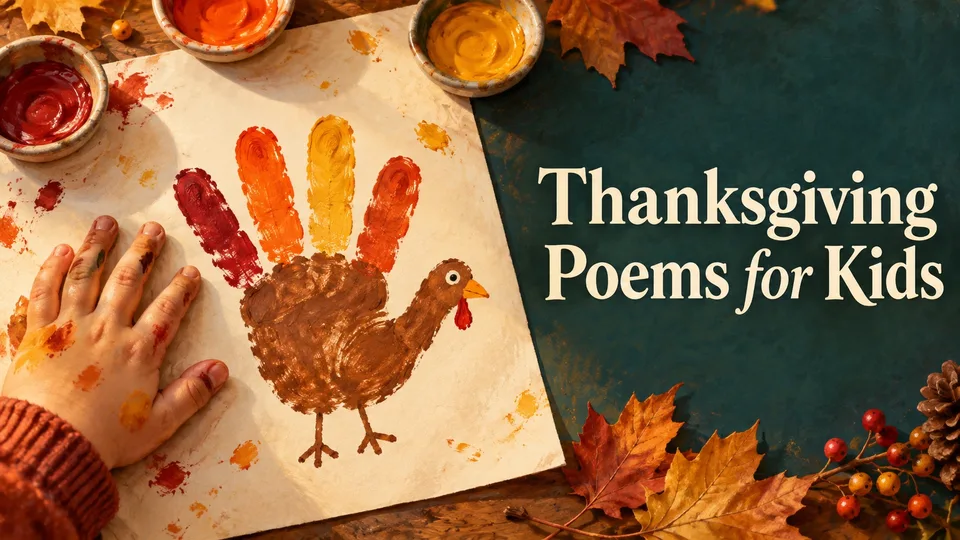
A painted handprint never looks quite like the one beside it. One finger stretches farther, another leaves a little gap, and the thumb becomes a wonderfully unusual turkey head. I like the way a row of those pictures lets every child's work remain recognizably their own.
These Thanksgiving poems for kids offer eight original readings about gratitude, sharing, helping, and a turkey who enjoys being noticed. The first three are simple choices for preschool and kindergarten with adult support. The next two suit children who are ready for a small story or a quieter reading. The last three are longer poems for older children, a school program, or a grown person to share aloud.
The age suggestions are flexible. Some children will want to read independently; others will enjoy making a hand motion while somebody else carries the words. “My Handprint Turkey” can go beside a child's turkey picture. “The Shared Apple” takes only three lines. The repeated lines in “We All Have Thanks to Give” let a group participate without learning a whole poem at once.
I have kept the gratitude concrete. There are napkins to fetch, an apple to share, and a kind thing to do tomorrow. Nobody has to announce that everything in their life is wonderful. Naming one useful or comforting thing is a good beginning. For more seasonal observation before or after your Thanksgiving activity, my fall poems for kids follow leaves, pumpkins, and an autumn walk. Here, we will start with a little hand and a friendly bird.
Preschool and Kindergarten Poems with Simple Motions
An adult can read while children join a motion or a word. Let a child watch instead if that is how they prefer to take part.
My Handprint Turkey
The uneven feathers are my favorite part of a handprint turkey because they belong to the child who made it. I wanted this verse to celebrate that little piece of individuality while giving the picture a thankful voice.
Free verse, six lines. Preschool and kindergarten with an adult.
My hand became a turkey.
Four fingers spread their feathers.
My thumb looked up.
I gave it autumn colors
and one thing to be thankful for.
That part came from me.
Spread one hand on the first two lines and gently point to the thumb on the third. For a picture to accompany the poem, trace a spread hand, use the thumb shape as the head, and let the other fingers become feathers. A child can tell you one thing they appreciate to write beside the drawing.
A Thankful Little Turkey
The turkey's proud strut becomes a thank you song, which is the turn I enjoy. Children can spread their fingers for the feathers and give the bird a little gobble after the poem, at whatever volume fits the room.
Limerick, five lines. Preschool and kindergarten with an adult.
A turkey was proud of his tail,
Which fluttered as bright as a sail.
As he strutted along,
He burst into song,
And sang thanks to his friends on the trail.
Ask children to name a thankful detail before you read, such as a friend, a blanket, or somebody who helped. They can say “gobble” together after the poem or simply fan a hand like a tail.
The Shared Apple
I like how the apple becomes two gifts without becoming any bigger. The poem can begin a simple conversation about sharing, without asking children to offer something they need to keep.
Haiku, three lines. Preschool and kindergarten with an adult.
Red apple cut through
Two small hands receive a half
Both say thank you now
Hold your hands close as though carrying an apple, then open them gently to each side. Children can say “thank you” on the final line. This is an imagining activity; real food is not needed.
Short Readings for Early Elementary Children
One More Napkin
The child notices a missing napkin before anybody asks, which is the small kindness I value here. I would use this reading when a group is talking about ways to help that are within a child's reach.
Ballad, eight lines. Suggested for early elementary readers or shared reading.
We counted every waiting plate
And set the cups in line.
One napkin more was needed there,
Beside a friend of mine.I brought another from the shelf
And placed it by the bread.
“You saw just what we needed here,”
The smiling grownup said.
After the poem, ask what the child noticed. Let listeners suggest another small job they might choose to help with at home or in the classroom.
A Small Job
I like the practical pleasure of a chair being set in the right place. The poem leaves the child with a real job and a moment to pause, rather than making helping sound like an endless assignment.
Blank verse, four lines. Suggested for early elementary readers or an adult reader.
I bring a little chair beside the wall.
I place a folded napkin by the cup.
A grownup smiles and thanks me for my help.
I sit and watch the window fill with light.
Children can quietly mime carrying a chair and setting down a napkin. Ask what job they would enjoy, and accept that different children will choose different things.
Longer Readings for School Programs and Older Children
We All Have Thanks to Give
The useful things in this poem are deliberately ordinary, especially the story and the kite string. I like giving a whole group a refrain that does not ask them to compare the size of their gifts.
Villanelle, nineteen lines. One reader with a group joining the two returning lines.
We find a little kindness every day.
The morning light makes gold of simple things.
A thankful word is ours to give away.We help to put the waiting cups away.
The kite is safe upon its knotted strings.
We find a little kindness every day.We ask a friend to join our game and stay.
We make a paper bird with yellow wings.
A thankful word is ours to give away.A grownup has a story for today.
We laugh at all the joy the story brings.
We find a little kindness every day.The clouds are dark; the windows show us gray.
A little voice beside the doorway sings.
A thankful word is ours to give away.The room has space for what we want to say.
We fold the paper birds and fix their wings.
We find a little kindness every day.
A thankful word is ours to give away.
The Things We Bring
The clean towel and folded paper let a child bring something useful without buying a gift. I appreciate the ending because it gives quiet children a place in the gathering, too.
Sonnet, fourteen lines. For older children or an adult reading to the group.
I do not need a gift from any store,
To bring a little kindness to the day.
I hold a clean dry towel beside the door,
And help to put the waiting cups away.
I bring a folded paper to a friend,
With one red leaf drawn neatly in the square.
I have a patient ear that I can lend,
To hear a story someone wants to share.
A little help can be a useful thing;
A quiet voice can make a welcome clear.
We do not need to shout or dance or sing,
To show that we are glad a friend is here.
The smallest gifts can find a place to start,
When given with a kind and willing heart.
Tomorrow's Kindness
The thankful word turns into something a child can do on an ordinary morning. I like that movement beyond the holiday, especially the friend being invited into a game that has already begun.
Sonnet, fourteen lines. For older children or an adult reading to the group.
Tomorrow I can hold the open gate,
And let a friend go through before I do.
I need no special dinner on a plate,
To find a little kindness that is new.
I put a borrowed book upon the shelf,
And help to lift the box beside the chair.
I ask a friend who waits there by himself
To join the game, with room for one more there.
A thankful word is good to say today;
Tomorrow I can give the word some feet.
It need not hurry far along the way,
To help a friend who lives across the street.
The holiday will end, but I can show
A kindness with another day to grow.
Giving Every Child a Way to Join
When children share a poem, the smallest part can feel important. One child reads a line, another opens a hand like a turkey tail, and somebody else listens for the word “thanks.” I would keep those choices available rather than asking every child to perform in exactly the same way.
The handprint verse can accompany a drawing made with crayons, paint, or a simple outline. Let the feathers keep their odd shapes. You might write the child's own thankful detail underneath, using the words they actually offered. A child who says “my blue cup” has noticed something real. The answer does not need to become grander to belong on the page.
For a school program, practice the returning lines together and let one reader carry the middle verses. Keep the pace comfortable. Children who do not wish to speak can hold their pictures or sit with the group. Participation should feel like being included, not like passing a test in front of an audience.
If you use the longer sonnets, ask for one image afterward rather than a complete explanation. A towel, a gate, or a friend joining a game may be what a child remembers. That is a good meeting with a poem.
For a family reading later, the broader poems about Thanksgiving offer a quieter collection. I hope these children's poems leave gratitude close enough to touch: in a shared apple, a helpful hand, and a little kindness that can begin again tomorrow.
Useful supplies for a thankful handprint drawing
For parents and teachers: a pencil outline and paper you already have work well. Use existing crayons before buying more.
These are paid links. As an Amazon Associate I earn from qualifying purchases.
- View on Amazon
Crayola Crayons
Color the hand outline into a turkey and add the child's own thankful detail underneath.
Two boxes of 24 crayons, 48 crayons total
- View on Amazon
Astrobrights white cardstock
Give the traced handprint turkey a sturdy page and leave space for the child’s own thankful words.
75 white U.S. Letter sheets, 8½ × 11 inches, 65 lb
Send a little poetry to someone you love.