
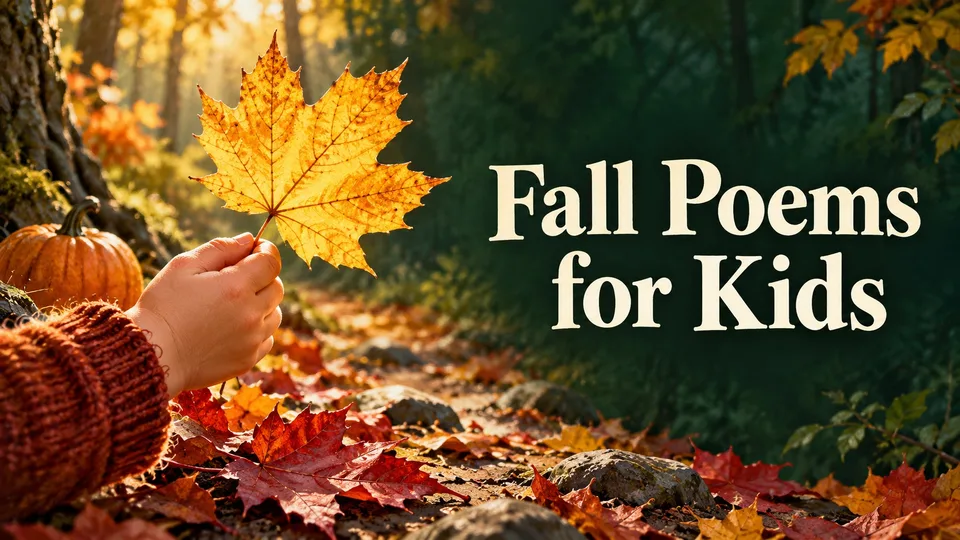
A child holding a fallen leaf will often see something I missed. The stem becomes a handle. A torn edge looks like a mountain. Turn the leaf over, and there is a whole little map on the back. Autumn offers plenty to notice before we ever ask a child to name a season.
These fall poems for kids begin with that kind of looking. The eight original poems follow a leaf boat, a pumpkin with big plans, a mitten waiting to be found, and a garden settling down. Some are very short. Others have room for a story or a repeated line that children can learn by listening.
The first five selections are quick readings for an autumn morning, a classroom circle, or a few minutes after a walk. The final three are longer poems for shared reading and older children. I have included different forms because a season has more than one kind of music. A tiny haiku can hold one leaf; a ballad can follow a small adventure from beginning to end.
You do not need special materials to use these poems. Ask a child to choose a color, listen for a repeated word, or tell you which object they would put in a pocket. A drawing is a good response, too. For a quieter collection written with grown readers in mind, my poems about autumn spend more time with the feelings that changing seasons bring. This collection keeps its eyes near the ground, where children find so much worth carrying.
Five Short Fall Poems to Read Together
Leaf Boat
The puddle in this poem becomes large because a child is watching it closely. I like that change of scale, and I would ask a young reader where the little boat might go after the last line.
Free verse, six lines
One yellow leaf
lands in a puddle.
I give it a twig captain
and wait on the shore.
The wind has a whole ocean
to cross before lunch.
The Pumpkin with Plans
I am fond of this pumpkin's confidence, especially when its feet finally enter the conversation. It is a useful little poem for listening to rhyming words, with a joke that children can see coming and still enjoy.
Limerick, five lines
A pumpkin decided to race
With a wonderful grin on its face.
But it looked at its feet,
Found them rather petite,
And decided to stay in its place.
A Leaf in My Hand
Holding the leaf still lets the moving branches become more noticeable. I like the quiet difference between the small thing we can keep and the larger scene that keeps changing around us.
Haiku, three lines
Red leaf in my hand
Cold wind shakes the branches bare
Gold rests on my sleeve
The Red Mitten
A lost mitten waiting on a fence is such an ordinary sight, but it can hold a complete story. I enjoy the child's happy discovery here, especially after the mitten has spent the morning looking like a little flag.
Ballad, twelve lines
A mitten rested on the fence,
A flag of woolen red.
The children hurried through the gate
With leaves above their heads.It waited through the morning wind
And watched the sparrows hop.
A little girl came down the path
And made a sudden stop.“My mitten!” called the little girl,
And reached beside the rail.
She slipped it on and waved goodbye
To autumn's windy trail.
Under the Oak
I like how the sound of a step changes beneath a tree. These lines leave space to listen, so I would read them slowly and let children describe a sound they have heard outside.
Blank verse, four lines
We stop beneath the oak beside the gate.
The leaves make little sounds against our shoes.
I hold a fallen acorn in my palm.
The path is full of things I want to keep.
Longer Autumn Poems for Shared Reading
The returning lines in the next poem can become a group response. The two sonnets that follow offer fuller pictures of a walk and a garden, with fourteen lines in each.
Listen to the Leaves
When leaves scrape along a path, I sometimes think the season is trying out its own voice. I wrote the two returning lines so children could join them together, then notice a new autumn detail between each return.
Villanelle, nineteen lines
The leaves have little stories on the ground.
A yellow one goes sailing down the lane.
We stop our busy feet to hear the sound.A red leaf turns and spins itself around.
The smallest ones are hiding from the rain.
The leaves have little stories on the ground.A brown leaf wears the color of a hound.
A gold one makes a window on the pane.
We stop our busy feet to hear the sound.An acorn waits beside the treasure mound.
A maple leaf has found the stormy drain.
The leaves have little stories on the ground.The wind has made a path where none was found.
The trees have sent us letters once again.
We stop our busy feet to hear the sound.We leave the largest pile safe and sound.
Tomorrow we can visit it again.
The leaves have little stories on the ground.
We stop our busy feet to hear the sound.
A Pocket Full of Fall
The pocket grows heavy with things that have no price tag, which is the part I value most. A child reading this poem might choose a single autumn treasure rather than collect a whole pocketful, then explain what makes it worth keeping.
Sonnet, fourteen lines
I put a little acorn in my coat,
And found a leaf as yellow as the sun.
A curled brown leaf could be a tiny boat;
I took it home when all our walk was done.
A smooth gray stone was waiting by the tree;
I brushed away the dirt and held it tight.
The smallest things were coming home with me,
To sit upon my windowsill tonight.
My pocket sagged beneath its little load;
I heard the acorn knock against the stone.
A gust of wind went skipping down the road,
And left the branches standing there alone.
I brought no gold to show upon the sill,
But all my autumn treasures pleased me still.
The Garden Goes to Sleep
I wanted the empty garden to feel restful rather than forgotten. The child remembering seeds beside a row gives the quiet scene a hopeful ending, even though nothing needs to happen there today.
Sonnet, fourteen lines
The garden beds are quiet in the sun;
We put the empty basket by the gate.
The busy days of picking now are done,
And little seeds have quite a while to wait.
A pumpkin sits beside the kitchen door;
The rake is leaning safely by the wall.
The wind has spread a blanket on the floor,
Of leaves that turned to yellow in the fall.
I watch a sparrow settle on a rail,
Then hop along the rows of folded brown.
The sky grows pale beyond the garden trail;
The gentle evening settles on the town.
I know the place where we will plant a row,
When spring comes back and tells the seeds to grow.
A Small Autumn Activity After the Poems
After a reading, I would give children a few moments to look before asking them to make anything. A leaf beside a shoe, a bare branch outside the window, or a pumpkin on a step can be enough. The object does not need to be unusual. Poetry often begins when an ordinary thing receives a little extra attention.
Try asking each child for three words about one autumn object. They might choose “red, curled, crunchy” for a leaf or “round, orange, heavy” for a pumpkin. Write the words down, say them together, and let the child decide which one belongs at the beginning of a new line. There is no need to insist on rhyme.
For children who prefer drawing, fold a page in half. On one side, they can draw something from a poem. On the other, they can draw something they actually noticed. The two pictures may look quite different. That is a good chance to talk about how a poem can make a leaf into a boat without asking a real leaf to grow a sail.
If October celebrations are part of your plans, the short Halloween poems offer gentle classroom and family readings. Leave time for autumn beyond the holiday, too. A windy Tuesday has plenty of its own material. I hope these poems encourage a child to stop, listen, and point out one thing that the rest of us might have walked past.
Useful supplies for the autumn drawing activity
For parents and teachers: use scrap paper and the crayons children already have. The leaf walk and poem reading need no special materials.
These are paid links. As an Amazon Associate I earn from qualifying purchases.
- View on Amazon
Crayola Crayons
Draw an image from a poem on one half of the page and something noticed on the walk on the other half. This pack has two boxes of 24 crayons.
Two boxes of 24 crayons, 48 crayons total
- View on Amazon
Astrobrights white cardstock
Use a sturdy sheet for the poem-and-walk drawing or a leaf rubbing with crayons already on hand.
75 white U.S. Letter sheets, 8½ × 11 inches, 65 lb
Send a little poetry to someone you love.