
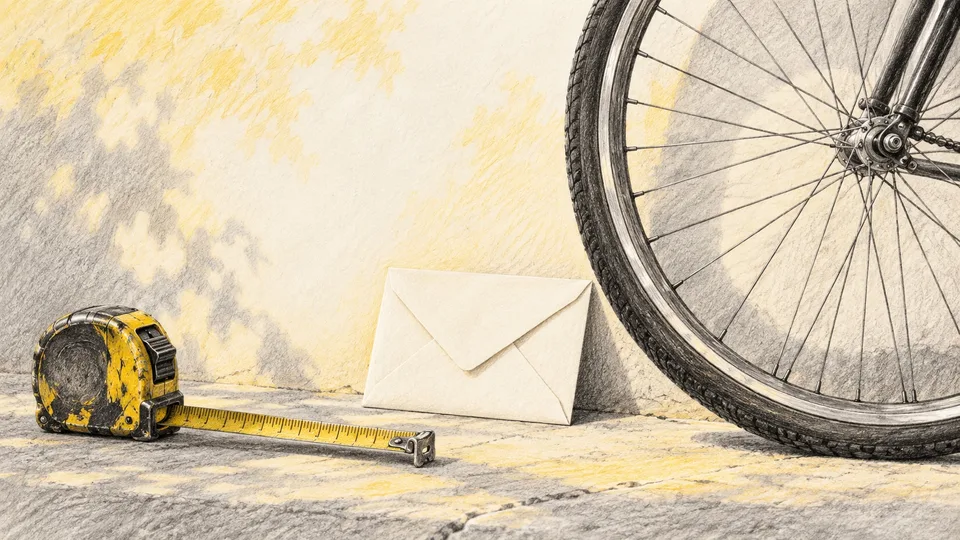
Thank you Dad poems can begin with something as small as a bicycle tire. Someone held the frame while you learned. Someone came to get you when the afternoon went wrong. Years later, those ordinary favors may be the things you most want to name.
I like gratitude that has a little dirt on its shoes. It feels more personal than calling someone the greatest father in the world and stopping there. A specific memory gives him something he can recognize, and it gives your thanks a place to land.
These five original poems offer different ways to say it, from a tiny verse for a gift tag to longer words for a letter. Their speakers are grown children finding language for practical, patient care.
For a broader reflection on what a father passes along, the collection about a father's advice and legacy looks at that longer view. Here, the purpose is simply to turn toward Dad and say thank you.
Poems for the occasion
The Second Try
I like the moment when the bicycle wobbles and nobody scolds. The thanks in this poem belongs to the patience that made another attempt possible.
You held the saddle while I found the street,
Then stepped aside and let me ride alone.
You did not make a joke of clumsy feet
Or mind the times I called you on the phone.
The things you fixed were never just the chain,
The brake that caught, the stubborn garden latch.
You helped me face the work and try again,
And find the loose thread underneath the patch.
I cannot count the hours you freely gave;
They ran beneath the days I thought were mine.
You never asked that I be always brave,
But helped me put one foot across the line.
So here is thanks, without a grand display:
You made it easier to find my way.
A Screw in the Tin
That saved screw makes me smile because it is such an unceremonious little rescue. I can imagine a whole thank you note growing from the sound of the tin opening.
A screw in the tin,
Dad finds just the one I need.
Small things hold us up.
The Rainy Pickup
The father in this story does not need a speech about reliability. I feel it in the dry towel waiting on the seat and in the ride that comes before any questions.
The buses stopped beyond the square;
The rain came slanting down.
I called you from a grocery store
Across the flooded town.You brought a towel for the seat
And shoes inside a sack.
You asked me if I wanted food
And drove the long road back.I thanked you then for coming out;
I thank you now for more:
The certain way you let me know
What calling you was for.
What You Never Charged
I am fond of the difference between a bill and a gift here. The grown child finally understands that being helped never meant being kept in debt.
You never kept a ledger of the days
You spent beside the things I could not do.
No little bill arrived to claim my praise;
No sum was marked as something I must rue.
You taught me how to mend a broken shelf,
Then watched me choose a different sort of wood.
You let me build a version for myself,
And said the crooked corner still looked good.
Now I can see what once I did not see:
The gift was more than skill or time or care.
You gave without requiring more of me
Than knowing I could ask and find you there.
Dad, take these words as freely as they came:
My life is better, and your love's the name.
The Number I Still Know
The familiar telephone number feels almost like a physical object to me. I like that the final thanks arrives without pretending the speaker has stopped needing anyone.
I can forget a password
between one room and the next,
but I still know your number.It sits behind my thinking
like a tool in its own place.Thank you for answering
when the question was small,
when the answer was difficult,
when all I needed to say was,
Dad, are you there?
A few words to carry with you
The most useful poem may be the one that reminds you of an actual afternoon. A borrowed tool, a ride through rain, or a lesson repeated without irritation can carry a great deal of feeling. You do not need to fit every good thing your father has done into one card.
If you share a complete poem, put your own memory beside it. Tell him which bicycle, which road, or which problem came back to you while you were reading. Keep the poem's line breaks so it can be read easily, and let the accompanying note sound like you.
These pieces speak from relationships where care was present. If your experience is more complicated, there is no need to borrow a certainty you do not feel. You can thank someone for one real kindness without making a statement about everything.
I keep coming back to that little tin of screws. Love can be wonderfully practical. Sometimes the words arrive years after the repair, and they are still worth saying.
A thank you for Dad
A card you already have or a folded sheet of paper is enough. If you would like him to tell you his stories too, this is a good choice.
These are paid links. As an Amazon Associate I earn from qualifying purchases.
- View on Amazon
Tell Me Your Life Story, Dad
Give this with your poem, and ask him to fill it in for the family.
One guided journal
- View on Amazon
Thank You Cards with Kraft Envelopes
Copy a short poem inside a card and name one thing you never thanked him for.
52 cards with envelopes and stickers
Send a little poetry to someone you love.