

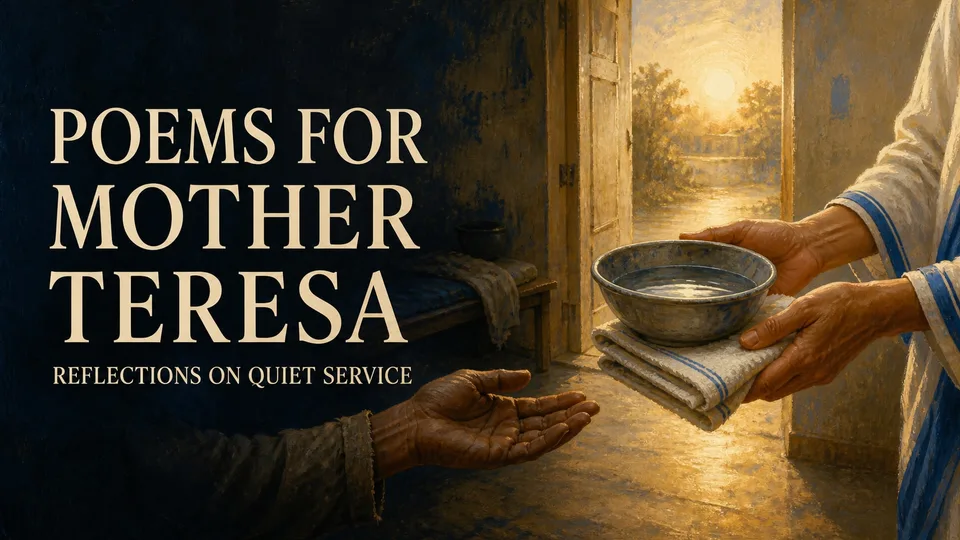
Mother Teresa is a historical religious figure, so I want to keep the boundary clear. The Nobel Prize biography records that she was born Agnes Gonxha Bojaxhiu, founded the Missionaries of Charity, and received the Nobel Peace Prize in 1979. The original poems below reflect on service, attention, and care, but they do not reproduce her words or try to write in her voice.
These reflections may sit beside poems of gratitude for teachers and mentors or poems for a pastor or spiritual leader. Use them as thoughtful starting points, and remember that a real person’s life contains complexity beyond any short collection of poems.
Poems for the Quiet Servant
The Small Bowl of Water
This poem uses a bowl of water as an image of practical care. It is not a claim about a particular event in Mother Teresa’s life. It is an original reflection on how small service can become meaningful.
A small bowl of water waits
Beside a weary hand.
No trumpet calls the moment out,
No crowd is asked to stand.Yet care can live in simple work,
In water, cloth, and time.
A quiet act can make a room
Feel briefly more like home.
The Open Door
This poem considers welcome as a form of service. It does not define one religious practice as the only path to compassion. The door is a symbol of attention offered without spectacle.
The open door receives the one
Who waits beyond the rain.
It does not ask for polished words,
Or proof of hidden pain.A chair is drawn, a cup is filled,
A listening heart grows wide.
The world can change by making room
For someone left outside.
Work That No One Sees
This poem honors service that is rarely applauded. It keeps the speaker with the action rather than creating a heroic portrait. The context invites readers to think about their own unnoticed acts of care.
The work that no one sees can still
Make morning kinder be.
A floor swept clean, a letter sent,
A hand held quietly.No record keeps each patient act,
No photograph can show.
But care can leave a lasting mark
In places hearts will know.
The Face in the Crowd
This poem asks the reader to notice an individual within a large crowd. It avoids claiming that one person can solve every need. The poem’s hope is attention that leads to a next step.
A face appears among the crowd,
A life we do not know.
We cannot carry every grief,
Or make each sorrow go.But we can meet one pair of eyes,
And ask what help may be.
Compassion starts when someone stops
To notice what they see.
A Thread of Mercy
This poem uses thread as a metaphor for repeated care. It does not quote scripture or present a doctrinal conclusion. The image is meant to be open to readers of different backgrounds.
A thread of mercy passes through
The fabric of a day.
It may be found in gentle speech,
Or in a choice to stay.One thread may seem too small to hold
The weight of human need.
Yet many hands can weave a cloth
Of help through word and deed.
The Humble Work
This poem separates humility from invisibility. It suggests that service can be quiet while still requiring courage and boundaries. The tone is reflective rather than celebratory.
The humble work is not always
A work of being small.
It may be choosing what is right
When no one sees at all.It may be learning when to rest,
Or asking others in.
A life of care needs honest hands
And room to begin again.
Let Kindness Begin Here
This closing poem brings the theme back to the present reader. It does not ask anyone to imitate a historical person. It offers one possible beginning in the next ordinary interaction.
Let kindness begin here today,
In one unhurried word.
Let care be more than something felt,
Let it be something heard.We cannot mend the whole wide world,
Or answer every prayer.
But we can make one corner less
Lonely by being there.
When writing about a named person, keep the poem original and honest about what is known. Use authoritative sources for historical details, then let the poems explore themes without pretending to speak for that person.
Send a little poetry to someone you love.