

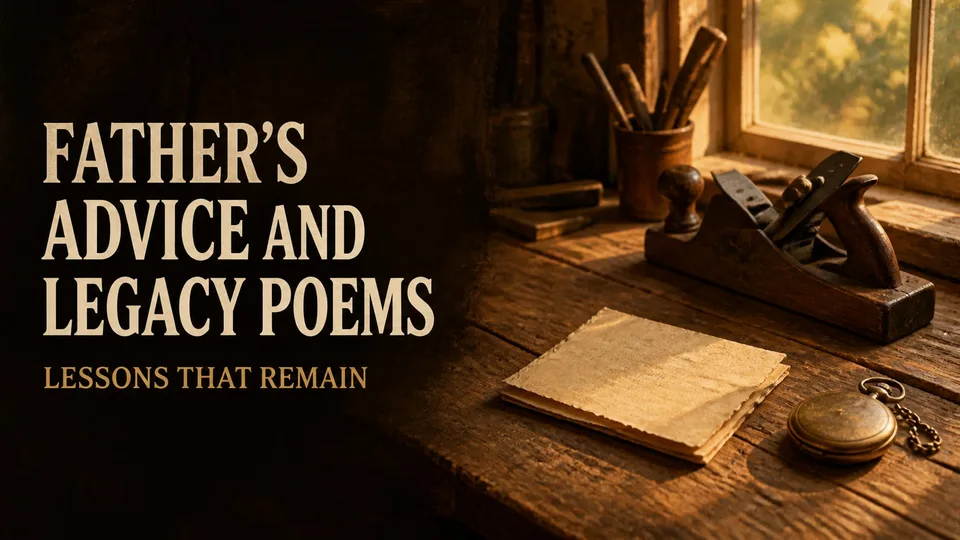
A father’s advice may arrive in a speech, a question, a repaired hinge, or the example of showing up when work is difficult. Legacy is not only what a person leaves behind. It is also what continues through the choices, patience, humor, and care they teach others to practice.
These original poems can suit a birthday, Father’s Day, memorial, retirement, or private letter. Choose what fits your family story, and remember that a father’s influence can be complicated. You do not have to make a person perfect in order to honor what was true and useful.
Poems for a Father’s Advice and Legacy
The Work of His Hands
This poem remembers practical work as a form of instruction. It is for the father whose example appeared in tools, repairs, meals, or steady labor. The details can be changed to fit a particular life.
His hands knew wood and wire and rain,
The weight of every tool.
He taught me work is more than strength,
It is a way to make things whole.I watched him measure, mend, and try,
Then start the task again.
His hands left more than finished work,
They taught my hands to begin.
The Advice I Carry
Advice can become clearer as we grow older. This poem gathers short lessons into the larger practice of living. It works for a father’s birthday or an adult child’s letter.
Do what you say, and say what’s true,
Leave room for someone’s pain.
If you are wrong, begin again,
Then try the road again.These words have traveled years with me,
Through fields and crowded streets.
A father’s advice can find a home
In ordinary heartbeats.
The Porch Light
The porch light is a familiar image of welcome and return. This poem honors a father who made home feel possible without claiming that every family home was perfect. It is gentle enough for a card or memorial reading.
The porch light waited through the dark,
A small and steady flame.
It did not ask where I had been,
It only knew my name.I carry that light into the world,
When roads are hard to see.
A father’s welcome can become
The way I welcome me.
What He Did Not Say
Some fathers teach through quiet presence more than long explanation. This poem notices the unspoken lessons in attention and reliability. It leaves room for a relationship where words were limited.
He did not say the world was safe,
Or promise every day.
He showed me how to meet the work,
Then find a kinder way.He did not name each sacrifice,
Or ask to be admired.
I learned from all the quiet things
That kept the house inspired.
A Father’s Table
A family table can hold advice, stories, and the pauses between them. This poem uses a meal as a place of belonging. It fits a celebration where the family wants to honor shared memory.
Around a father’s table,
We learned to pass the bread.
We learned that listening matters,
And not all things are said.The stories took their time to grow,
The laughter crossed the room.
A table can become a legacy
That gives old love more room.
The Road He Let Me Choose
Good advice does not always mean choosing someone else’s road. This poem honors a father who offered guidance while allowing a child to become an individual. It is a blessing for a grown son or daughter.
He showed me where the roads could turn,
He told me what he knew.
Then opened up his steady hands,
And let me choose my view.The road I took was mine to walk,
The lessons came along.
A father’s love can give you roots,
Then let you grow strong.
The Legacy of Enough
This closing poem defines legacy through sufficiency rather than possessions. It is about teaching a person that they can live with honesty, care, and a useful heart. The tone is grateful and calm.
You taught me enough to carry on,
Enough to face the rain.
Enough to offer kindness first,
Then try the work again.I may not hold the things you held,
Or walk the roads you knew.
Yet every good and faithful choice
Keeps part of you in view.
When writing about a father’s legacy, name one ordinary lesson that still guides you. The small detail often carries more truth than a long list of virtues.
Send a little poetry to someone you love.