

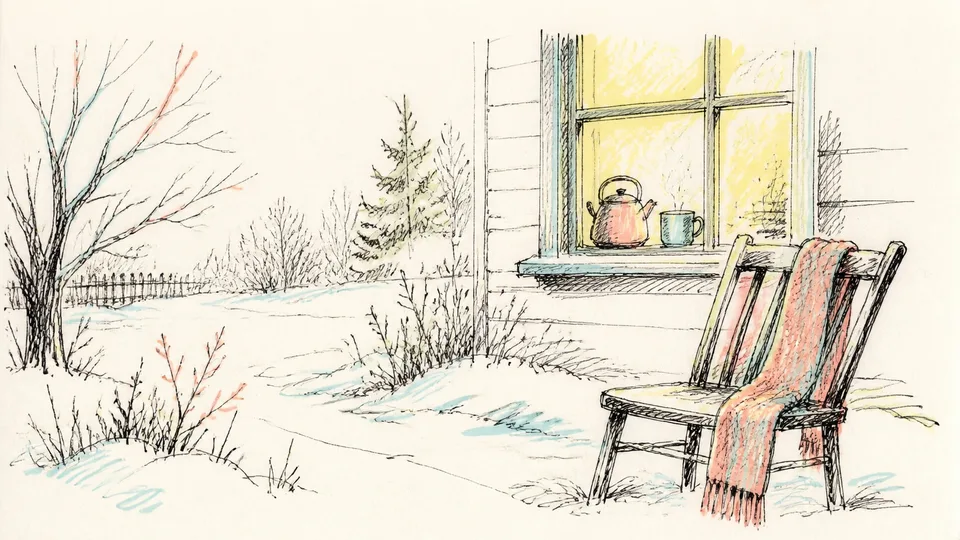
Winter changes the volume of the world. Snow can soften a road, bare branches can show the architecture of a tree, and a warm room can feel like a small lantern held against the long dark. The season invites us to notice what keeps working beneath the quiet.
These poems about winter include two sonnets, a villanelle, free verse, and a limerick. They are for a seasonal gathering, a note beside a gift, a classroom reading, or a private evening when the weather has made the day feel close.
I have always admired the practical kindness of winter rituals. Soup simmers, boots dry by the door, and someone checks the window before bed. If you enjoy poems about rest and night, you may also like these poems about sleep and these poems about the elements.
Poems About Winter
Winter at the Window
This Shakespearean sonnet uses an ABAB CDCD EFEF GG rhyme pattern. The window frames a winter world while the closing couplet finds warmth in the act of noticing and making room.
The winter presses silver to the pane,
A bare branch writes its handwriting in white,
The kettle sings a small and steady strain,
While dusk folds early underneath the night.I set a lamp beside the waiting chair,
And bring a book whose pages smell of rain,
The room grows warm with ordinary care,
A quilt, a cup, a hand upon the grain.Outside, the road is quiet as a thought,
The snow receives the footprints of the day,
Inside, I learn that comfort can be wrought
From simple things we choose to keep and stay.The cold may draw the world beyond my sight,
But kindness makes a window of the night.
Keep the Kettle Singing
This villanelle uses nineteen lines, two repeating refrains, and two rhyming sounds. Its refrain returns like a winter habit, reminding the speaker that warmth is something people make together.
Keep the kettle singing through the snow.
Set one more cup beside the fire's glow.
The night is long, but love can learn to grow.The windows hold a lace of ice below,
The porch light paints a circle on the snow.
Keep the kettle singing through the snow.A neighbor brings a loaf, still warm to show,
A child builds mountains where the small drifts go.
The night is long, but love can learn to grow.We tell the same old stories soft and slow,
Then find one new detail we did not know.
Keep the kettle singing through the snow.The dark may press its shoulder to the glow,
Yet every room can make a warmer row.
The night is long, but love can learn to grow.I watch the steam rise, patient as a vow,
And let the simple evening have its flow.
Keep the kettle singing through the snow.
The night is long, but love can learn to grow.
Snow in the Yard
This second sonnet follows an ABBA ABBA octave with a six line resolution. Snow becomes a record of small lives and a reminder that quiet can reveal more than it hides.
The snow in the yard has covered every stone,
Yet prints appear where fox and sparrow pass,
A child's round boot has pressed the shining grass,
And moonlight gives the sleeping fence a tone.The cold has made the familiar world unknown,
But not erased the paths beneath the glass,
The ground keeps every memory that can last,
And waits for warmer weather of its own.I read the marks and think of all we leave,
The kindness, hurt, and questions in the white,
The ways a quiet day can make us grieve,
The ways a lamp can teach the dark its light.By morning, footprints fade beneath the sun,
Yet every step was real because it shone.
A Pocket of Blue
This free verse poem finds a small blue patch in a gray winter day. The open lines leave the color suspended, like a thought that keeps a person company.
Between two roofs,
a pocket of blue.I carry it inside
while buying bread,
while brushing snow
from the steps.A little sky
can warm a coat pocket
for miles.
The Snowman Who Needed a Scarf
This limerick follows a five line AABBA pattern. Its playful turn gives winter a little humor without losing the season's gentleness.
A snowman stood proudly in town,
But complained that his nose had turned brown.
A child brought a scarf,
He said, “Now I am warm,”
And bowed as the snow settled down.
Keeping Warm Through the Quiet
Winter poems do not have to be gloomy to be honest. The cold season can hold loneliness, but it can also hold soup, books, shared stories, and the kind of rest that becomes possible when the outside world asks us to slow down.
Use Winter at the Window for a quiet evening or a seasonal card. Keep the Kettle Singing fits a gathering, while Snow in the Yard suits anyone thinking about traces and memory. A Pocket of Blue is a small encouragement, and the snowman can make a child smile.
If you share one of these poems, name the warmth that is real in your own winter. Mention the blanket, lamp, meal, person, or song that makes the dark less difficult. Concrete comfort is more generous than a vague promise that everything will be easy.
The season will turn when it is ready. Until then, we can keep a light on, listen for the kettle, and let the quiet teach us what ordinary care is able to do.
Useful cards for winter wishes
Use stationery you already have or send a message. Blank cards are an optional way to share the winter poems with someone far away.
These are paid links. As an Amazon Associate I earn from qualifying purchases.
- View on Amazon
Seasons of Life blank note cards
Choose a winter tree card, add a short poem, and name the ordinary comfort you hope to share with the recipient.
24 blank cards and white envelopes, four tree designs, 3½ × 4⅞ inches
Send a little poetry to someone you love.