
A father may know exactly how he feels about his son and still hesitate over the first sentence of a card. Pride is part of it, but not the whole of it. There is also affection, worry, gratitude, and the wish to say something that will remain useful after the occasion has passed.
These five poems from father to son give those feelings a few different places to settle. They include a shelf built together, an unwelcome letter, a chair kept ready, muddy boots, and a small kindness on the walk home. Each poem speaks in an imagined father's voice rather than describing a particular family.
I wanted this collection to leave room for more than achievement. A son should be able to hear that he is loved when something goes well, certainly, but also when he is disappointed or simply finding his own way. The ordinary objects help keep those larger feelings close enough to touch.
Two sonnets offer longer messages, while a repeating poem makes a steady promise of company. There is also a brief verse for a small note and a story that could be read aloud with a younger child.
You might choose one for a birthday, graduation, or letter sent for no occasion at all. Read it first with your own son in mind. The most useful poem will be the one that sounds like something you genuinely want him to know.
Five Poems From Father to Son About Love That Keeps Making Room
The Shelf We Made
I like the pencil line beside the father's thumb because it puts both people close to the same small task. The important turn comes when the father waits instead of explaining. That pause lets his pride become respect for the person his son has grown into.
I held the board; you marked it with a square.
The pencil left a line beside my thumb.
I almost said to put the bracket there
Then waited for the thought I saw would come.You moved it where the wall could bear the weight;
I fetched the screws and set them in a row.
The shelf went up; we found the edges straight.
I learned a thing I thought I'd come to show.For years I thought my part was just to teach
To point the way and keep you in my sight.
But there are things your hands alone can reach
And ways of yours that need no guiding light.I love the boy who asked me what to do;
I love the man who lends me something new.
A Chair Beside My Own
The kettle clicking and the plates being put away make this invitation feel possible on an ordinary evening. I am especially drawn to the father admitting that he has doubts of his own. He offers company without requiring his son to explain everything or feel better on command.
There is a chair for you beside my own.
You need not find the perfect words to say.
You do not have to carry this alone.Your cup can rest beside the silent phone.
I'll put the little stack of plates away.
There is a chair for you beside my own.I have some doubts that you have never known.
We both have things that will not mend today.
You do not have to carry this alone.I cannot clear each pebble, root, and stone
Or tell the clouds to take their rain away.
There is a chair for you beside my own.But I can hear the worry in your tone
And sit with what you do not choose to say.
You do not have to carry this alone.Whatever waits beyond the porch light's cone
You need not make it small for me to stay.
There is a chair for you beside my own.
You do not have to carry this alone.
Room on the Mat
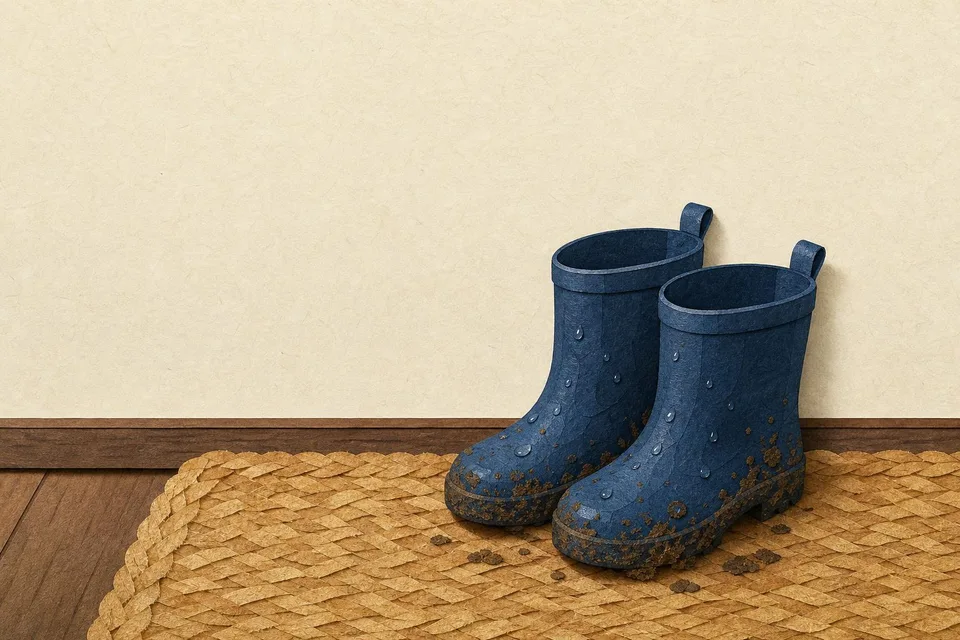
Those dripping boots make me smile because belonging can be wonderfully untidy. I like the father making space beside his own things rather than asking the child to leave every trace of the outdoors behind. This little verse would fit a note tucked into a picture book or beside a photograph of a rainy walk.
Your small boots drip rain
I leave room beside my own
Spring mud on the mat
Before You Tried
The butter softening while the letter sits on the table is the detail that stays with me. Disappointment can make a room feel suspended, even while ordinary things continue. I value the father's decision not to fetch a ready answer, and his reminder that affection was there before the application ever began.
You set the folded letter by your plate;
I watched the butter soften in the sun.
You read their answer, formal, brief, and late
And whispered that the chance you had was done.I could have fetched a saying from the shelf
A tidy phrase to turn the whole day bright.
But you had brought enough words home yourself;
You did not need a speech to set things right.I saw the care you gave from day to day
The crossed out words, the pages on the floor.
One answer cannot take that care away
Or make you less the son I loved before.So let the toast grow cold; we'll make some new.
Before you tried, my son, I treasured you.
The Mitten by the Swings
I appreciate that the father and son never find out who retrieves the mitten. The child notices something easily passed by and takes a moment to help without a thank you waiting at the end. For a father writing to a younger son, that is a particular kind of pride worth naming.
We took the long way home that day
With apples in a sack.
You saw a mitten by the swings
And asked if we'd go back.The playground gate was nearly closed;
The light was growing thin.
You laid it high upon the rail
Where someone would come in.We never saw whose hand it warmed
Or heard a thank you call.
You slipped your hand back into mine;
The dusk began to fall.
What You Want Your Son to Hear
What stays with me across these poems is the father's willingness to notice. He sees a useful idea at the workbench, effort behind an unwelcome answer, and kindness offered to someone who is not there to receive it. His affection becomes more particular because he has been paying attention.
If you are choosing a poem for your son, begin with the present moment rather than the largest possible message. A young child might enjoy the mitten story. A grown son finding his own direction may hear something important in the shared work of building a shelf. Disappointment calls for a different kind of company.
A few words of your own can sit beside the poem without explaining it. Name something you appreciate, recall a small task you enjoyed together, or say that you would like to spend an afternoon with him. One true detail often carries more warmth than several broad compliments.
Read your choice aloud before sharing it. Notice whether the promise feels like one you can keep and whether the voice feels comfortable in your mouth. You do not have to turn a quiet relationship into a grand public declaration. A folded page offered privately can be enough.
I hope the final feeling is not that a son must become someone remarkable to deserve these words. There is room here for muddy boots and cold toast, for learning and waiting, for a conversation that takes its time. Sometimes the clearest thing a father can offer is a place beside him, with nothing to prove before sitting down.
For another collection, visit Poems About Sons: Pride, Patience, and Room to Grow or Poems for a Father’s Advice and Legacy.
A book to share with your son about love and belonging
Nothing needs buying to share these poems with your son. Reading one aloud or adding a few personal words on paper is enough.
These are paid links. As an Amazon Associate I earn from qualifying purchases.
- View on Amazon
The Boy, the Mole, the Fox and the Horse
Read this story together after the poems as a gentle starting point for talking about kindness, facing fears and finding belonging.
One hardcover book
Send a little poetry to someone you love.