
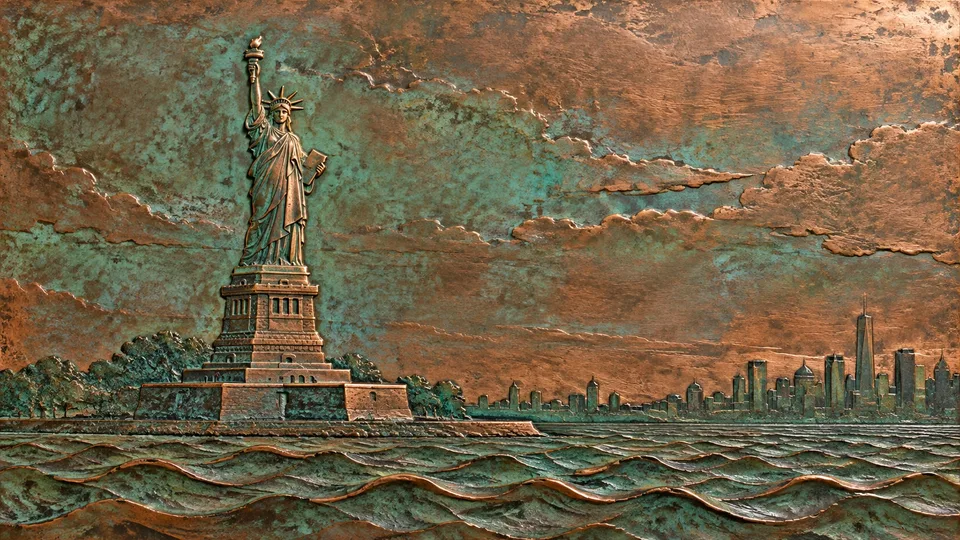
Poems about the Statue of Liberty can look up toward the torch and also look closely at the work a welcome asks of ordinary people. A monument can offer a powerful image. The question of how we treat someone arriving among us remains a living one.
For these five original poems, I used the National Park Service's account of the statue's symbols as a starting point. It identifies the torch with enlightenment, the tablet with July 4, 1776, and the broken chains near the statue's feet. The reflections and fictional encounters below are my own, rather than quotations from a historical poem or a visitor's testimony.
I am interested in the distance between a large symbol and a small action: explaining a form, learning a name, making space for someone to speak. The collection moves between the harbor view and those everyday choices.
For a more general reflection on possibility, the poems about hope offer another kind of beginning. Here, the raised light asks what we will do when we turn toward one another.
The poems
The Torch and the Work
The torch is an arresting image, but the waiting hand is what moves me most. I like the way the poem brings a public ideal down to an encounter where somebody can act.
The lifted torch stands clear against the sky;
The harbor takes the morning, green and gray.
A gull makes one white mark and passes by;
The water leaves no record of its way.
The copper figure cannot learn a name
Or hear a question asked beside a door.
We have the hands that must complete the claim
That welcome means a little something more.
A form explained, a patient pause to hear,
A place where unfamiliar words can start:
The light becomes more useful, brought this near,
A daily task, a habit of the heart.
Let symbols lift our eyes above the foam;
Let living hands help make a place feel home.
Harbor Morning
The brief flash of the gull brings movement to a very familiar silhouette. I like letting the monument share the scene with something that will not hold still.
Green torch, open sky.
One gull cuts the harbor wind.
The water moves on.
Below the Hem
The chains near the feet can be easy to miss in a distant view. I am interested in how noticing a smaller detail changes the questions a familiar image asks.
The eye climbs toward the torch.
It follows the bright idea upward.Then the gaze comes down
to the feet,
to the broken chain
near the edge of the robe.A symbol has more than one place
to begin reading.What have we passed over
because we were looking
only at the light?
A Welcome Carried Home
The imagined visitor does not return with a grand speech. I like the small connection between the harbor outing and the patient explanation offered the next morning.
She brought a postcard from the boat
And set it by the bread.
The green torch pointed toward the sky;
No other words were said.Next morning at the corner shop,
A neighbor asked the way
To fill a little printed form
That seemed to take all day.She put her parcels on the floor
And pulled a stool up near.
The postcard stayed beside the bread;
Its work had started here.
What Stone Cannot Complete
I like that this poem treats admiration as a beginning rather than a finished duty. The last turn asks the viewer to carry something practical away from the harbor.
No monument can finish what we owe
To people standing near us in the street.
A torch can lift its lesson from below;
It cannot give a tired stranger a seat.
A tablet keeps a date in copper lines;
A living day asks more than dates can say.
The harbor gathers all its moving signs;
Our choices take the welcome on its way.
We need not make the symbol small to see
The work that waits beyond the water's edge.
An open hand can offer something free;
A patient ear can help fulfill the pledge.
We leave the harbor with a thought to tend:
A welcome is a task that does not end.
A few words to carry with you
A familiar monument can become easier to see when we pause over one detail. The torch, the tablet, and the chains do different work in the statue's design. The Park Service source linked above offers that factual starting place; the poems turn from those details toward questions about welcome.
If you read one aloud, the short harbor poem gives a clear image, while the sonnets carry a longer reflection. The postcard story may be useful when you want a concrete example of someone bringing an idea into an ordinary day.
These verses do not reproduce Emma Lazarus's poem or present a fictional arrival as a documented family history. Their speakers are asking what a public symbol might mean in practice, including the gap between admiring a promise and helping it become real.
I keep coming back to the parcels set down on the shop floor. It is a modest action. Someone has decided that another person's question is worth the interruption. A large welcome begins to have a useful shape there.
A flag for the welcome she stands for
Nothing here is needed to enjoy these poems. If these poems stir your pride, this is a simple way to show it.
These are paid links. As an Amazon Associate I earn from qualifying purchases.
- View on Amazon
American Flag Made in USA
Fly this flag and share one of these poems on a patriotic day.
One 3 x 5 foot nylon flag
Send a little poetry to someone you love.