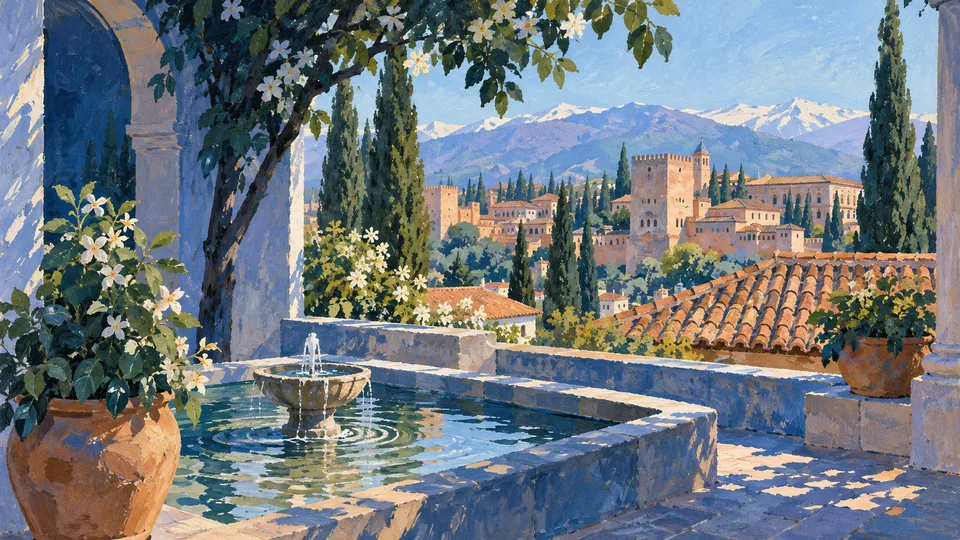
Poems about Spain can begin by admitting how much one page cannot hold. A country is more than a familiar image on a postcard, and a poem is a small act of attention rather than a complete account of a place or its people.
For these seven original poems, I have imagined individual scenes: courtyard water, a dropped orange, the shade beside a wall, an open notebook. Granada gives some of them a geographical anchor. Spain's official Granada guide describes the city at the foot of the Sierra Nevada and its fountains, gardens, and historic neighborhoods. Those are useful starting points; the speakers and events below are inventions, not memories of a journey I am claiming to have made.
I like a place poem that looks closely and leaves room for what it has not learned. A fountain can be both a real detail and an invitation to listen more carefully. It need not explain an entire culture.
The forms range from a tiny haiku to sonnets and a repeating final poem. If you enjoy close attention to landscapes and growing things, the poems about nature offer another path. Here, we begin with water moving through a courtyard and let the view widen slowly.
The poems
Water in the Courtyard
The fountain's narrow channel catches my attention before the larger view does. I like how the speaker learns to be a little less hurried by watching something that continues without an audience.
A thread of water travels through the stone,
Then gathers in the basin, clear and deep.
The shadows draw a pattern of their own;
The smallest leaves lie floating half asleep.
Beyond the wall, the afternoon moves fast;
A footstep fades, a distant engine turns.
Here, light is broken, gathered, let go past,
And nothing asks what any brightness earns.
I came with space to fill upon a page,
With names I hoped would hold a whole place still.
The water makes no claim about its age;
It slips beneath the leaf and has its will.
I leave one line unwritten, let it be
A place for what has not been shown to me.
Shade at Noon
The slice of shade feels almost tangible to me. I like the way this very small scene asks the eye to notice where the day's coolness has gathered.
White wall, narrow shade.
A small lizard keeps its place.
Noon moves past the door.
The Orange That Rolled
The orange gives strangers a reason to help one another without turning them into representatives of a country. I like the simple action, especially the final return of the fruit to the bag.
An orange slipped a paper bag
And rolled toward the street.
A woman caught it with her shoe
Beyond the passing feet.She lifted it and brushed it clean;
The owner laughed and bowed.
A second orange threatened flight;
They caught it in the crowd.The bag was folded twice this time;
The crossing light turned green.
The day moved on, but left behind
One small, complete, kind scene.
Stone Above the City
I like the pause in the middle of this poem, where looking becomes different from claiming to understand. The speaker can appreciate the stone and still admit that much of its history remains unread.
The hillside holds its stone against the light;
Below, the roofs descend toward the stream.
A wall can keep the edges of a dream
Without explaining all it guards from sight.
I watch the swallows make their quick, dark flight
And leave my easy phrases at the seam
Between the thing I see and things that seem
Too large to fit inside a word like bright.
There will be names and histories to learn,
And other voices speaking of this view.
I leave a little room for them to show
What patient eyes and open questions earn.
The stone stays stone; the passing day stays new.
I close the book with something left to know.
A Map With Room Left
The blank margin is the detail I keep returning to. I like a map that can guide a traveler without pretending the named places are all there is.
I can find the city on a map.
I cannot find
the woman choosing a pear,
the bicycle left by a blue door,
the reason a window opens
at that exact hour.The map is useful.
So is the part it cannot give me.I leave room in the margin
for a name I have not learned.
After the Fountain
The change from a public courtyard to a private page feels gentle to me. I like that the water continues in the speaker's attention after the immediate scene has ended.
I turn the page and find a drop of rain.
It spreads a little circle through the dust.
The fountain keeps its narrow, silver thread
Beyond the wall, beyond this borrowed view.
I have not brought the city to a close.
I only stopped and listened for a while.
A sound can leave more room than any name;
The open page receives what passes through.
Leave Space for What You Do Not Know
The recurring line works like a reminder written to the speaker rather than advice delivered to a whole country. I like its humility, and the way the view remains larger than the notebook.
Leave space for what you do not know.
A fountain loosens threads of light.
Let water teach the page to flow.The narrow shadows lengthen slow;
A roof grows copper, then turns white.
Leave space for what you do not know.The names you learn have roots below
The little scene you hold in sight.
Let water teach the page to flow.An open window, voices low,
The passing blue of coming night:
Leave space for what you do not know.No single painted view can show
A city in its living height.
Let water teach the page to flow.Set down the claims you brought to sow;
Attend to what is here tonight.
Leave space for what you do not know.
Let water teach the page to flow.
A few words to carry with you
The courtyard, the orange, and the unfinished map are small subjects. That is deliberate. A place poem can become more welcoming when it gives a reader one clear detail instead of trying to gather a country into a handful of familiar symbols.
If you read these aloud, try giving the short pieces their own pauses. The fountain and the repeating final lines move at different speeds, and that difference is part of the collection's shape. You might notice which scene makes you want to look more closely at an ordinary thing near you.
The factual setting and the imagined moments should remain distinct. The Granada guide linked above can help locate some of the landscape; it does not document the fictional orange, the speaker's notebook, or the thoughts beside the water. Those belong to the poems.
Readers who know these places will bring experiences and knowledge far beyond this page. I like leaving space for that larger life, including the details a visitor might never notice and the stories a resident might tell differently.
Perhaps that is the useful habit to carry away: to look carefully, make modest claims, and stay curious. The notebook does not have to be filled to prove that the afternoon mattered. Sometimes an open margin is an honest part of the work.
For your journey through Spain
These poems can take you there from your chair. If you are traveling, these are good to pack.
These are paid links. As an Amazon Associate I earn from qualifying purchases.
- View on Amazon
Essentials Dot Matrix Notebook
Keep notes on water and stone beside your favorite line.
One A5 hardcover notebook, 192 dot grid pages, 5¾ × 8¼ inches
- View on Amazon
Our Adventure Book Scrapbook
Bring home photographs and ticket stubs and give them a place to stay.
One scrapbook photo album
Send a little poetry to someone you love.