
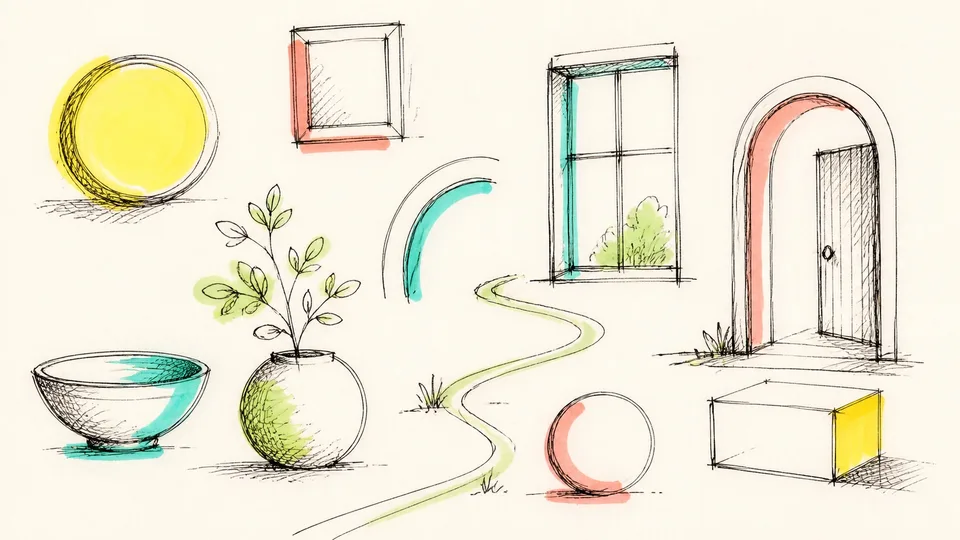
Shapes are everywhere once we slow down enough to see them. A circle can be a plate, a moon, or a family gathered close. A line can be a road, a sentence, or a boundary that teaches us where one thing ends and another begins.
These poems about shapes include two sonnets, free verse, a villanelle, and a haiku. The collection is playful enough for a classroom and thoughtful enough for a journal. It invites readers to notice how form can hold memory without locking it in place.
I have always enjoyed the geometry of ordinary rooms. A window makes a bright rectangle on the floor, a spoon curves beside a bowl, and a shadow changes its outline as the day moves. If you enjoy poems about visual attention, you may also like these poems about fashion and these poems about footprints.
Poems About Shapes
The Shape of a Day
This Shakespearean sonnet uses an ABAB CDCD EFEF GG pattern. It follows a day from the first rectangle of morning light to the roundness of evening, showing how time gives familiar forms new meanings.
The morning makes a rectangle of light,
Across the floor where yesterday was dust,
A cup becomes a circle, warm and bright,
A spoon keeps one small curve because it must.The noon is broad, a line of open road,
The afternoon bends softly toward the west,
We carry every shape of every load,
Then set them down to give the heart a rest.At dusk, the window turns a darker square,
The moon makes room for silver on the pane,
The day has changed its outline in the air,
Yet leaves its quiet measure in the brain.A life can change its form and still be true,
Like light that finds a different shape in you.
A Line, Then a Door
This free verse poem uses a few simple shapes to describe a choice. Its line breaks make the movement from boundary to welcome visible on the page.
I draw a line
around the thing I cannot carry.Then I draw a door
in the line.The door does not erase the boundary.
It teaches the boundary
how to open.
Circles in the Margins
This second sonnet follows an ABBA ABBA octave and a six line resolution. It treats circles in old notes as signs of attention, worry, and the possibility of returning to a question with more kindness.
The circles in the margins still remain,
Around a word I could not understand,
Around a date I held within my hand,
Around the line that sounded like a pain.I read the page and find no need to feign
A perfect answer written where I stand,
The ink has made a map of what I planned,
Then left a room for wonder in the stain.A circle can be shelter, not a chain,
A way to bring a scattered thought back near,
A mark that says I looked at this again,
And found a different shape when I came here.The page is full, yet still it lets me start,
A little margin opening the heart.
The Forms We Return To
This villanelle uses nineteen lines, two repeated refrains, and two rhyming sounds. The refrains return like familiar shapes in a life, while the changing middle lines show that repetition can still lead somewhere new.
We find the forms that help us make a way.
A circle holds the pieces we can keep.
The old shape opens differently each day.A road repeats the turn, yet not the day,
A window frames a sky that will not sleep.
We find the forms that help us make a way.A child draws houses where the shadows play,
A hand makes room for one more chair to keep.
The old shape opens differently each day.The line we feared can soften into clay,
The square can hold a garden growing deep.
We find the forms that help us make a way.No shape is finished simply because it stays,
No boundary needs to be a wall or gate.
The old shape opens differently each day.I draw one door beside the word “obey,”
And let the unmarked paper breathe and sleep.
We find the forms that help us make a way.
The old shape opens differently each day.
Moon in a Small Bowl
This haiku finds a moon shape in a bowl of water. Its five, seven, five syllable pattern makes the image suitable for a short art prompt or a child's nature note.
Moon in a small bowl
Water holds a silver face
Night fits in two hands
Letting a Shape Change
Shapes help us notice structure, but they do not have to become rules. A circle can widen, a line can bend, and a door can be added to a boundary. The forms we inherit can become more generous when we look at them again.
Use The Shape of a Day for a lesson about observation or change. A Line, Then a Door fits a note about healthy boundaries, while Circles in the Margins belongs to a writer or reader returning to an old page. The villanelle can accompany a group reflection, and Moon in a Small Bowl is a small invitation to look.
If you share one of these poems, draw the shape that belongs to your day. It might be a plate, a road, a window, or the curve of a familiar shoulder. A real shape gives an abstract thought somewhere to stand.
We are shaped by rooms, roads, habits, and people, but we are not trapped by the first outline. There is always a margin, a hinge, or a little open sky. Let your next line have room to change.
Useful supplies for drawing the shapes you notice
Use a pencil and a spare page first. If you want to add color to the drawing suggested in the article, use crayons you already have.
These are paid links. As an Amazon Associate I earn from qualifying purchases.
- View on Amazon
Crayola Crayons
Draw the plate, road, window, or other shape that belongs to your day, then add the colors you noticed.
Two boxes of 24 crayons, 48 crayons total
- View on Amazon
Astrobrights white cardstock
Draw circles, lines, or other shapes on a sturdy page, then write a short description beside them.
75 white U.S. Letter sheets, 8½ × 11 inches, 65 lb
Send a little poetry to someone you love.