

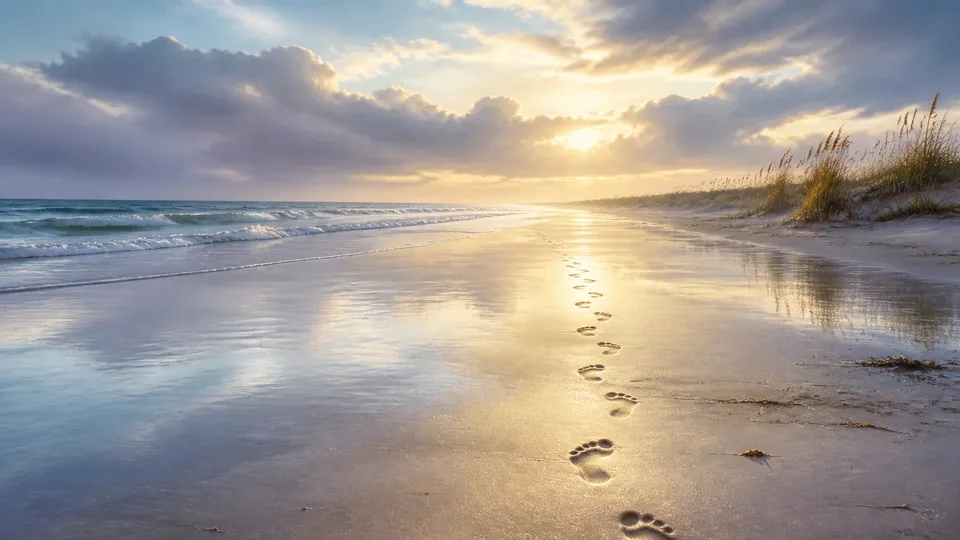
Footprints are temporary marks with a lasting way of making us wonder. A shoe presses into wet soil, a child crosses a room in flour, or a line of steps appears along a beach and disappears with the tide. The mark says someone was here, but it does not tell the whole story.
These poems about footprints consider both the paths we have taken and the traces we leave in other people. Two sonnets offer formal reflection, blank verse follows a measured walk, a villanelle returns to the shoreline, and a haiku keeps one small mark in view. Together they make room for movement, memory, and the fact that no path stays unchanged forever.
I like the humility of a footprint. It is evidence without being a monument. It can be softened by weather, joined by another step, or erased completely while the journey still matters. We do not need to leave a permanent mark to have made a difference.
If you are thinking about memories and the details that remain, these poems about memories may speak to you. For another collection about the act of moving through the world, try these poems about walking.
Poems About Footprints
The Path Behind the House
This Shakespearean sonnet follows a familiar path through changing seasons. Its fourteen lines use an ABAB CDCD EFEF GG rhyme pattern. The closing couplet turns the footprints into a form of gratitude rather than ownership.
The path behind the house begins in rain,
Each footprint darkens softly in the clay,
A child runs out and runs back in again,
Then leaves a trail of summer through the day.The years replace the shoes, the gate, the fence,
The path grows thin beneath the taller grass,
Yet every step retains a little sense,
Of all the selves that learned to leave and pass.I walk there now with slower, careful feet,
The evening gathers silver on the ground,
No mark remains where childhood used to meet,
But something kind is waiting in the sound.The road goes on beyond what eyes can see,
And every vanished step still carried me.
Measured Steps
This blank verse poem uses unrhymed lines with a steady, measured rhythm. It follows a speaker who lets walking become a way of listening. The lack of end rhyme keeps the path open.
I walk before the morning finds its name.
The sidewalk holds the silver from the rain.
My steps are not a race toward any door.
They give the quiet room to speak its truth.
A sparrow lifts, a truck turns down the street.
I learn the day by what it does nearby.
The body knows a road before the mind.
I return with less demand for proof.
The Sand Takes Every Name
This second sonnet uses an ABBA ABBA opening and a six line resolution. The beach erases footprints without erasing the people who made them. The poem holds impermanence as a natural part of love.
The tide will take the footprints from the sand,
The careful heel, the small and wandering toe,
The line of two that walked where grasses grow,
And smooth the shore with one unanswering hand.No mark can make a moment understand,
Or keep a summer afternoon from flow,
Yet while we walked, the sea was bright below,
And salt wind carried music over land.I do not need the shore to hold us still,
The body leaves, the memory remains,
A vanished path can keep a living will,
A little light can travel through the rains.The tide erases what the sand has known,
But not the love that made the walk our own.
Return to the Shore
This nineteen line villanelle uses two refrains and two rhyming sounds. Repeated lines echo the tide's return and the speaker's recurring memory. The form is intentionally circular, with no need to force a final answer.
The tide returns to soften every trace.
I find your footprints where the water shines.
The shore keeps changing, yet I know this place.A gull lifts white above the open space.
The wind unthreads the edges of the lines.
The tide returns to soften every trace.I bring a question, not a claim of grace.
The sand receives the shape, then realigns.
The shore keeps changing, yet I know this place.We walked where foam had made a silver lace.
The late sun warmed the ordinary signs.
The tide returns to soften every trace.I speak your name, then give the shore its space.
The waves move on, the day declines.
The shore keeps changing, yet I know this place.I leave with salt and quiet on my face.
The path is gone, but something still inclines.
The tide returns to soften every trace.
The shore keeps changing, yet I know this place.
One Print in the Mud
This haiku holds one small mark after rain. It uses a checked five, seven, five syllable pattern. The image is brief, but it opens a question about who passed by and where they went.
One print in the mud
Rain fills the shape with cloudy light
Road bends out of sight
What a Footprint Means
A footprint is not a measurement of a person’s worth. Some paths are long, some are interrupted, and some are taken quietly where no one else notices. The marks we leave may be practical, emotional, or almost invisible. A kind question can be a footprint. So can a lesson, a recipe, a song, or the courage someone borrowed from us for one afternoon.
The Path Behind the House is for a familiar place that has changed with you. Measured Steps suits a morning when you need to move without solving everything. The Sand Takes Every Name belongs to a beach or a season of release. Return to the Shore is for memories that arrive in cycles, and One Print in the Mud can fit a small note about a new direction.
When you read these poems, notice which marks you are following and which you are making. You do not need to turn every experience into a legacy. It is enough to walk with care, to leave a place kinder than you found it when you can, and to understand that even an erased path may have carried someone toward home.
The next rain will change the ground. Another person will cross the road. The story will keep moving beyond the place where we can see it. That is not a failure of memory. It is the generous fact that a life can continue after one set of footprints disappears.
Send a little poetry to someone you love.