

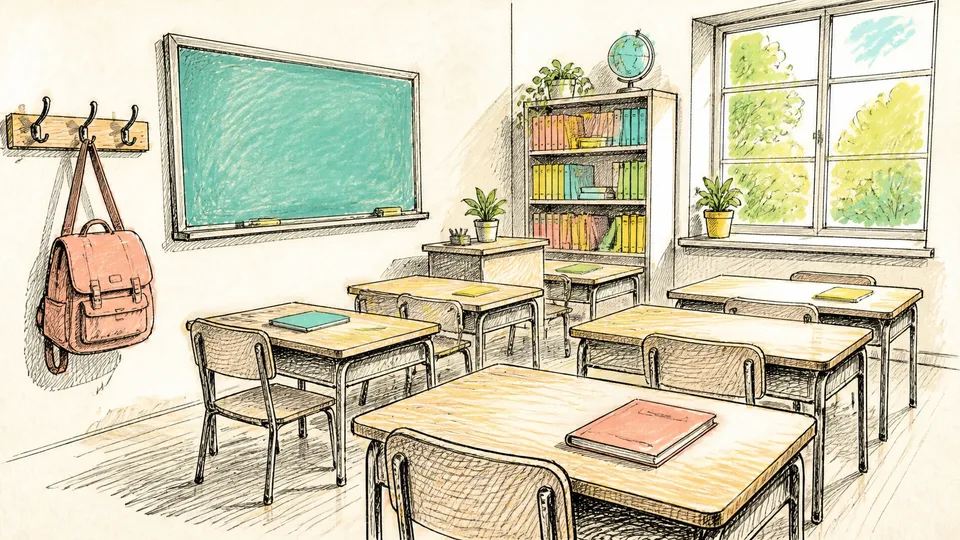
Schools are rooms full of beginnings. A clean board, a row of desks, a book waiting on a shelf, and the first question of the morning can all carry the feeling that something is about to open. Learning does not happen only in the loud moments. It also grows in pauses, mistakes, patient explanations, and the courage to raise a hand.
These poems about schools include two sonnets, free verse, a haiku, a ballad, and blank verse. They honor students, teachers, custodians, families, and all the ordinary workers who make a school feel ready. The poems may be useful for a classroom reading, a thank you note, a graduation memory, or a quiet reflection on the places that helped shape you.
I remember the particular hush of a classroom before the first arrival. Chalk dust rested near the board, morning light found the desks, and the room seemed to hold a promise without making a speech. Later, working in education, I learned that a good question could change the whole temperature of a day.
Every school is different, and not every student experiences school in the same way. These poems leave room for that truth. They focus on welcome, curiosity, effort, and the people who help a learner feel that there is a place for their voice.
If you are writing for a teacher, these poems for teachers may offer another path. For readers who find their best thinking in quiet pages, these poems about reading and poems about books may keep the conversation going. I hope one of these school rooms feels familiar in a good way.
Poems About Schools, Questions, and Belonging
Before the Bell
The empty classroom in this poem feels full to me, even before anyone enters. I notice the pencil pausing beside a name, because a small object can suggest a whole student waiting to be known. This sonnet may suit a teacher who wants to remember that preparation is also a form of welcome.
Shakespearean sonnet
Before the bell, the empty room is clear,
The chairs make quiet circles on the floor,
A square of morning gathers bright and near,
While dust turns slowly by the open door.
The board waits clean, the books lean in a row,
A pencil rolls and pauses by a name,
The teacher checks the windows’ steady glow,
And trusts that every question will find flame.
One child brings a question in each hand,
Another carries weather from the street,
One draws a river no one else had planned,
One finds a hard word and makes it sweet.
A school becomes the place where we can grow,
Because a listening heart says, “You can know.”
The First Question
I like the turning point in this poem, when a question changes the room instead of interrupting it. The child’s uncertainty is treated as an invitation, and that is one of the most generous things a teacher can offer. Keep this one for a classroom celebration or for a student who needs to hear that curiosity belongs here.
Free verse
The first question is small,
almost hidden under a sleeve.It asks about the moon,
then the creek,
then why a word has two doors.The teacher does not hurry past it.
She draws a circle,
leaves room around the answer,
and watches the whole class lean closer.
Chalk Dust
The chalk dust gives this haiku a soft, old fashioned classroom feeling without naming a particular year. I see the waiting desks and the books opening like doors, and I love how the image makes learning feel active before a lesson has even begun. These lines would fit neatly in a note to a teacher or on the first page of a school journal.
Haiku
Chalk dust warms the air
Sunlight finds each waiting desk
Books open like doors
The Long Hallway
This ballad follows a student who feels lost in a long hallway and discovers that belonging can begin with one familiar voice. I notice how the school becomes less imposing through small details, such as a bright window and a shared pencil. That gentle shift may help anyone remembering a first day, a move, or a season of learning how to enter a new place.
Ballad
The hallway seemed a river,
The doors were wide and tall,
A child held tight to one blue book
And listened for a call.A teacher by the window smiled,
Then moved a chair aside,
She showed the room a little map
And walked there by his side.At noon he knew the drinking tap,
The garden and the bell,
A friend shared half a yellow pencil,
And soon the place felt well.The hallway stayed a hallway,
The doors stayed wide and tall,
But now one voice, one open chair,
Had made a home of all.
After the Students Leave
The paper sun and the question about changing words are the details I carry from this poem. I like the idea that a lesson can remain in a room after the voices have gone, not as a perfect answer but as a new possibility. It is a fitting piece for a teacher at the end of a long day or for anyone who wonders what quiet work has mattered.
Petrarchan sonnet
The hallway holds the echo of their feet.
A paper sun still hangs beside the door,
The evening settles softly on the floor,
While quiet gathers where the voices meet.
I stack the books and leave the pencils neat,
One question follows me from near the end,
A child had asked if every word could bend,
And make a difficult beginning sweet.
I said that words can open what was closed,
A patient sentence may become a key,
A listening room can help a thought be posed,
And give a learner room enough to see.
Tomorrow brings another lighted hall,
A waiting heart can find its place in all.
What School Rooms Give Us
The best school memories are often made from details that seem ordinary at the time. A particular desk, a helpful classmate, a teacher who waited, or a book opened at the right hour can become part of the way we understand ourselves. Learning leaves more than information behind. It leaves habits of attention and the memory of being invited to try.
“Before the Bell” honors the preparation that students may never see. “The First Question” is a warm choice for a child who is still finding confidence, while “Chalk Dust” can brighten a short thank you. “The Long Hallway” belongs to new beginnings, and “After the Students Leave” recognizes the quiet labor that continues after the room is empty.
When you share a school poem, add a real detail if you can. Name the tree outside the window, the color of the classroom door, the book that changed your mind, or the person who explained something one more time. A small detail helps a reader feel remembered rather than addressed in general terms.
School can be joyful, difficult, noisy, lonely, exciting, and ordinary, sometimes all in one day. These poems do not try to smooth every experience into a simple lesson. They make room for effort and uncertainty while holding on to the possibility that a patient room and a listening person can matter greatly.
Even after we leave school, we keep learning how to ask better questions. We learn from family tables, worn books, weather, work, and the people who show us a new way to look. May every reader find one welcoming door, one useful question, and enough room to grow.
Send a little poetry to someone you love.