
Poems about roses need not begin with a bouquet or a declaration of romance. A rose can be a tight bud after rain, an awkward cane leaning over a path, or a hip left after the flower has finished. I wanted these seven original poems to spend time with the growing plant and its changing shapes.
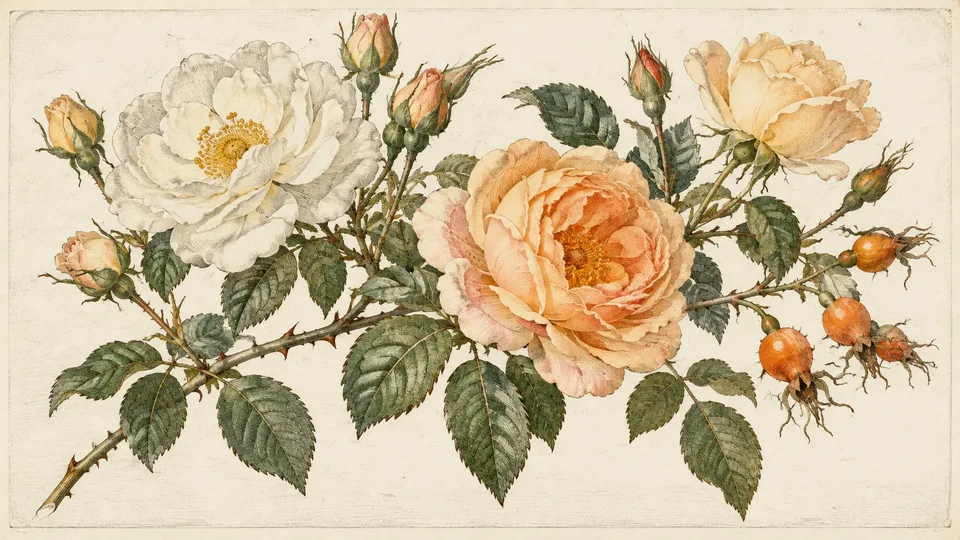
There are many familiar meanings attached to roses. This collection leaves those meanings open. A white bloom is allowed to be white, an apricot bloom its own color, without making either carry a secret message the reader must decode. Sometimes looking closely is already a satisfying way to love a flower.
The poems move from a tiny rain scene to the root beneath the surface, then through a garden story and a few reflections on what remains after petals fall. Their speakers are imagined observers rather than voices offering a guide to pruning or plant care.
If you are looking specifically for the romantic red flower, the poems about red roses take that different path. Here, we can pause by a rose at any stage of its growing. I like the untidy whole of it: leaves, canes, fading flowers, and the small green beginnings that do not yet look like much.
The poems
A Bud in the Rain
The closed bud keeps its own timing, which I find quietly pleasing. The little verse gives it attention before there is an open flower to admire.
Rain on a closed bud.
One drop gathers at the tip.
No hurry to bloom.
The Root Beneath the Rose
I notice the contrast between the flower everyone can see and the hidden work beneath it. The poem lets that difference remain physical before turning it toward a human thought.
We praise the rose that opens into view,
The lifted cup, the delicate, pale seam.
We watch a petal deepen from its blue
Of morning shade into the noon's warm gleam.
Below the surface, where no eyes can see,
The root has made its slow way through the ground.
It spreads beneath the leaves of bush and tree,
And makes a living where no praise is found.
I think of all the work we do unseen,
The notes revised, the daily care we give.
A flower holds more life than one bright sheen;
The hidden things make room for it to live.
I leave the root its darkness and its due,
And see the flower with a wider view.
The Bent Cane
The gardener changes the route instead of making the whole morning about one inconvenient branch. I like the little accommodation and the way it lets someone else see the flower from a new angle.
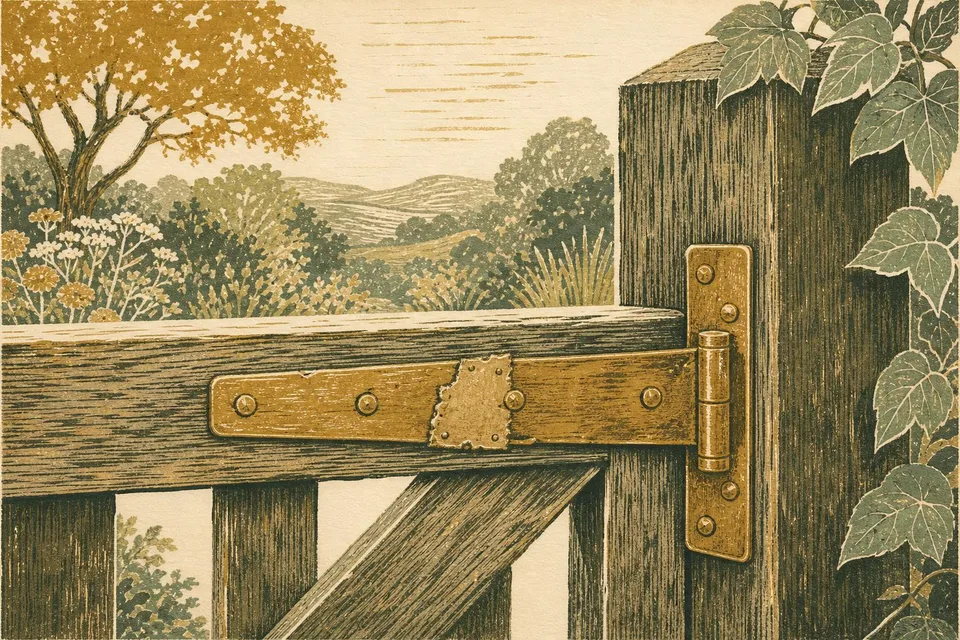
A rose cane leaned across the path
And brushed the garden gate.
The gardener stopped with string in hand,
Then paused a while to wait.A child had found a little bloom
Beneath the leaning spray.
She bent to see its apricot
And called him from the way.He tied the cane a little higher,
And moved one stepping stone.
They left a narrow place to kneel
And see the bloom alone.
Colors Without a Code
The vase can be pleasing without becoming a puzzle. I like the freedom of choosing a color because it catches the eye, with no larger message required.
The white rose is white
because that is the bloom
I stopped to look at.The peach one leans
toward the open window.I have not arranged
a secret alphabet.Some days the world
does not need decoding.
I put the flowers in water
and enjoy the colors.
After the Petals
The fallen petal keeps its color for a little while, which gives the poem a gentler turn than a simple ending. I like the attention given to the plant that remains.
A petal falls and settles on the stone;
The branch lifts slightly, lighter than before.
The flower's open summer has been shown;
It need not keep that shape forevermore.
The leaves remain, the thin green canes extend;
The day goes on around the loosened bloom.
Not every lovely thing must be an end
That fills the whole horizon of the room.
I watch the color resting near my shoe,
Then lift my gaze to where the branches meet.
The plant has more than one good thing to do,
More than one way to make the season sweet.
I leave the petal where the light has lain,
And see the whole rose standing after rain.
The Rose Hip
The change in scale is what I enjoy: the showy flower has given way to a small, firm shape. The observer has to adjust their attention rather than ask the plant to repeat itself.
The flower has left a small, firm globe behind.
It holds the orange of a lower sun.
I nearly passed it, looking for the bloom,
Then stopped beside the bare and branching cane.
The thing I came to see was no more there;
Another shape had taken up the light.
I gave the little globe a moment's room,
And left the stem untroubled by my hand.
Leave Something for the Morning
The returning line makes the speaker sound as though they are reminding themselves to be patient. I like ending the garden walk with something still unopened.
Leave something for the morning light.
The closing gate puts work away.
The folded bud can wait tonight.A petal falls past flowers white;
The canes have cast long shades of gray.
Leave something for the morning light.The last bee ends its wandering flight
And takes another narrow way.
The folded bud can wait tonight.The garden loosens from my sight;
Its colors take their leave today.
Leave something for the morning light.I need not gather each delight
Or make the smallest flower stay.
The folded bud can wait tonight.The path has dwindled out of sight.
I let the evening have its say.
Leave something for the morning light.
The folded bud can wait tonight.
A few words to carry with you
The garden in these poems changes as you move through it. A closed bud, a root, an open flower, and a rose hip ask for different kinds of attention. None needs to be the final or most important version of the plant.
That is what I wanted the collection to hold: a rose with a life beyond its moment in a vase. There is room for a lovely bloom, but also for a branch that leans inconveniently and a flower that has already let its petals go. The small adjustments of looking can become part of the pleasure.
Choose the rain haiku if you want a brief pause. The bent cane offers a little story; the root sonnet looks beneath what is immediately visible. The repeating final poem may suit an evening reading, when leaving something unfinished can feel like a kindness rather than a failure.
These are observations and imagined scenes, not instructions for tending a particular rose. A garden has practical needs of its own, and a poem's job here is simply to notice.
I like the image of a stepping stone moved a little to one side. It allows the visitor to look from a different angle without asking the flower to become anything else. Sometimes a small change in where we stand is enough to reveal another part of what we came to see.
Writing about roses
Nothing here is needed to enjoy these poems. If you want to draw or write about a rose yourself, these can help.
These are paid links. As an Amazon Associate I earn from qualifying purchases.
- View on Amazon
Prismacolor Premier Colored Pencils
Try to catch the color of one bloom beside your favorite poem.
One set of 24 soft core colored pencils
- View on Amazon
Mont Marte Calligraphy Set
Letter a favorite line and give it with a fresh flower.
32 piece set
Send a little poetry to someone you love.