

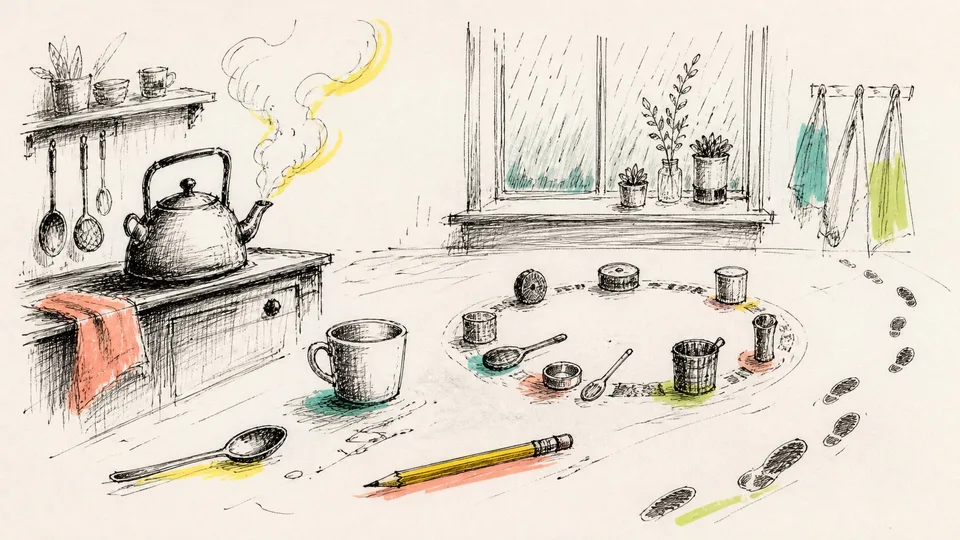
Rhythm is not limited to a drum or a song. It lives in footsteps, breathing, dishes, rainfall, and the repeated work that gives a day its shape. A rhythm can steady us, surprise us, or help us notice when something needs to change.
These poems about rhythm include two sonnets, a haiku, a villanelle, and blank verse. They are for musicians, dancers, teachers, workers, and anyone who finds meaning in the patterns that keep returning.
I have always noticed rhythm in a classroom before I notice silence. Pencils move, pages turn, chairs shift, and a question changes the pace of the room. You may also enjoy these poems about dancing and these poems about motion.
Poems About Rhythm
The Rhythm of the Kitchen
This Shakespearean sonnet uses an ABAB CDCD EFEF GG rhyme pattern. The kitchen's repeated sounds become a music of care, ending with the idea that shared work can make a home feel alive.
The kitchen keeps a rhythm of its own,
A knife taps twice, the kettle starts to sing,
A wooden spoon makes circles in the stone,
And plates reply to every little thing.The morning steps are measured by the floor,
The cupboard opens, closes, opens wide,
A child calls out, a neighbor knocks the door,
The room makes space for every beat inside.We do not need a concert or a stage,
The day can find its music in the grain,
A careful hand can turn a crowded page,
A steady heart can keep time through the rain.The rhythm changes, yet the house can start
A simple song that gathers every heart.
Footsteps in the Hall
This haiku notices the rhythm of a house waking. Its five, seven, five syllable pattern keeps the sound close to the body and the floor.
Footsteps cross the hall
Morning gathers one by one
The house finds its beat
The Meter of a Life
This second sonnet follows an ABBA ABBA octave and a six line resolution. It considers a life as a changing meter, where pauses and uneven measures can still belong to the music.
The meter of a life is not a line
That keeps one pace from morning into night,
It stumbles, rests, then gathers up its light,
And finds a different measure in its time.
A pause can hold the place where words decline,
A breath can make the next true phrase take flight,
A heart may lose the rhythm it called right,
Then learn a softer pattern by design.
I do not need to dance each beat I hear,
Or make the silence answer to my hand,
The life I have can keep a rhythm clear,
By changing when a change is what I need.
The song grows honest when the pauses stay,
And lets the quiet have its proper say.
Keep the Beat, Keep the Door
This villanelle uses nineteen lines, two repeating refrains, and two rhyming sounds. Its repeated lines connect daily rhythm with the welcome of a door that remains open to change.
Keep the beat, keep the door, let the morning in.
A steady step can carry a changing heart.
The song begins wherever we begin.
A spoon, a shoe, a pencil, and a grin,
Each finds its place before the day can start.
Keep the beat, keep the door, let the morning in.
The rhythm breaks, then gathers once again,
A pause can be the first part of the art.
The song begins wherever we begin.
We do not need to know where every beat will spin,
We need a hand, a breath, a willing part.
Keep the beat, keep the door, let the morning in.
The room grows wide when listening can begin,
The old refrain makes room for a new chart.
The song begins wherever we begin.
I tap one finger on the kitchen tin,
And let the day make music from the start.
Keep the beat, keep the door, let the morning in.
The song begins wherever we begin.
The Worker's Measured Morning
This blank verse poem follows repeated work without making it feel mechanical. Its unrhymed, measured lines notice the dignity of a rhythm chosen and sustained.
The worker ties the apron, checks the clock.
The first machine begins a patient hum.
A broom makes long strokes underneath the light.
The body learns the order of the room.
Yet one small song can change the pace of work.
A window opens, and the air comes in.
The measured morning leaves a little space.
A person is more than the task at hand.
The rhythm serves the life, not life the rhythm.
At noon, the worker steps outside to breathe.
Finding a Rhythm That Fits
Rhythm can be comforting, but no pattern deserves to become a cage. A healthy rhythm leaves room for rest, interruption, and the new beat that a changing season may require.
Use The Rhythm of the Kitchen for a family or cooking reading. Footsteps in the Hall is a small morning note, while The Meter of a Life suits a reflection on change. The villanelle belongs to a group or journal, and The Worker's Measured Morning honors practical effort.
If you share one of these poems, name the sound that carries your day. It might be a kettle, a pencil, a shoe, a machine, or rain on a roof. Real rhythm begins with listening.
The beat will not always be steady. That is part of being alive. Keep the pattern that supports you, change the one that no longer fits, and leave a little silence for the next honest note.
Send a little poetry to someone you love.