

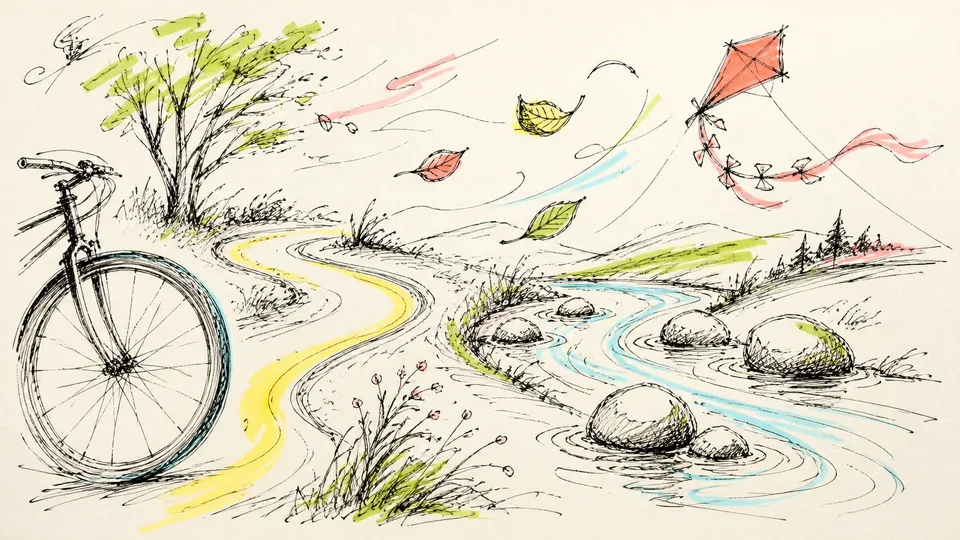
Motion can be dramatic, like a train leaving a station, or so small that we almost miss it. A hand reaching for a cup, a curtain breathing at an open window, or a river working around a stone all remind us that stillness is only one part of a life.
These poems about motion hold several kinds of movement together. You will find two sonnets, a short ballad, a haiku, and free verse. The poems are for readers who are beginning again, traveling toward an uncertain place, or learning that progress can be measured in small changes.
I often think of a classroom before the students arrive. The chairs are still, but the room is already waiting for voices, questions, and the turning of pages. If you want another collection about movement through the world, try these poems about road trips or these poems about dancing.
Poems About Motion
A Wheel on the Road
This Shakespearean sonnet uses the turning wheel as an image of steady change. It has fourteen lines in an ABAB CDCD EFEF GG pattern. The final couplet suggests that motion can carry memory rather than erase it.
A wheel turns silver underneath the sun,
It finds the road by yielding to the stone,
The miles divide, yet still the miles are one,
And every distant place can lead us home.I watch the fields move backward through the glass,
A fence post blinks, a cloud begins to run,
The present does not ask the past to pass,
It rides beside me, warmed by evening sun.We change by leaving, and by choosing where
To stop and listen when the road grows wide,
The heart may carry more than it can bear,
Then set one old regret beside the side.The wheel keeps turning, faithful to its art,
And makes a moving room inside the heart.
The Red Kite
This ballad tells a small story about a child who loses a kite and finds a new sense of trust. Its song like movement uses repeated sounds and a clear beginning, middle, and turn.
A red kite rose above the schoolyard fence,
Its tail wrote commas in the air.
The child held tight, then felt the line grow tense,
And lost the kite to weather there.It crossed the roof, it crossed the tree,
It tugged against the blue.
The child stood still, then laughed to see
The sky had room to hold it too.A teacher tied a new string on,
And showed the child the breeze.
Some things we love must travel on,
While some return with ease.
What the River Teaches
This second sonnet follows a Petrarchan design with an ABBA ABBA octave and a six line resolution. The river offers a picture of motion that bends around obstacles without losing its direction.
The river does not argue with the land,
It turns where roots and fallen branches lie,
Then gathers up the loosened bits of sky,
And carries them in one unbroken hand.I bring my plans and watch them change their strand,
A careful map grows softer by and by,
The road I feared becomes a road nearby,
The life I have can still be freely spanned.No current keeps the shape it held before,
Yet every bend belongs to what it knows,
The water leaves, then finds another shore,
And teaches patience to the stone it flows.I need not force the future to agree,
I can keep moving and still remain me.
Shoes Across the Floor
This haiku notices the smallest motion in a home. It follows a five, seven, five syllable pattern and lets a familiar sound carry the emotion.
Shoes cross the quiet floor
Morning opens one window
Dust turns in gold light
Small Motions
This free verse poem treats ordinary gestures as evidence that a life is still unfolding. The short lines leave space around each action, like a pause between one breath and the next.
A spoon lifts soup.
A page turns.
Someone waters the basil
though the week has been hard.The hand that reaches
is already a kind of hope.
Moving Without Losing Yourself
Motion does not always mean speed. Sometimes it means allowing a feeling to change shape, letting a plan become more honest, or taking one step after a long rest. The smallest movement can be the beginning of a whole new direction.
Choose A Wheel on the Road for a farewell, a journey, or a season of transition. The Red Kite is gentle enough for a child, while What the River Teaches may suit a person who is learning to live with an unexpected turn. Shoes Across the Floor belongs to a quiet morning, and Small Motions can be shared when encouragement needs to be simple.
If you adapt one of these poems, add the motion that belongs to your own story. It might be a suitcase closing, a gate opening, or a hand reaching across a table. Real details give movement a human scale.
We do not have to know the whole route before taking the next step. A wheel, a river, a kite, and a pair of shoes all know something about beginning again. Let the next small motion be enough for today.
Send a little poetry to someone you love.