

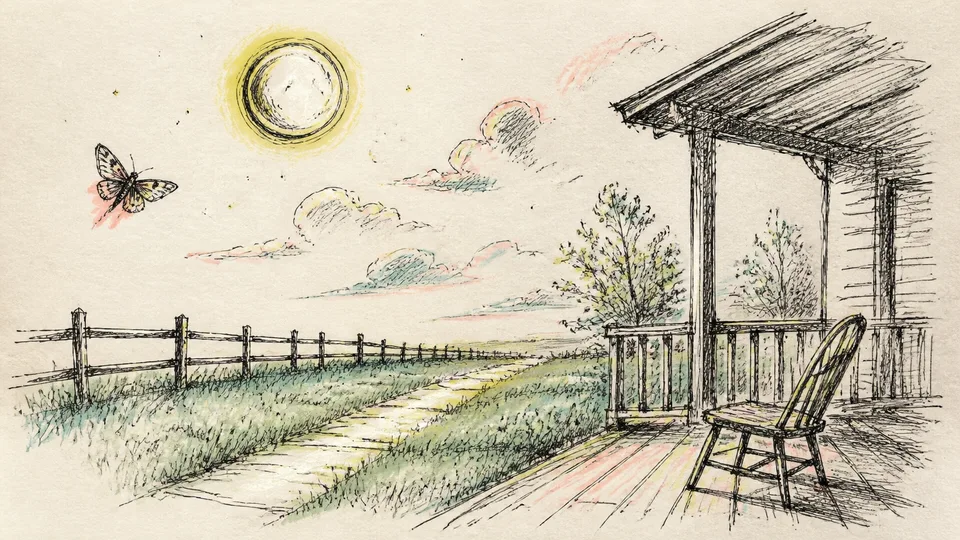
The moon is familiar enough to greet and distant enough to remain mysterious. It changes shape without losing its place, and its light can make a road, a roof, or a quiet face look briefly new.
These poems about the moon include two sonnets, a villanelle, blank verse, and a haiku. They are for bedtime, a night walk, a classroom about the sky, or anyone who needs a small companion for the darker hours.
I have always liked the moon as a patient witness. It does not hurry a person into cheerfulness. It simply gives the eye another way to find the edges of a world. You may also enjoy these poems about the elements and these poems about sleep.
Poems About Moon
The Moon Above the Fence
This Shakespearean sonnet uses an ABAB CDCD EFEF GG rhyme pattern. The moon watches an ordinary yard while the speaker learns that night can hold rest instead of fear.
The moon above the fence is thin and bright,
It lays a silver road across the grass,
A moth turns slowly through the patient night,
While clouds make room and let the quiet pass.I close the gate, then stand beside the tree,
The day's old questions waiting in my hand,
The moon does not demand an answer of me,
It only makes the familiar land more grand.A roof, a path, a chair, a sleeping door,
Become enough to hold a human thought,
I do not need the dark to give me more,
I need to see the kindness it has brought.The moon keeps shining, faithful to its art,
And leaves a little lantern in the heart.
The Moon Returns
This villanelle uses nineteen lines, two repeating refrains, and two rhyming sounds. Its returning lines echo the moon's phases and the way a question can come back with a kinder answer.
The moon returns above the sleeping street.
Its borrowed light makes every window glow.
The night can hold the heart and keep it sweet.A late train hums, a dog moves down the street,
The porch boards cool, the garden shadows grow.
The moon returns above the sleeping street.I think of names I could not make complete,
Of roads I left, of seeds I did not sow.
The night can hold the heart and keep it sweet.The clouds move on, the stars become more fleet,
A small light finds the place I used to know.
The moon returns above the sleeping street.No darkness asks that grief be made discreet,
It gives the tender things a place to go.
The night can hold the heart and keep it sweet.I turn toward home with unhurried feet,
And let the moon decide how far to show.
The moon returns above the sleeping street.
The night can hold the heart and keep it sweet.
A Light That Does Not Rush
This Petrarchan sonnet uses an ABBA ABBA octave and a six line resolution. It treats moonlight as a form of patience, offering visibility without insisting that the whole road be known.
A light that does not rush the fields below,
The moon rests softly on the winter pane,
It does not try to turn the dark to day,
Or force the hidden branches into show.It gives enough for careful eyes to know
The fence is there, the path is free of rain,
The heart can move without a perfect plan,
And quiet does not mean we walk alone.
I take one step, then one, and let it be,
The night will offer what the night can spare,
A little light, a little room to see,
A breath that settles gently in the air.The moon has never promised me the dawn,
Yet gives me courage to keep traveling on.
The Window at Midnight
This blank verse poem watches a house at midnight. Its measured, unrhymed lines keep the scene quiet and let small domestic details carry the comfort.
The window holds a square of patient sky.
A cup grows cool beside the waiting book.
The hallway keeps the footsteps of the day.
I hear the furnace settle in the wall.
No answer comes, but neither does the storm.
The moon has found the table and the floor.
I turn the page and let my shoulders fall.
The night is large enough for one more breath.
By morning, I will know what I can do.
For now, the light is here, and so am I.
Moon in the Water
This haiku places the moon in a small puddle. Its five, seven, five rhythm lets the sky become intimate without pretending it can be held.
Moon in the water
One leaf trembles on moonlight
Night fits in the road
A Gentle Light for Night
Moon poems can carry romance, but they can also carry solitude, work, grief, and rest. The moon belongs to everyone, yet it meets each person through a different window.
Use The Moon Above the Fence for a night walk or a quiet card. The Moon Returns suits a recurring memory, while A Light That Does Not Rush belongs to a person taking one careful step. The midnight poem is for sleepless hours, and the haiku fits a short caption.
If you share one of these poems, add the place where your moon appeared. Name the window, road, field, or puddle. A specific horizon gives a distant light a human home.
The moon will keep changing and returning. We do not have to understand every phase to receive what it offers. Sometimes enough light for the next step is a generous kind of answer.
Send a little poetry to someone you love.