
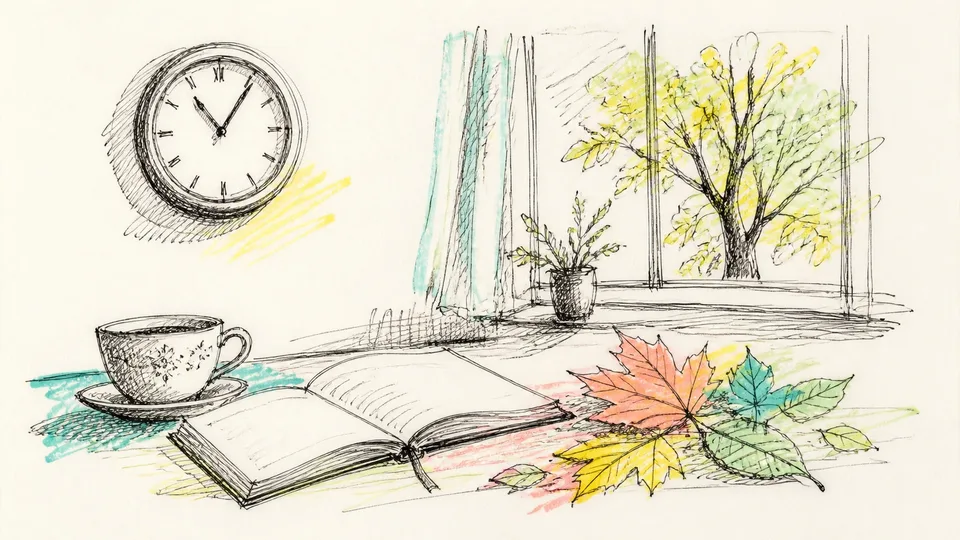
Time can feel like a straight road, a circle of seasons, or a handful of moments we keep returning to. A clock measures one kind of time, but memory has its own way of stretching an afternoon or bringing an old room close again.
These poems about time include two sonnets, a limerick, blank verse, and a villanelle. They are for birthdays, transitions, anniversaries, journals, and the ordinary days when you want to notice where your attention has gone.
I have learned that time is not only what passes. It is also what we give. A child waiting for an answer, a page revised with care, or a friend listening at the kitchen table can make a short hour feel generous. You may also enjoy these poems about memories and these poems about today.
Poems About Time
The Clock in the Kitchen
This Shakespearean sonnet uses an ABAB CDCD EFEF GG rhyme pattern. The kitchen clock becomes a witness to work, family, and the changing meaning of an ordinary hour.
The kitchen clock keeps tapping through the day,
It counts the bread, the lesson, and the rain,
It watches little hands grow tall and stray,
Then hears the key return along the lane.I used to think that time was what it took,
A distance measured by a moving hand,
But now I find it living in a look,
A pause beside the sink, a chair at hand.The hours I gave were never truly lost,
Though some were hard and some were filled with doubt,
They shaped the careful kindness of the cost,
And taught my heart what giving time means out.The clock keeps moving, faithful to its part,
While time grows wide wherever we give heart.
A Minute in My Pocket
This limerick uses five lines and an AABBA rhyme pattern. Its playful speaker discovers that a minute can feel surprisingly useful when it is not spent trying to make it larger.
I carried a minute one day,
It refused to be hurried away.
It sat in my shoe,
Then turned bright blue,
And asked me to notice the way.
The Years Beneath the Tree
This Petrarchan sonnet follows an ABBA ABBA octave and a six line resolution. A tree holds the visible record of seasons while the speaker considers the quieter changes inside a human life.
Beneath the tree, the years have made their rings,
Each circle keeps a weather of its own,
A narrow spring, a summer overgrown,
A winter that forgot the shape of wings.I touch the bark and hear no grander things
Than sap and rain and roots beneath the stone,
Yet feel how much a patient life has known,
And how a quiet heart can still have springs.We do not need to count each passing year,
Or prove that every season made us wise,
A life can change while no one else is near,
Then show new leaves beneath familiar skies.The tree does not explain the work it starts,
It simply keeps a little shade for hearts.
The Hour Before the Answer
This blank verse poem stays with waiting without turning it into a failure. Its unrhymed, measured lines let uncertainty remain present while the speaker continues ordinary work.
The hour before an answer has its weight.
I wash a cup and fold the waiting cloth.
Outside, a sparrow tests the morning fence.
The news will come when it is ready to.
I cannot pull the future through the door.
I can make tea, and let the kettle sing.
A quiet task can hold a restless mind.
The clock moves on, but does not ask me to.
I breathe until the room grows wide enough.
The answer may arrive to find me here.
Time Turns, Time Returns
This villanelle uses nineteen lines, two repeating refrains, and two rhyming sounds. The repeated lines echo the way memory revisits a life while the middle lines keep changing around them.
Time turns, time returns, and still we grow.
The old road holds the footprints of the rain.
What leaves the hand may find another flow.A child becomes the person we can know,
A field turns gold, then green, then gold again.
Time turns, time returns, and still we grow.The letters fade, but not the voice below,
The room is changed, yet welcomes us the same.
What leaves the hand may find another flow.We learn to let the closed door close and go,
Then find a window shining through the pane.
Time turns, time returns, and still we grow.No hour can keep the shape it had to show,
No memory is required to stay plain.
What leaves the hand may find another flow.I set one cup beside the evening glow,
And let tomorrow make its own refrain.
Time turns, time returns, and still we grow.
What leaves the hand may find another flow.
Giving Time a Human Shape
Time can feel less frightening when we notice what it contains. It holds meals, conversations, repairs, mistakes, and second attempts. The passing hours are not empty space. They are the material from which a life is made.
Use The Clock in the Kitchen for a family reflection. A Minute in My Pocket can lighten a card, while The Years Beneath the Tree suits a birthday or anniversary. The Hour Before the Answer belongs to a season of waiting, and the villanelle can accompany a journal about change.
If you share one of these poems, connect it to a real moment rather than a general statement about age. Name the room, the tree, the clock, or the task that held you. Concrete memory gives time a place to stand.
We cannot stop the clock, but we can choose what receives our attention while it moves. Give one person a listening hour, one page a patient revision, or one ordinary morning your full gaze. That is time made generous.
Send a little poetry to someone you love.