
Poems about Japan can hold a view of a river, but they cannot hold a whole country still. I wanted this collection to begin with that distinction. These are seven original, imagined scenes, not translations of Japanese poems or a claim that one landscape reveals how everyone there thinks or lives.
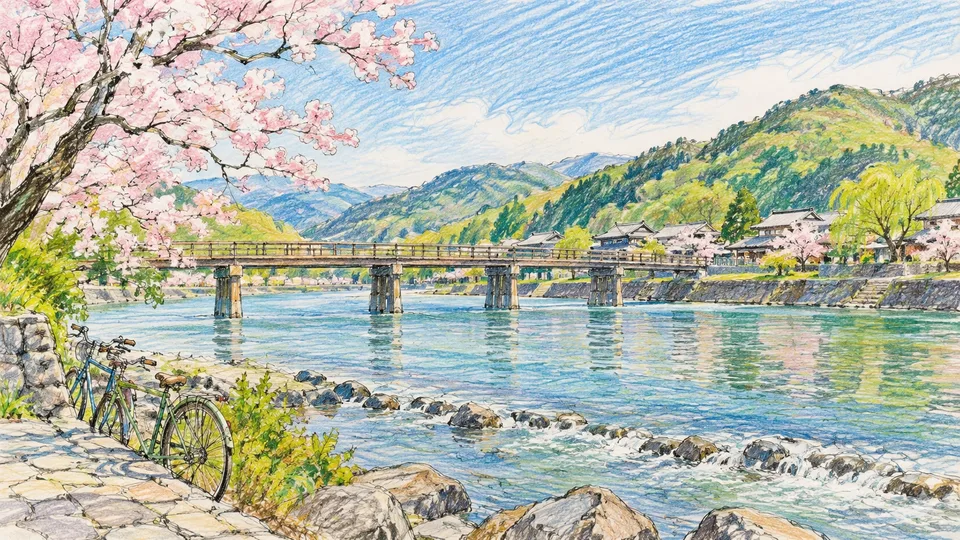
The Uji River provides a real geographical starting point. The Japan National Tourism Organization's Uji River guide describes the river dividing Uji and the bridge and riverside paths around it. The encounters, weather, and private thoughts in these poems are fictional. I am not presenting them as memories of a visit.
A river rail, a returned umbrella, a passing train window: those are the small places where I have set the attention. Some poems look outward; others notice the limits of the person doing the looking. Contemporary objects sit alongside water and trees because a living place is more than its most familiar picturesque view.
There is one English language haiku among the sonnets and other forms. It is an original exercise in close attention, with no claim to speak for a literary tradition. For more poems centered on the natural world, visit poems about nature. Here, the first pause is beside the river rail.
The poems
At the River Rail
The neat row of parked bicycles gives this scene a lived scale. What interests me is the difference between a river that seems peaceful to a visitor and a river woven through ordinary errands.
Bicycles lean near the river.
One basket holds a folded bag.
One saddle wears a cover against rain.The water passes all of them
without choosing a favorite.Someone has stopped here
between one useful place and another.The view is not waiting
to become a picture.
It is already part
of somebody's day.
A Bridge at Uji
The bridge offers a place to pause, but it does not make the water stop. I like the modest change in the speaker, who ends with a more open question instead of a discovery about everyone else.
A bridge extends its line above the flow;
The river breaks the sky to blue and gray.
A leaf turns once where quieter waters go,
Then takes its little shadow on its way.
The rails divide the view in measured bars;
Beyond them, hills rise softly through the air.
The day has brought no message from the stars,
No secret that the water came to share.
It asks no more than looking for a while,
And leaving room for what I cannot see:
The life beyond the bend, the farther mile,
The names this crossing does not give to me.
I rest a hand, then leave the rail behind,
With one less easy answer in my mind.
After the Shower
I notice the sleeve drying slowly while the water keeps moving. The two different paces make this little verse feel spacious to me.
Rain beads on the rail.
The wide river takes the light.
My sleeve dries slowly.
The Returned Umbrella
The umbrella's return is an imagined kindness, not a statement about a national character. I like how little the two people need to say for the moment to be complete.
She left the small umbrella where
The station benches meet.
A stranger saw the blue curved handle
Beside his waiting feet.He called, then hurried to the stair;
She turned and saw the blue.
The rain was gathering once again;
It had a job to do.She thanked him, took it, raised it wide,
And crossed the shining square.
The stranger found his waiting place;
The bench was empty there.
The Other Bank
The blank windows across the river invite a story, but the poem refuses to invent certainty. I like that the far shore can remain somebody else's place.
Across the stream, a row of windows shines;
One has a plant that leans toward the pane.
Between the buildings, thin electric lines
Hold drops that have not yet released the rain.
I cannot know who moved the little pot,
Or why the curtain opens halfway there.
The view allows a guess, and also not:
A life need not explain itself to air.
There is a grace in leaving things unknown,
In letting distant windows keep their light.
The person at that sill has days their own,
And need not make a story for my sight.
The river gives two banks a space between;
Not all a place contains is to be seen.
A Train Window
The fleeting views keep interrupting the temptation to make a finished picture. That feels right to me for a poem about looking from a moving place.
The window gathers roofs and lets them go.
A line of shirts appears above a wall;
Then nothing but a slope of moving green.
The little garden leaves before its name.
I cannot keep the whole view in my hand.
The train goes on; a child adjusts a bag.
The glass reflects the sleeve upon my knee.
Outside, another window enters sight.
Let the River Keep Its Moving Light
I enjoy the repeating lines because they return without making the water still. The bridge and the current are allowed to do different work.
The river keeps its moving light.
A loose leaf turns in open air.
No bridge can hold the current tight.The far bank shifts from green to white;
A cloud unthreads its shadow there.
The river keeps its moving light.The rail stays firm beneath the sight
Of water passing without care.
No bridge can hold the current tight.A bicycle rolls out of sight;
Its basket holds a folded square.
The river keeps its moving light.The bank receives the coming night;
A window opens here and there.
No bridge can hold the current tight.I leave the view its living right
To be much more than I can share.
The river keeps its moving light.
No bridge can hold the current tight.
A few words to carry with you
What remains after a place poem may be a small thing: a bicycle cover, an umbrella handle, a plant leaning toward a window. Those details do not explain Japan. They give these imagined speakers a manageable place to practice paying attention.
The Uji setting is grounded in the source linked above, while the individual scenes remain inventions. Keeping those two things separate matters to me. A poem can imagine a pause on a bridge without turning that imagined pause into evidence about the people who cross it each day.
If you return to a particular piece, notice what its speaker does not know. The distant window has its own life. The train moves on before the garden can be named. The river remains a river after the observer has closed a notebook. That unfinished quality can be part of the pleasure of reading.
You could try the same attention close to home. Look at one familiar crossing or one ordinary object and describe it before deciding what it means. The exercise need not end in a large conclusion.
I like leaving these poems at the water, where a bridge makes a useful connection and the current continues underneath. A little knowledge can help us look more carefully. There should still be room in the view for what we have yet to learn.
For your journey through Japan
These poems can take you there from your chair. If you are traveling, these are good to pack.
These are paid links. As an Amazon Associate I earn from qualifying purchases.
- View on Amazon
Essentials Dot Matrix Notebook
Keep notes on crossings and everyday light beside your favorite line.
One A5 hardcover notebook, 192 dot grid pages, 5¾ × 8¼ inches
- View on Amazon
Our Adventure Book Scrapbook
Bring home photographs and ticket stubs and give them a place to stay.
One scrapbook photo album
Send a little poetry to someone you love.