

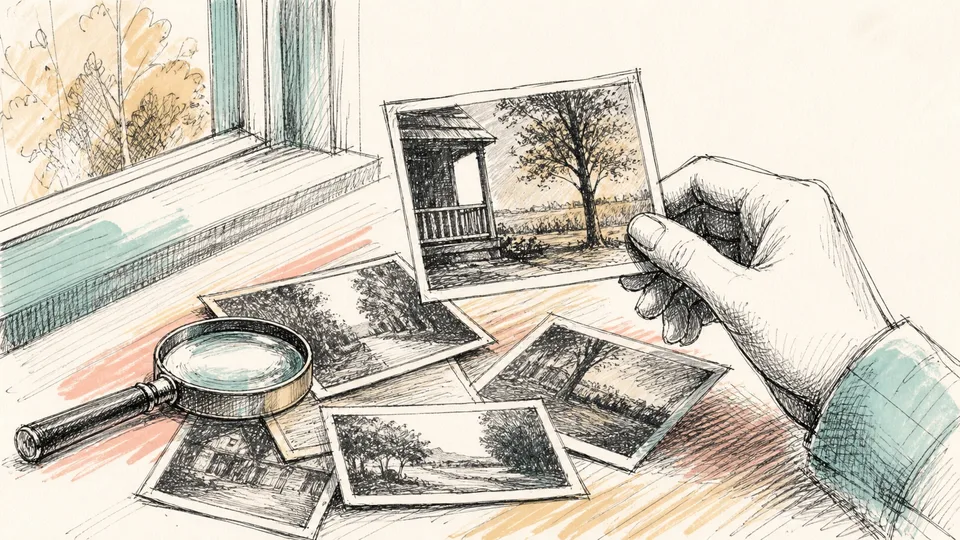
An image can return a room to us before we remember its address. One glance at a porch rail, a school window, or a familiar tree may bring back the weather, the voices, and the person who stood just outside the frame. Pictures keep surfaces, but the heart supplies sound, motion, and meaning.
These poems about images consider photographs, reflections, mental pictures, and the images poets make with words. The collection includes two sonnets, a villanelle, a haiku, and free verse. Each form asks a slightly different question: What does a picture preserve, what does it leave out, and what do we add when we look again?
I am especially drawn to imperfect photographs. A thumb may cover the corner. Someone may blink. The horizon may lean. Those flaws can make a picture feel more truthful because they remind us that a living person stood there, trying to keep a moment that was already moving away.
Even the blur has a story.
Readers interested in the stories a picture can awaken may enjoy these poems about memories. The poems about reading explore another way that marks on a page can open a world beyond themselves.
Five Poems About Pictures, Memory, and Seeing
The Photograph Knows the Porch
This sonnet looks closely at an old family photograph without claiming that the picture tells the whole story. The visible porch becomes a doorway to sounds and feelings held beyond the paper.
Sonnet
The photograph remembers porch and tree,
A tilted step, a shadow near the rail;
It keeps the summer light that used to be,
But cannot hold the laughter in the tale.
The paper shows a dress of faded blue,
A hand half raised to someone out of sight;
I study every grain as if I knew,
Which voice had called that face into the light.
The image offers evidence, not proof,
A window open briefly on the past;
I hear imagined rain against the roof,
And wonder which remembered sounds will last.
A picture guards the edges of a day,
While love supplies what time has worn away.
Reflection in a Classroom Window
Sometimes an image appears without a camera. This sonnet catches a classroom reflected in evening glass, where the day inside and the weather outside briefly share one frame.
Sonnet
The window holds the desks and falling rain,
Two worlds composed upon a single sheet;
A chalk word floats above the silver pane,
While puddles gather near the children’s feet.
The empty chairs look out across the lawn,
Their wooden backs made pale by cloudy light;
The lesson waits although the class is gone,
And maple branches write into the night.
I stand between the picture and the room,
Unsure which side contains the truer view;
The glass makes space for weather, work, and gloom,
Then gives my quiet face a place there too.
Some images arrive when worlds align,
And ask the watching eye to draw the line.
What the Frame Leaves Out
This villanelle returns to the limits of every picture. Its repeated lines remind us that looking carefully includes humility about all that remains beyond the frame.
Villanelle
The frame can never hold the whole wide day,
It catches one bright gesture, one small room;
The rest lives just beyond what pictures say.We see the garden gate, the child at play,
But not the song that made the lilacs bloom;
The frame can never hold the whole wide day.A face looks up before it turns away,
While unseen supper sends its warm perfume;
The rest lives just beyond what pictures say.We name the year, then softly disagree,
As memory moves the furniture through gloom;
The frame can never hold the whole wide day.Still, light preserved can show a faithful way,
A hand, a path, a freshly swept back room;
The rest lives just beyond what pictures say.So look with love, but leave some space to pray,
For lives no square of paper can consume;
The frame can never hold the whole wide day,
The rest lives just beyond what pictures say.
River in the Lens
This haiku focuses on a camera lens beside moving water. The image may pause a surface, but the river continues beyond the captured instant.
Haiku
River fills the lens
One bright ripple stays behind
Water travels on
Contact Sheet
This free verse poem looks at several near identical pictures and finds meaning in the small changes between them. It values the blink, the turning head, and the instant before everyone is ready.
Free verse
Six small squares keep one afternoon.
In the first, nobody looks up.
In the second, a sleeve crosses the sun.
By the third, someone has begun laughing.
The fourth is blurred with motion.
The fifth holds every face just right.
I choose the sixth,
where all of us are turning toward home.
Looking With Attention and Grace
Pictures can be precious, but they are not neutral containers. The person behind the camera chose where to stand. The person in the frame may have smiled for one second during a difficult day. A photograph can tell the truth and still tell only a small part of it. That is why careful looking includes both gratitude and imagination.
When you write from an image, begin with what is plainly there. Name the light, the objects, the distance between people, or the edge that has faded. Then ask what the picture makes you feel without declaring that feeling to be a fact about everyone shown. This distinction keeps a poem honest and gives mystery room to breathe.
You might choose “The Photograph Knows the Porch” for a family album, “Reflection in a Classroom Window” for someone who loves teaching, or “Contact Sheet” for a gathering where the imperfect picture became the favorite. Add a date or a remembered detail if you know it. Leave a question open if you do not.
An image does not stop time. It gives attention a place to return. Each return may reveal a new corner, a new tenderness, or a new uncertainty. The picture remains still, but the person looking continues to grow. In that meeting between fixed paper and changing heart, another kind of image begins.
A notebook for the details you want to keep
Any notebook, scrap paper, or notes app will do. If you want a dedicated place for these observations and memories, this is one optional notebook.
These are paid links. As an Amazon Associate I earn from qualifying purchases.
- View on Amazon
Essentials Dot Matrix Notebook
Write the names, sounds, and memories a photograph brings back, alongside a draft of your own poem.
One A5 hardcover notebook, 192 dot grid pages, 5¾ × 8¼ inches
Send a little poetry to someone you love.