

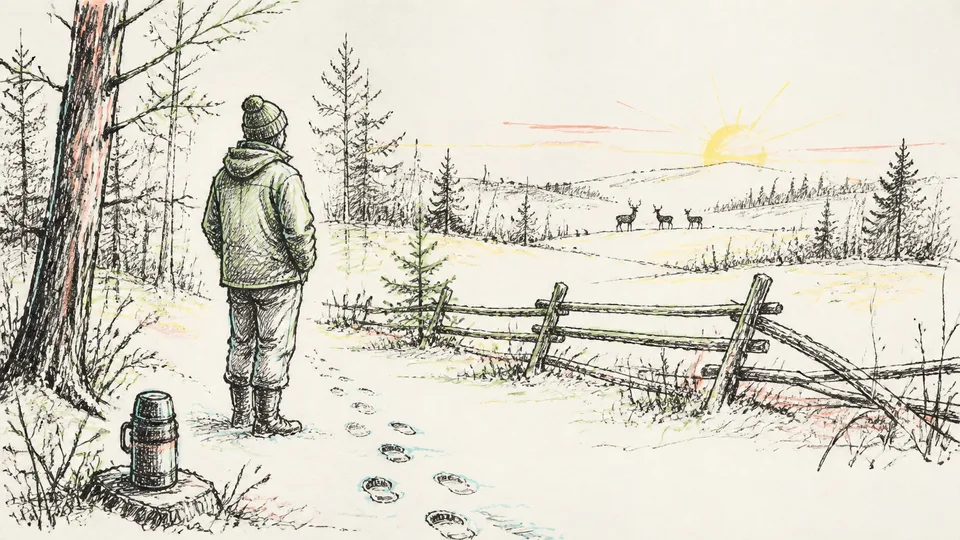
Hunting can bring a person into close attention with weather, tracks, distance, and the limits of a human body. It can also raise serious questions about responsibility and respect. These poems stay with the quiet woods, the patient observation, and the care that should guide any encounter with a living creature.
This collection of poems about hunting includes two sonnets, a playful limerick, a ballad, and free verse. The poems do not celebrate cruelty or treat the outdoors as a trophy room. Instead, they consider preparation, restraint, memory, and the humility of listening before acting.
A field teaches us to notice what we might otherwise hurry past. A bent stem, a feather, or a line of prints can make the morning feel larger than our own plans. For another path into the natural world, you may enjoy these poems about nature and these poems about walking.
Poems About Hunting
Before the Woods Awake
This Shakespearean sonnet uses an ABAB CDCD EFEF GG rhyme pattern to describe the hour before sunrise. Its closing couplet emphasizes that the first responsibility in the woods is attention, not possession.
Before the woods awake, the frost lies still,
A pale line rests along the cedar fence,
The dark holds every branch and folded hill,
And breath becomes a small white evidence.I check my pack, then listen to the ground,
The patient earth is older than my need,
A distant owl gives one unhurried sound,
And leaves a quiet question in the seed.The trail is not a promise made to me,
The living world is more than what I seek,
I walk with care enough to let it be,
And keep my footsteps measured, mild, and meek.The morning opens wide without demand,
Respect must be the compass in my hand.
The Hunter Who Hummed
This limerick is a gentle five line AABBA rhyme about a person whose song is louder than the woods. Its humor points toward patience and self awareness without making light of the living world.
There once was a hunter who hummed,
So loudly the squirrels all drummed.
He sang through the glen,
Then whispered, “Again,”
When the quiet at last had come.
A Different Kind of Trophy
This second sonnet uses a Petrarchan ABBA ABBA octave followed by a six line resolution. It turns the idea of a trophy toward memories of weather, good judgment, and leaving a place unharmed.
The finest prize is not a mounted head,
Nor antler shining over polished wood,
It is the trail returned to living good,
The warm red dawn that found me where I tread.I keep a feather and a leaf instead,
A photograph of mist above the wood,
A note about the silence where I stood,
And thank the earth for every path it led.To travel far and leave no wound behind,
To know when wanting must give way to care,
These are the marks I hope to keep in mind,
The quiet measures of a morning fair.A memory can fill the empty hand,
And make a gentler hunter of the land.
Tracks at Daybreak
This ballad follows two companions reading tracks in the first snow. Its song like movement makes room for a choice to wait, watch, and let the animal pass beyond their reach.
Two sets of prints crossed the early snow,
One small and one with careful stride.
“The woods are speaking,” someone said below,
And both companions stepped aside.They watched the tracks go toward the creek,
They watched the silver water run.
No one had found the prize they seek,
Yet neither called the morning done.They carried home the story told
By ice and feather, bark and stone.
The day was bright, the air was cold,
And patience felt like something grown.
Permission to Listen
This free verse poem makes listening the central act. Its open lines move from gear and expectation toward the more difficult practice of letting the woods remain larger than the speaker.
I bring my boots,
my thermos,
my careful plans.The woods bring a fox colored shadow,
one crow,
and the patience of a stone.I lower my voice.
The morning does not need me
to prove that I was here.
Walking Home with Respect
Outdoor traditions deserve honest language. A poem can hold the appeal of a dawn in the woods while still acknowledging responsibility, restraint, and the fact that animals are not scenery arranged for human wishes.
Choose Before the Woods Awake for a reflective reading before a trip. The limerick can lighten a conversation among friends, while A Different Kind of Trophy offers a way to speak about memory and ethics. Tracks at Daybreak belongs to a family story, and Permission to Listen can be shared with anyone learning to pay closer attention.
If you adapt one of these poems, include the place as it really is. Name the kind of tree, the weather underfoot, or the sound that made you pause. Honest detail encourages care rather than turning the outdoors into a backdrop.
The woods will remain mysterious after we leave them. That mystery is not a failure of knowledge. It is a reminder that respect begins when we accept that the living world has its own purposes, its own rhythms, and its own right to continue.
Send a little poetry to someone you love.