
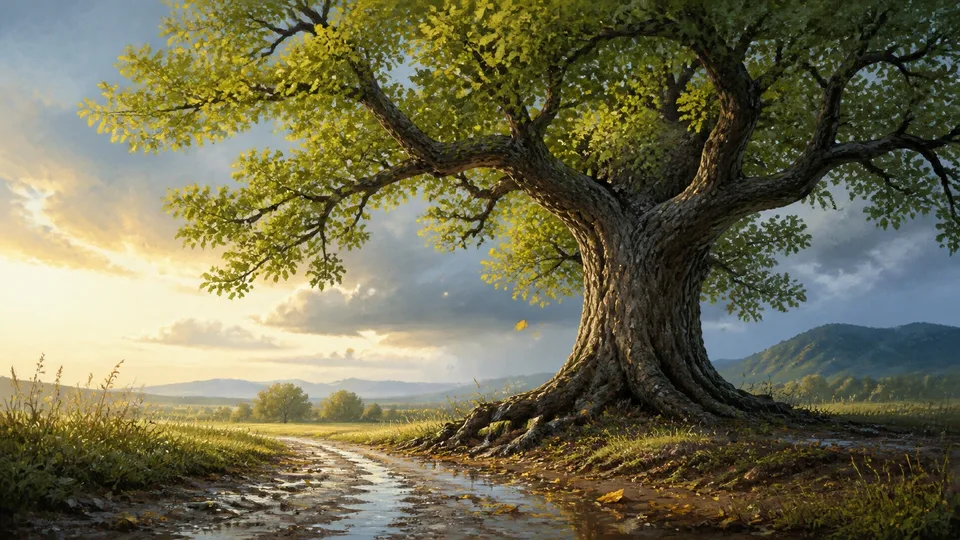
A tree can make time visible. New leaves arrive, branches lose what they cannot keep, and rings gather quietly inside the trunk. We may pass the same tree for years before realizing how much it has been witnessing while we hurry from one part of life to another.
These poems about a tree explore that steady presence through several forms. Two sonnets offer patient reflection, a villanelle lets repeated lines return like seasons, blank verse follows a walk, and a haiku gathers one brief image. Together they ask what it means to grow without rushing and to remain rooted without staying unchanged.
Trees have always made me feel that attention can be an act of gratitude. A branch does not need to explain its usefulness. It gives shade, shelter, color, and a place for birds to begin their day. Even a bare tree has a shape worth seeing.
You may also enjoy these poems about the elements or these poems about walking when you want to continue into the natural world.
Poems About a Tree
The Tree Beside the Road
This Shakespearean sonnet treats a tree as a long lived neighbor. It has fourteen lines with an ABAB CDCD EFEF GG rhyme pattern. The closing couplet turns from the tree's age to the speaker's own unfinished growth.
The tree beside the road has watched me pass,
Through summers bright and winters washed with snow,
Its roots lie deep beneath the waving grass,
Its patient branches teach the wind to slow.I knew it first when I was small and quick,
My pockets full of stones and borrowed string,
I climbed no higher than the lowest stick,
Yet thought I could command each hidden thing.Now years have placed more questions in my hand,
More roads have taught me how to leave and stay,
The tree still lifts its shelter from the land,
And makes a little room beside the way.I cannot grow as trees and seasons do,
But I can deepen what I offer too.
The Old Tree Keeps the Weather
This nineteen line villanelle uses two repeating refrains and two rhyming sounds. Its return pattern mirrors the way weather revisits a familiar place. The tree becomes a steady listener for questions that do not need quick answers.
The old tree keeps the weather in its leaves.
It leans above the path and listens still.
Its roots hold more than any eye believes.Each spring, a green astonishment retrieves.
A bird folds evening into one small hill.
The old tree keeps the weather in its leaves.I bring my questions, and the shade receives.
It does not hurry what the years will fill.
Its roots hold more than any eye believes.The branch lets go of what the wind deceives.
A fallen gold can rest beside the sill.
The old tree keeps the weather in its leaves.When winter writes its white, the trunk believes.
The patient bark remembers every chill.
Its roots hold more than any eye believes.I leave with slower steps and fewer needs.
The dusk grows wide, the air grows soft and still.
The old tree keeps the weather in its leaves.
Its roots hold more than any eye believes.
Rings Beneath the Bark
This second sonnet uses an ABBA ABBA opening and a six line resolution. The tree's rings become a quiet record of endurance, but the poem avoids treating hardship as the only measure of worth. Rest and growth share the same ground.
Beneath the bark, the patient circles turn,
Each ring a year the open seasons know,
The dry year sleeps beside the year of snow,
The fallen branch still feeds the living fern.No ring is praised for being wide or bright,
No narrow year is asked to leave the tree,
The trunk receives the darkness and the light,
And keeps a place for what it cannot see.I touch the bark and hear no grand decree,
Just grain and weather, shelter, sap, and rain,
A life can hold both stillness and release,
And make a little shade from every pain.The tree does not explain what it has known,
Yet leaves me less afraid to grow alone.
Before the Leaves Are Loud
This blank verse poem follows a quiet walk in unrhymed lines with a steady, measured rhythm. Its form lets the speaker think without needing an end rhyme. The tree teaches through presence rather than speech.
Before the leaves are loud, I cross the yard.
The tree receives the first unsteady rain.
Along its bark, the years have made a map.
I place my palm upon the patient grain.
It does not speak, yet teaches me to stay.
Each ring has held a season without praise.
I watch one sparrow balance on a twig.
And feel my own small balance settle there.
By dusk, the roots are dark beneath the ground.
I walk back home with branches in my mind.
Green Leaves Lift the Rain
This haiku gathers the tree into one fresh image. It uses three lines with a checked five, seven, five syllable pattern. The poem is brief because the moment itself is brief.
Green leaves lift the rain
One tree shades the waiting path
Birdsong fills the dusk
What a Tree Can Hold
A tree offers a useful picture of patience, but it is not a command to endure everything without change. Branches bend. Leaves fall. Roots spread into new soil, and sometimes a tree must be moved, pruned, or allowed to become part of the ground. Steadiness can include adaptation.
Choose The Tree Beside the Road when you are thinking about a familiar place that has watched your life unfold. The villanelle suits a question that keeps returning. Rings Beneath the Bark may help when you are comparing one season of your life with another. The blank verse poem belongs to a walk, and the haiku can fit into a note about a favorite tree.
If you share one of these poems, add a true detail about the tree you mean. Mention its position near a road, the way its leaves sound, the shade it gives at noon, or the bird that visits one branch. Specific attention turns a general nature image into a place someone can recognize.
We may never know all that a tree has held. That mystery is part of its welcome. It stands in weather, gives what it can, and keeps making room for new leaves. Perhaps we can practice one small version of that work, offering shade where we are able and trusting that a quiet life may still be deeply useful.
A notebook for the details you want to keep
Any notebook, scrap paper, or notes app will do. If you want a dedicated place for these observations and memories, this is one optional notebook.
These are paid links. As an Amazon Associate I earn from qualifying purchases.
- View on Amazon
Essentials Dot Matrix Notebook
Return to the same tree and note its leaves, weather, and changing shadow across the seasons.
One A5 hardcover notebook, 192 dot grid pages, 5¾ × 8¼ inches
Send a little poetry to someone you love.