

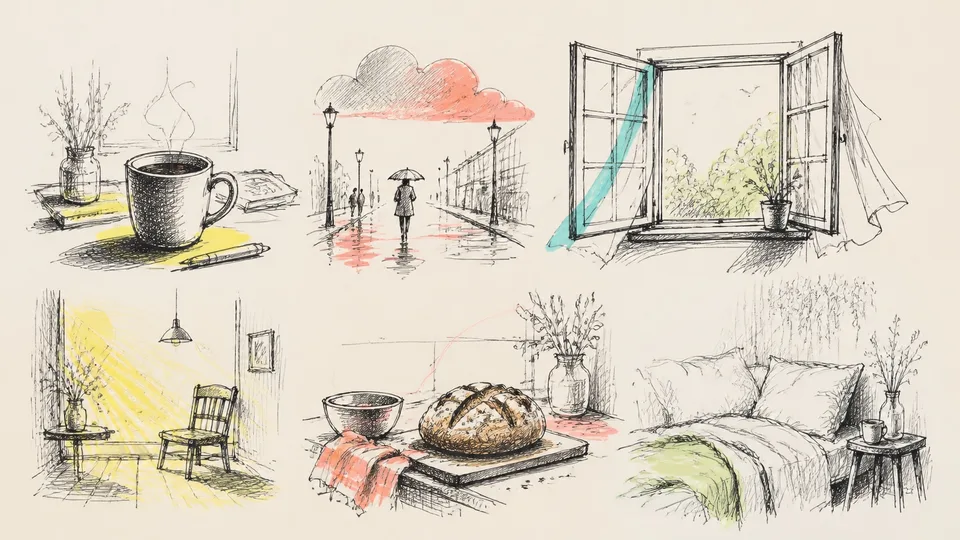
The days of the week can feel very different, even though the clock keeps the same measure. Monday may ask for courage, Wednesday may need a pause, and Sunday may offer a quiet chance to gather what the week has taught.
These poems about days of the week include two sonnets, a ballad, a haiku, and free verse. They are for planners, teachers, families, workers, and anyone who wants to notice the texture of ordinary time.
I like the way a week becomes a small story through repeated rituals. A particular mug, a library visit, a market trip, or a phone call can give a day a personality. You may also enjoy these poems about today and these poems about time.
Poems About Days of the Week
Monday Opens the Door
This Shakespearean sonnet uses an ABAB CDCD EFEF GG rhyme pattern. Monday is not treated as an enemy, but as a door that opens onto imperfect work and new possibility.
Monday opens one unpainted door,
The week stands waiting with its papers spread,
A cup grows warm beside the kitchen floor,
A hundred little questions lift their head.I do not need to love the rushing start,
Or make the morning brighter than it feels,
I only need to bring an honest heart,
And choose the first small task that time reveals.The week will bend, and Friday will arrive,
The plans will change, the weather will surprise,
Yet Monday gives the ordinary drive
A place to practice how a person tries.One day can open what the heart has sought,
By making room for one unfinished thought.
The Week's Little Train
This ballad gives each day a place on a small imaginary train. Its song like movement keeps the week playful while still honoring work and rest.
Monday pulled the morning car,
Tuesday brought the mail.
Wednesday carried garden tools,
Thursday watched the trail.Friday wore a yellow scarf,
Saturday brought bread.
Sunday held a quiet lamp,
And let the travelers rest their head.
The train went on through changing weather,
Its windows bright and wide.
Each day had room for one small life,
And all the days could ride.
Wednesday's Open Window
This second sonnet uses an ABBA ABBA octave and a six line resolution. Wednesday becomes a useful pause where a person can adjust pace without abandoning the week.
By Wednesday, I can hear the week's deep breath,
The first bright plans have gathered dust and rain,
A middle day lies open on the pane,
And offers rest without pretending death.
I open one small window to the west,
Let air move through the papers on the floor,
The work remains, but asks for less than war,
The heart can find a steadier request.
A week is not a ladder built of haste,
It has a middle where the mind can mend,
A place to change the rhythm without waste,
A quiet turn before the final bend.
I close the window when the light grows thin,
And carry Wednesday's patience forward in.
Weekend Light
This haiku notices the first slow morning of the weekend. Its five, seven, five syllable pattern keeps the restfulness close to a few simple objects.
Saturday light rests
Warm bread rests beside a book
No clock calls my name
The Day I Have
This free verse poem releases the pressure to make every day exceptional. Its short lines bring attention back to the day that is actually present.
I have Monday's list,
Wednesday's tired shoulders,
Friday's small relief.I have Saturday bread
and Sunday rain.Today does not need
to become a legend.It needs a chair,
a little care,
and my attention while it is here.
Letting the Week Have Texture
No day has to carry the whole meaning of a life. A difficult Monday can be followed by a kinder afternoon. A quiet Sunday can still be useful even when it does not feel productive.
Use Monday Opens the Door for a new beginning or work note. The Week's Little Train is playful for children, while Wednesday's Open Window suits a person in the middle of a demanding week. Weekend Light can be a short message, and The Day I Have is for anyone practicing presence.
If you share one of these poems, add the ritual that gives a day its real shape. Name the mug, market, class, walk, or phone call. Ordinary detail is what makes a calendar feel lived.
The week will turn again. We do not have to win every day. We can meet the day in front of us, give it what care we have, and let the next day arrive with its own small invitation.
Send a little poetry to someone you love.