

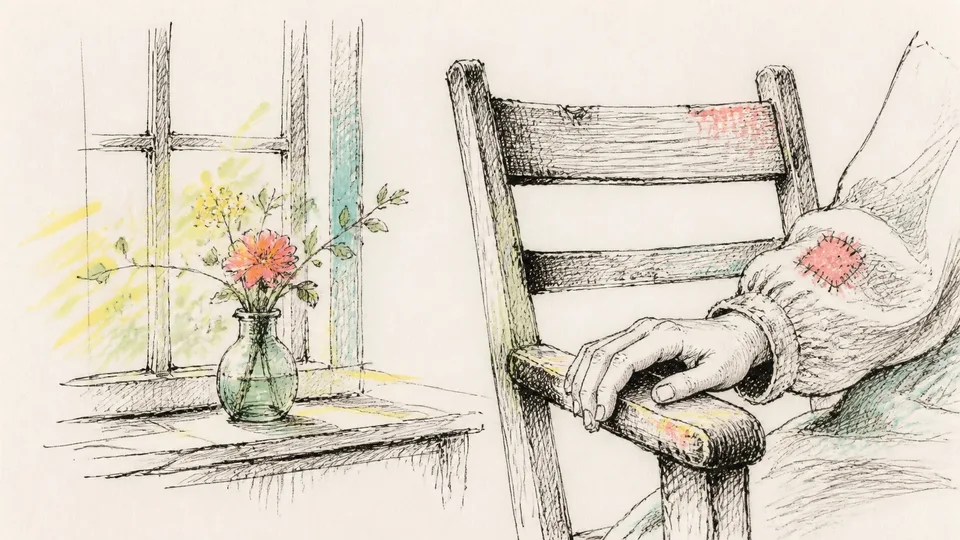
Beauty is not always polished or easy to name. It can be a mended sleeve, a tired face in kind light, a garden after rain, or the moment someone notices that another person needs a chair.
These poems about beauty include two sonnets, free verse, a ballad, and a haiku. They are written for readers who want language for appreciation without reducing people or places to decoration.
I have always trusted beauty that shows evidence of living. A softened book spine, a porch board worn smooth, or a hand marked by work can carry more feeling than a flawless surface. You may also like these poems about fashion and these poems about flowers.
Poems About Beauty
The Beauty of the Worn Chair
This Shakespearean sonnet uses an ABAB CDCD EFEF GG rhyme pattern. The worn chair becomes beautiful through use, memory, and the welcome it continues to offer.
The worn chair leans beside the kitchen wall,
Its arms are smooth from years of waiting hands,
It has received the tired and the small,
And held the quiet work of making plans.No polish hides the places where we sat,
No perfect cloth can tell the chair's whole tale,
A child once slept beneath its woven mat,
A friend found courage resting from the gale.The beauty here is not a shining face,
But usefulness that deepens into care,
A thing made gentle by its staying place,
A little room that says, “You may sit there.”The chair has worn its years and still can prove
That beauty grows wherever people love.
The Window Opens
This free verse poem lets beauty enter through a simple window. Its short lines make room for air, weather, and a change in attention.
The window opens.
Not a grand view,
only the fence,
a sparrow,
and laundry lifting in the breeze.Still,
the room changes shape.Light touches the table.
Someone remembers to breathe.
The Face in the Morning Glass
This Petrarchan sonnet begins with an ABBA ABBA octave and resolves through a six line sestet. It treats an aging face as a record of presence rather than a problem to be corrected.
The morning glass returns a changing face,
A silver thread, a line beside the eye,
The years have left their weather passing by,
Yet every mark has found its rightful place.I do not need to borrow younger grace,
Or ask the mirror for a different sky,
The face I have is here, and so am I,
A living record time cannot erase.
The mouth has learned the shape of many names,
The hands have held a child, a book, a cup,
The eyes have watched both losses and the flames
Of small bright joys that would not give them up.Beauty is presence, patient, whole, and near,
A face that stays to meet another year.
The Dress for Ordinary Days
This ballad follows a person choosing a favorite dress for an ordinary day. Its song like movement shows beauty as comfort, color, and permission to feel at home in one's body.
She chose the dress with pockets deep,
The blue one soft with use.
It held a key, a folded note,
And one small sprig of spruce.The day was not a wedding day,
No camera waited near.
She wore the blue to buy some bread,
And met the morning clear.
A woman smiled beside the door,
A child admired the seam.
The dress was beautiful because
It let her move and dream.
A Beauty I Can Keep
This haiku notices a small beauty that does not need to be owned. Its five, seven, five rhythm keeps appreciation separate from possession.
Sun on the old fence
One gold leaf turns in the wind
I carry the light
Beauty Without a Test
Beauty becomes kinder when it is not used as a score. A person does not have to look a certain way to deserve attention, and a place does not have to be untouched to be worthy of care.
Use The Beauty of the Worn Chair for a reflection on home and memory. The Window Opens can fit a short note, while The Face in the Morning Glass offers a gentler language for aging. The dress ballad is warm for a friend, and A Beauty I Can Keep suits a nature journal.
If you share one of these poems, name what you noticed without turning it into a rule for everyone else. Mention the light, the object, the gesture, or the texture. Specific wonder leaves room for difference.
Beauty is not a finish line. It is an attention we practice, a way of seeing what is present and valuable before it changes. Look closely, speak kindly, and let the ordinary shine on its own terms.
Send a little poetry to someone you love.