
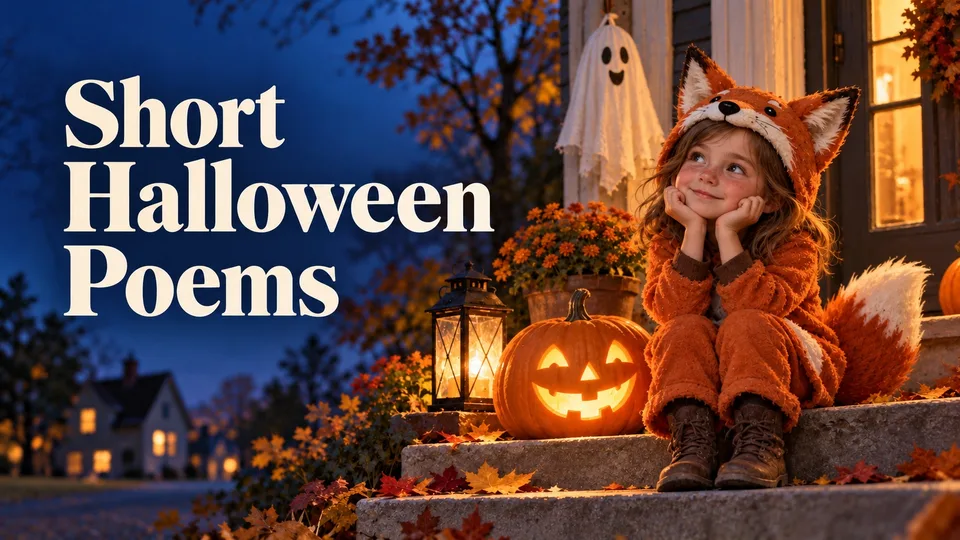
A paper ghost does not need much wind to dance. One small breath through an open window, and its pointed hem begins to move. I like that about Halloween. A little preparation can give an ordinary room a whole new mood, even before anyone puts on a costume.
These short Halloween poems are written for children, classroom readings, and families who want a little October fun without a frightening story. The eight original poems begin with five quick selections about decorations, a wiggly witch, costume pockets, a quiet knock, and the moment before a classroom celebration. The last three are longer readings for older children or a grown person to share aloud.
For a very brief reading, choose the three lines of “Paper Ghost.” “A Witch with a Wiggle” offers a small joke in five lines. The other short poems have room for a second voice, an easy gesture, or a thoughtful pause. There is no need to turn a reading into a performance contest. A child who wants to listen is taking part, too.
I have kept the ghosts friendly and the pleasures familiar. There are no dreadful surprises waiting at the end. If you would like a broader collection about neighborhood kindness and October evenings, visit my poems about Halloween. Here, we will start with something small enough to learn while a costume is still being buttoned.
Five Quick Halloween Poems for Kids
Paper Ghost
I like the tiny movement in this poem, especially the way a decoration seems to wave back. It makes a gentle first reading for a child who would rather notice something friendly than pretend to be frightened.
Haiku, three lines
White ghost in the breeze
Paper fingers wave hello
Leaves skip past the door
A Witch with a Wiggle
That broom has an opinion of its own, which is what makes me smile. I would leave a small pause before the final line so the children have a moment to picture the landing.
Limerick, five lines
A witch with a wonderful hat
Said, “My broom is as quick as a cat!”
But it wiggled its toes,
Did a dip with its nose,
And deposited her on the mat.
My Costume Has Pockets
The leaf in the pocket is my favorite detail here. Children often bring home treasures that have nothing to do with the event we planned, and I like giving those discoveries their own little place.
Free verse, six lines
My costume has pockets.
One holds a smooth stone.
One holds a red leaf.
The last one is empty,
waiting for something
I have not found yet.
The Smallest Knock
A quiet child can be brave without becoming a loud one. I wanted the person behind this door to understand that, and I like how the ending gives the small knock a proper welcome.
Ballad, eight lines
A little bear went up the walk
And stopped beside the light.
He practiced once his smallest knock,
Then tried it out that night.The neighbor brought the basket near
And smiled upon the stair.
“That was a lovely knock, my dear.
I'm glad to meet a bear.”
Before the Bell
I enjoy the brief stillness before a room fills with voices. These lines let a classroom reading begin quietly, with a pumpkin waiting just as patiently as the children.
Blank verse, four lines
The paper moon is hanging by the door.
A row of capes is waiting on the hooks.
We hear the leaves come tapping at the glass.
The pumpkin seems to listen for the bell.
Three Longer Halloween Readings
These poems offer repeated lines or a fuller story. Read them together, or let a grown person carry the reading while younger children listen for a familiar word.
Our Classroom Pumpkin
I like a pumpkin whose smile asks nothing of the people around it. The two returning lines make this a pleasant group reading, with the children joining in whenever the pumpkin and its circle come around again.
Villanelle, nineteen lines
Our pumpkin keeps a circle full of light.
We set it where the paper bats can play.
Its crooked smile makes everything all right.A little owl has landed from its flight.
A cardboard dragon folds its wings away.
Our pumpkin keeps a circle full of light.The window shows the leaves in red and white.
Our painted stars have brightened up the day.
Its crooked smile makes everything all right.A shy brown bear comes closer for a bite.
We make some room and ask the bear to stay.
Our pumpkin keeps a circle full of light.We do not need to give our friends a fright.
There is a kinder game that we can play.
Its crooked smile makes everything all right.When costumes leave, the room is warm and bright.
We pack the paper moons and stars away.
Our pumpkin keeps a circle full of light.
Its crooked smile makes everything all right.
The Cape I Made
The uneven star matters more to me than a perfect costume would. I wanted this child to discover that something made with care can feel splendid even when a corner will not quite behave.
Sonnet, fourteen lines
I cut a yellow star to wear tonight,
And sewed it to a cape of faded blue.
One corner bent, but still it caught the light;
I liked the way it moved when breezes blew.
My shoes were just the shoes I wore to school,
My crown was cut from cardboard in a box.
I made myself a rather simple rule:
A king can wear his ordinary socks.
I walked outside and let my cape unfold;
It brushed the gate and fluttered past my knee.
The wind was brisk, but I was brave and bold,
And all the stars seemed glad to welcome me.
My crooked star was stitched with honest care;
No other king had such a star to wear.
A Light for Everyone
I notice the child who arrives without a costume in this poem. A welcoming room has space for that child as well, and the borrowed wings are a small way of making the welcome visible.
Sonnet, fourteen lines
We hang a paper lantern by the door,
And leave a little room beside the chair.
A child who has no cape can cross the floor
And find a set of wings that we can share.
The dragon takes a seat beside the bear;
The rabbit lets the tiny turtle pass.
A crown is quite a splendid thing to wear,
But kindness shines as brightly in our class.
We clap for every costume, large and small,
And listen when a quiet voice begins.
The pumpkin casts its light upon us all;
No child must shout to prove that someone wins.
A room can glow without a grand display,
When every friend has found a place to stay.
Choosing a Poem for Your October Reading
When I choose a poem to share with children, I begin with the room rather than the calendar. Is everyone bouncing with excitement, or is someone feeling uncertain about a mask? Do we have a few quiet minutes, or only the small space between fastening a coat and opening the door? The right poem can fit either moment.
“Paper Ghost” works well when you want a quick beginning. A child can wave a hand on the second line, and the whole group can imagine the leaves moving on the third. For an easy laugh, try the witch and her uncooperative broom. There is enough rhythm to enjoy even before every word is familiar.
With “The Smallest Knock,” you might ask how the neighbor helped the bear feel welcome. Keep the question open. One child may notice the smile; another may notice that the basket came closer. Neither answer needs correcting. The poem has room for both kinds of attention.
The longer readings can belong to another day. Let children join the returning lines in “Our Classroom Pumpkin,” or read a sonnet yourself and invite them to name one thing they remember. Understanding every word is not the only way to meet a poem.
If your gathering needs a little more laughter, my funny Halloween poems include costume mistakes and a very puzzled pumpkin. However you share these readings, I hope the children leave with one small image they like. Sometimes a waving paper ghost is plenty to carry home.
Useful supplies for paper Halloween decorations
For parents and teachers: start with scrap paper and crayons children already have. These basics can turn the paper ghosts and classroom pumpkin into a small drawing activity.
These are paid links. As an Amazon Associate I earn from qualifying purchases.
- View on Amazon
Astrobrights white cardstock
Cut or fold paper ghosts and pumpkin shapes for the reading; an adult can handle cutting and check cardstock printer settings if using a template.
75 white U.S. Letter sheets, 8½ × 11 inches, 65 lb
- View on Amazon
Crayola Crayons
Color a friendly pumpkin or costume detail while talking about an image from the poem.
Two boxes of 24 crayons, 48 crayons total
Send a little poetry to someone you love.