

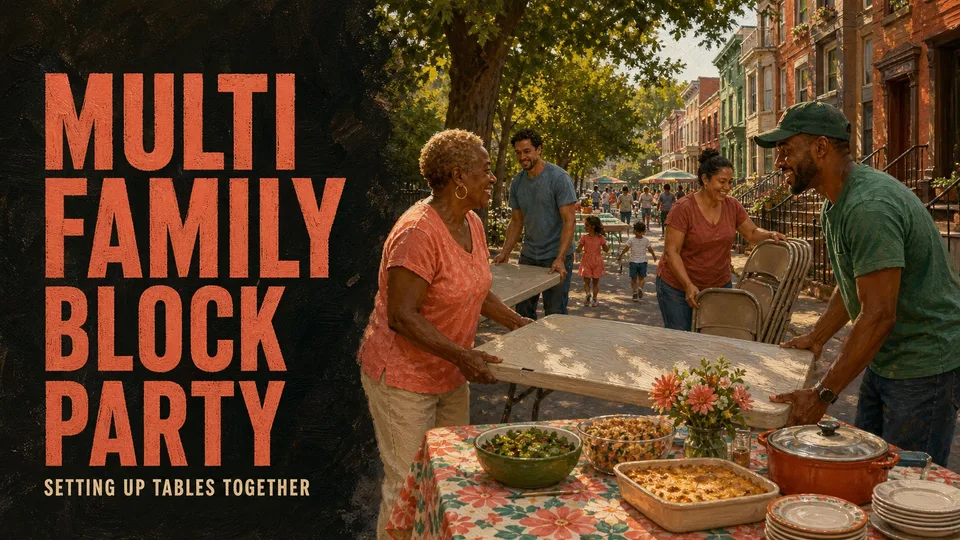
An annual block party begins before the music and food. Neighbors set up tables, carry folding chairs, compare dishes, and make room for families who may not know one another yet. These original poems celebrate the practical work and easy welcome of a multi family neighborhood gathering.
You may also enjoy community seed swapping at the local library or the transformation of an old alleyway into a pocket park. Both pieces honor the small work that turns a shared place into a community.
An Annual Multi Family Block Party
The First Table
This poem begins with the first table placed in the street or yard. It shows how a simple surface becomes a place for many stories. The scene is familiar without requiring a particular town.
The first table meets the morning,
Its legs are set just so.
Someone brings a cloth and cups,
Someone says hello.The party starts with practical work,
With lifting, carrying, care.
A table is an invitation
When people gather there.
Folding Chairs
This poem gives folding chairs a little personality. It uses gentle humor to show how neighbors prepare for a crowd. The ending shifts from objects to people.
The folding chairs come out in rows,
Each one with a careful sound.
They lean against the garage wall,
Then spread across the ground.A chair can hold a neighbor new,
A cousin, child, or friend.
The more we set around the block,
The more the block can bend.
Every Family Brings a Dish
This poem celebrates variety at the shared table. It avoids claiming one dish represents an entire culture. The joy comes from different contributions meeting together.
Every family brings a dish,
A bowl, a plate, a pan.
Each one carries something learned
From home and heart and hand.The table grows with different tastes,
With stories side by side.
A neighborhood can find its feast
When everyone provides.
The Children Run Through
This poem notices children moving through the gathering. It leaves room for adults to be part of the joy too. The scene is lively but not chaotic in a negative way.
The children run through open gates,
Their voices fill the air.
A ball rolls under someone’s chair,
A ribbon finds a stair.The grown ups call, then laugh, then let
The afternoon go on.
A party knows it has begun
When careful plans are gone.
The Neighbor I Had Not Met
This poem focuses on the first conversation between neighbors. It shows how an introduction can become the beginning of local friendship. The wording can be adapted for a new family on the block.
I met the neighbor down the street
While carrying a chair.
We talked about the weather first,
Then found more things to share.The party gave us time to learn
The names behind each door.
A street grows friendlier every time
A stranger is one more.
Setting Up Together
This poem honors cooperation. It recognizes that community is built through ordinary labor rather than a single speech. The tone is grateful and grounded.
We set the tables up together,
We carry what is large.
One holds the cloth, one finds the cups,
One watches for the cars.No task is too small to matter,
No helper stands apart.
The work becomes a kind of song
When many people start.
After the Last Chair
This closing poem looks at the quiet after the party. It remembers the work of cleaning up as another act of care. The final image leaves the neighborhood ready for another year.
After the last chair folds away,
The street grows calm and wide.
We gather plates and leftover stories,
Then carry them inside.The party ends, the welcome stays,
A light behind each door.
Next year we will set tables out
And meet one another more.
An annual block party poem becomes vivid when it names one real setup detail. The folding table, borrowed cooler, or neighbor who always arrives early can carry the whole feeling of the day.
Useful supplies for the block-party table
Borrow tables, bring a familiar game, and use scrap paper for labels. These optional supplies can help neighbors share food and a little play.
These are paid links. As an Amazon Associate I earn from qualifying purchases.
- View on Amazon
Oxford Heavyweight Ruled Index Cards
Label dishes with their names and supplied ingredient information, or write a short welcoming poem for the shared table.
100 white cards, 3 × 5 inches
- View on Amazon
UNO card game
Offer a table game for 2–10 neighbors ages seven and up once the setup is finished.
One card game, for 2–10 players ages 7 and up
Send a little poetry to someone you love.