

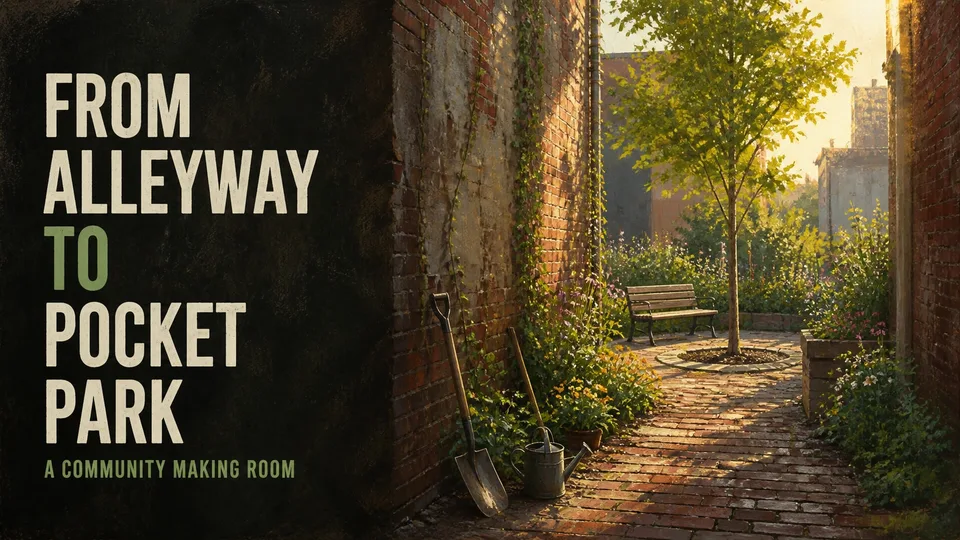
An old alleyway can look like a place the neighborhood has forgotten. Then someone clears a corner, someone brings a shovel, someone carries a bench, and a small piece of ground begins to welcome people again. These original poems follow that transformation from neglected passage to pocket park.
The story is about more than landscaping. It is about shared attention, patient work, and the way a public place can change when people decide it belongs to everyone. You may also enjoy the Saturday morning farmer market rush or poems about new beginnings for another collection about community and change.
The Transformation of an Old Alleyway into a Pocket Park
The Alley Before
This poem looks honestly at the neglected place before the work begins. It does not call the alley beautiful yet. It gives the old walls and weeds a history worth noticing.
The alley held a tired gray sky,
A bottle, brick, and weed.
The walls had learned to face the rain,
The ground had learned to seed.No child had reason to come through,
No bench invited a stay.
Yet underneath the dusty years,
A place was waiting one day.
Someone Brings a Shovel
Transformation often starts with one ordinary action. This poem notices the first person who brings a tool and begins without a crowd. The mood is practical and hopeful.
Someone brought a shovel,
Someone brought a glove.
The alley did not answer back,
Yet work is one form of love.A stone came loose, a root came free,
The old ground opened wide.
A place can change its story when
A hand stays by its side.
Neighbors at the Wall
Community work becomes visible when people join at different times and with different skills. This poem celebrates cooperation without pretending everyone agrees about every detail. The wall becomes a place for conversation.
Neighbors met beside the wall,
With plans in borrowed ink.
One talked of trees, one brought a chair,
One brought a pot and sink.The work was not a single song,
It changed from voice to voice.
A park begins when many hands
Decide to make a choice.
The First Green Shoot
Plants bring a visible sign of new life to the project. This poem keeps the focus on the small beginning rather than the finished park. It is a fitting image for any patient community effort.
The first green shoot came through the soil,
A small and stubborn flame.
It did not know the neighborhood,
Yet knew the sun by name.We built a little room around it,
We gave its roots some care.
A place becomes a promise when
New life is growing there.
The Bench in the Shade
A park becomes useful when people can stay, not only pass through. This poem imagines the first bench and the ordinary conversations it makes possible. The tone is warm and observant.
The bench was set beneath the tree,
Its boards still smelled of rain.
A child sat down, an older man,
Then both stood up again.The bench did not require a name,
Or ask what brought them through.
It simply held the neighborhood,
As patient benches do.
The Park Learns Our Names
Public places become familiar through repeated use. This poem treats the park as a gathering point where people become known to one another. It is about belonging made slowly.
The park learned names by afternoon,
By footsteps, shade, and play.
It learned which flowers opened first,
And where the sparrows stayed.The alley was no alley now,
The walls had softened tone.
A little green can make a place
Feel less like being alone.
A Small Place to Begin
This closing poem widens the project into a lesson about change. A pocket park does not solve every problem. It offers a place where care can begin and continue.
A small place to begin again,
A little path and tree.
A pocket park can hold the hope
Of what a town may be.The work goes on beyond the gate,
The seasons will revise.
Yet every cared for patch of earth
Can teach a heart to rise.
Community stories become strongest when they honor the work behind the beauty. Notice who cleared, planted, listened, and returned, then let the finished place carry the poem’s last word.
Useful supplies for volunteer planting
Borrow tools or use the garden supplies you own. For adults taking up the planting described here, a small hand tool can be enough to begin.
These are paid links. As an Amazon Associate I earn from qualifying purchases.
- View on Amazon
Fiskars Ergo Garden Trowel
Bring a hand trowel for small planting tasks agreed with the park’s organizers, alongside the community’s shared tools.
One garden hand trowel
Send a little poetry to someone you love.