

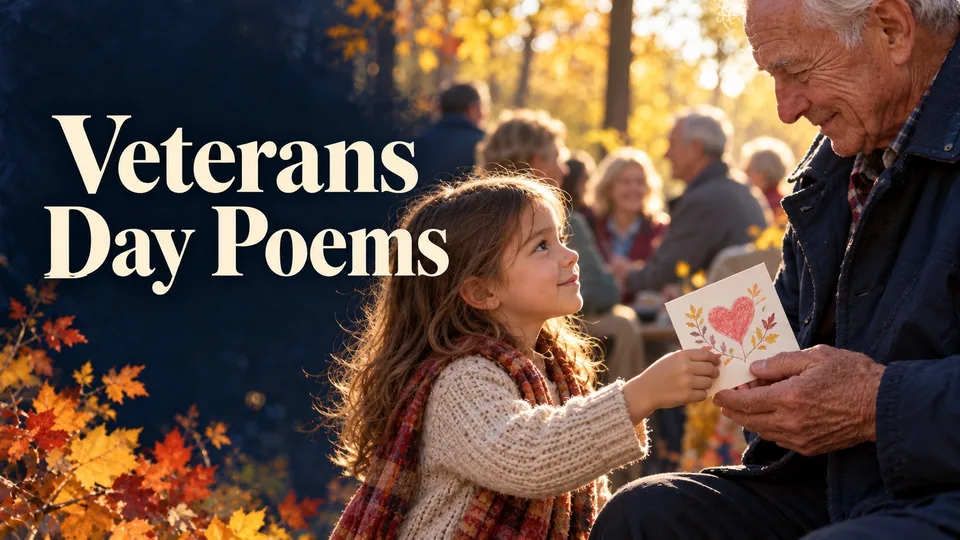
A thank you card can feel surprisingly difficult to begin. There is a blank space inside, a person you want to honor, and the knowledge that a few sentences cannot hold an entire life of service. I think the answer is to begin honestly rather than grandly. Simple words can still carry care.
These Veterans Day poems offer eight original ways to say thank you. The collection includes brief verses for cards, a small story for a school assembly, and longer readings about listening, unseen work, and the person beyond a uniform. None of the poems claims to speak for every veteran. They are invitations to gratitude, written from the position of someone who wants to notice and honor service.
For a card, start with “A Small Card” or “November Morning.” For an assembly, “A Seat Beside Us” gives one reader a gentle story to tell. “We Make the Time to Listen” can be shared by a lead reader and a group. Approximate reading times appear with each selection and cover the poem alone, read without hurry.
I find a quiet welcome more meaningful than an elaborate speech when the speech leaves no room for an answer. A veteran may wish to share a memory, or may simply wish to sit among neighbors. Both deserve respect. If you are looking for words of thanks beyond this holiday, my poems about gratitude notice the everyday care that also asks to be remembered.
What Veterans Day Honors
In the United States, Veterans Day falls on November 11. It honors those who served honorably in the military, in peacetime as well as wartime. Memorial Day focuses on remembering those who died in military service. This distinction comes from the U.S. Department of Veterans Affairs, and it guides the emphasis on thanks and living community in these readings.
Eight Veterans Day Poems for Cards and Readings
A Small Card
The uncrowded space inside the card matters to me here. I wanted a thank you that offers attention without asking the recipient to supply a story in return.
Free verse. About 15 to 20 seconds. One reader.
This card is small.
Your service was not.
I leave some quiet
around these words,
so my thank you
has room to reach you.
November Morning
I like the leaf passing through the scene while the people pause. It gives this little poem a living November setting, which may suit a card or a brief opening reading.
Haiku. About 10 seconds. One reader.
Cold sun on the steps
We pause to offer our thanks
One leaf drifts between
A Seat Beside Us
The boy carries a chair rather than a complicated speech, and that is the gesture I keep coming back to. I would read this at a school gathering where the children can see that welcome includes practical things.
Ballad. About 30 to 40 seconds. One reader.
The hall was full of folding chairs;
A boy stood by the door.
He saw a guest come up the steps
And fetched a chair once more.“There is a place beside us here,”
He said, and set it down.
The guest took off a woolen coat,
Still cold from crossing town.They shared the songs and listened close;
The morning passed along.
A chair had made a welcome real
Before the opening song.
The Work We Do Not See
I wanted to make room for service that cannot be understood from a photograph or a short introduction. The closed book is a reminder that respect does not require us to turn somebody else's life into our own account of it.
Blank verse. About 20 to 30 seconds. One reader.
We cannot see each hour another gave.
We do not know the work behind a name.
A life is not a picture on a wall,
Or one closed book that we have learned to read.
We offer thanks for what we cannot count,
And leave the telling in another's hands.
We Make the Time to Listen
The two returning lines give this reading a calm center, which I like for a group that wants to speak together. The lead reader can carry the new lines while the group joins each repeated line, allowing the poem to keep its quiet pace.
Villanelle. About 70 to 90 seconds. One lead reader, with an optional group response on the two recurring lines.
We make the time to listen and to stay.
The morning opens softly into light.
Our thanks are more than words we speak today.We cannot know each mile along the way,
Or every task completed out of sight.
We make the time to listen and to stay.We leave some room for what you wish to say,
And room for quiet, if that feels more right.
Our thanks are more than words we speak today.No life is ours to measure or display.
We offer care without a claim or right.
We make the time to listen and to stay.A welcome has a part that hands can play:
A chair pulled close, a doorway warm and bright.
Our thanks are more than words we speak today.Beyond this hour, beyond the last bouquet,
Let kindness keep its promise through the night.
We make the time to listen and to stay.
Our thanks are more than words we speak today.
After the Gathering
The final chair being folded brings this poem back to ordinary life. I like the idea that our gratitude should travel out of the hall with the people, rather than remain beside the decorations.
Haiku. About 10 seconds. One reader.
Last chair folds away
Thanks go home with those who served
Wind turns one more leaf
Beyond the Uniform
A person has interests and habits beyond the part of their life we are honoring. I wanted the worn garden glove and book to keep that whole person present, especially when the poem is read in a formal setting.
Sonnet. About 50 to 60 seconds. One reader.
We see the coat you hang beside the door,
A garden glove left drying in the sun.
Your days hold joys we have not seen before,
Beyond the lists of duties you have done.
A book lies open where you left a page;
The kettle waits beside a painted cup.
Your stories need no banner and no stage,
You choose which memories to open up.
We honor service, yet we honor you,
The person with a morning still to make.
Our thanks should leave some room for something new,
A quiet walk, a choice that you may take.
Beyond the words a ceremony brings,
A whole life waits among the daily things.
A Thank You We Can Keep
I notice the folded chairs and ordinary street at the end of a ceremony. This poem asks what happens after that moment, and I appreciate its small, workable answer: make the welcome last.
Sonnet. About 50 to 60 seconds. One reader.
When all the folding chairs are put away,
And every final song has met its end,
The street resumes its ordinary day;
We still can make the time to greet a friend.
A thank you need not vanish with the crowd,
Or wait until the banners rise once more.
It need not be elaborate or loud,
To keep a little welcome at the door.
We cannot write the chapters of your years,
Or know the weight of all you chose to do.
Respect makes room for silence and for tears,
And leaves the choice of telling up to you.
Let gratitude be something we can keep,
A promise with its roots both plain and deep.
Sharing a Reading with Care
When you choose a Veterans Day poem, think first about the person or group receiving it. A card can hold a brief selection and a sentence in your own voice. An assembly may need one clearly announced reader and a little space before the applause. There is no need to make the reading longer simply because the occasion matters.
If you know the recipient, add a detail you can honestly name. You might thank them for visiting the school, joining the gathering, or giving you time to listen. Avoid assuming a service history you have not been told. A plain thank you is kinder than an impressive sentence built from guesses.
For a group reading, rehearse where the recurring lines begin. Let the lead reader set a comfortable pace and invite the others to join without shouting. With younger children, “A Small Card” may be enough. They can write their own closing words underneath it or draw something that feels welcoming, without being asked to picture experiences beyond their understanding.
I would also leave room for a veteran who prefers not to speak. Gratitude can be offered without requiring a response. A chair, a warm greeting, and an unhurried goodbye are meaningful parts of a gathering, too.
These poems are small offerings, and they should remain small enough to let the person come first. My hope is that a reader finds words that feel sincere, then carries the same attention into an ordinary day after the holiday. That is where a thank you has room to become a habit.
Useful cards for a Veterans Day thank-you
A sincere thank-you needs only your words. Reuse stationery you own, or choose blank cards if you are preparing several handwritten messages.
These are paid links. As an Amazon Associate I earn from qualifying purchases.
- View on Amazon
Seasons of Life blank note cards
Write a respectful verse and a personal note of thanks, choosing words that suit the person receiving it.
24 blank cards and white envelopes, four tree designs, 3½ × 4⅞ inches
Send a little poetry to someone you love.