

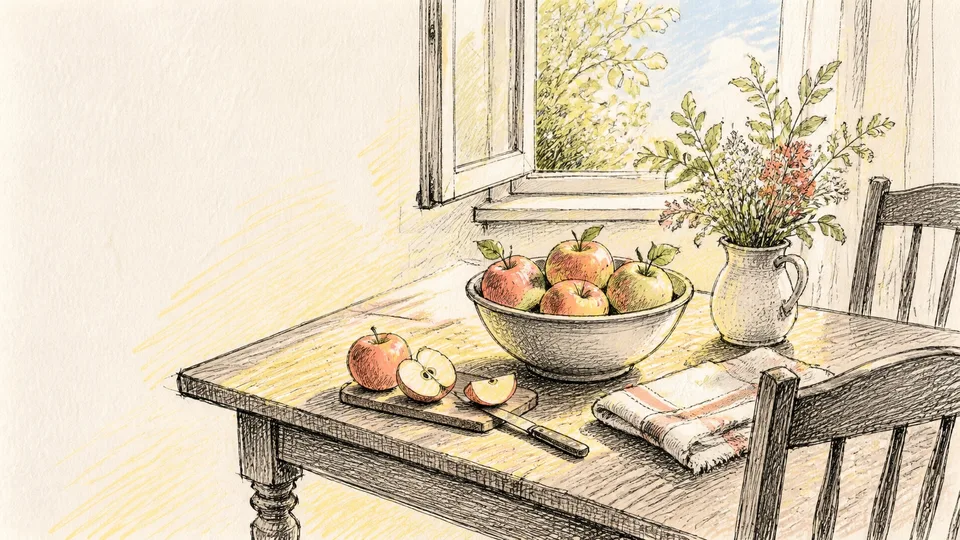
Gratitude does not always arrive as a grand feeling. Sometimes it begins with a clean cup, a chair pulled close, a bowl of fruit, or the sound of someone moving around a kitchen you know well. The smallest details can become doorways into a larger awareness of what has carried us.
These poems about gratitude include two sonnets, free verse, a haiku, and a ballad. They are written for quiet reflection, a family note, a thank you message, or the moment when you realize that an ordinary day has offered more than you first noticed. None of them asks you to pretend that every day is easy. They simply make room for the good that can stand beside the difficult.
I have always liked the way a table gathers separate lives into one place. A loaf is sliced, a story is told, and someone reaches for the bowl before being asked. Those gestures may look small from across the room, yet they become part of the private history we carry for years.
A grateful heart is not a heart that ignores trouble. It is a heart that keeps its eyes open long enough to see help, beauty, humor, and companionship when they appear. If you are searching for words to thank a person, honor a season, or steady your own thoughts, I hope these poems offer a beginning.
For a related path through memory, visit these poems about memories or these poems about family. Read slowly, and let one ordinary object become important for a little while. There is often more grace in the room than we had time to notice the first time through.
Poems About Gratitude in Ordinary Places
The Bowl on the Table
The bowl of apples is the first thing that catches my eye, because it turns preparation into a kind of quiet welcome. I love the way the poem notices the hands that set a table instead of waiting for a celebration to make the room meaningful. It may be useful when you want to thank someone for all the care they offer before anyone else arrives.
Shakespearean sonnet
Before the first guest finds the kitchen chair,
A bowl of apples gathers evening gold,
The window lays a square of shining air,
The quiet room remembers what we’re told.
I notice how the simplest gifts arrive,
A knife, a loaf, a place to set a plate,
The people who make ordinary things thrive,
By leaving room for one more at the gate.
I used to wait for reasons grand and bright,
Now thanks can rise for clean and borrowed chairs,
For rain that turns the garden green with light,
For voices traveling softly up the stairs.
The heart grows large by naming what is near,
And finds a feast in being gathered here.
Inventory of Thanks
Lists can be tender when they are made from real things. I notice how the poem moves from objects to people, then from people to the gift of another morning. This is a good one to read when your gratitude feels scattered, because it shows that naming one small thing can help the rest come into view.
Free verse
Thanks for the spoon left beside the sink,
for the towel hung straight,
for the window that held the rain.Thanks for the message that arrived
before I knew I needed it,
for the laugh at the end of a long day.Thanks for bread still warm in its cloth,
for a chair that knows my shape,
for a morning willing to begin again.
After the Rain
This haiku holds a whole change of weather in three short lines. I like the bee warming itself in the light, because gratitude here is not an idea floating above the garden. It is a green, living answer that makes a reader pause beside what is already growing.
Haiku
Rain beads on the thyme
One bee warms itself in light
Green answers the sky
The Extra Chair
An extra chair can say more than a formal welcome. I enjoy the gentle story of a household making room without asking a visitor to explain why the room is needed. This poem belongs at a family table, but it may also comfort anyone who has been grateful for one person who noticed and made space.
Ballad
We set the plates at half past six,
The soup was nearly done,
A chair stood waiting by the wall,
Though no one had yet come.My mother checked the window twice,
My father lit the light,
We listened for a careful knock
Along the falling night.A neighbor stepped across the walk,
Her coat was damp with rain,
We moved the chair beside the stove
And warmed the room again.The bread was passed, the stories grew,
The weather lost its claim,
One empty place became a door,
And gratitude came in.
Thank You for the Small Things
The sparrow, kettle, and washed window make this poem feel like a morning I could enter. I appreciate that the speaker does not chase a distant answer, but practices thankfulness by letting the near things stay visible. Keep it for a day when you need a quiet way to say that ordinary faithfulness has mattered.
Petrarchan sonnet
The morning leaves a silver on the pane,
A sparrow tests the puddle by the wall,
The kettle makes its small familiar call,
And sunlight threads the curtains after rain.
I keep these signs as letters without name,
They ask no grand response, no polished art,
Yet each one places calmness in my heart,
And makes the common hour a kind of flame.
If gratitude is more than saying thanks,
It is the pause that lets the moment stay,
The hand that steadies someone on the way,
The grace of noticing the river banks.
I will not chase each glittering distant star,
The near and faithful shape the way we are.
The Practice of Seeing What Is Near
Gratitude can be a practice before it becomes a feeling. We can begin by looking at the room, the weather, the work of another person, or the part of ourselves that kept going through a difficult hour. Attention gives thanks a place to begin.
“The Bowl on the Table” is a natural choice for a family note or a message to someone who hosts with care. “Inventory of Thanks” can become a journal prompt, while “After the Rain” would fit beside a photograph of a garden. “The Extra Chair” is for the person who has welcomed you, and “Thank You for the Small Things” is a quiet companion for a reflective morning.
If you are writing to someone specific, include one detail that only the two of you would recognize. It might be the way they keep fruit in a certain bowl, the chair they always choose, or the phrase they say while rain moves across the glass. Details do not make gratitude fancier. They make it true to the life you share.
Some days will hold more difficulty than ease, and a grateful poem should never ask you to deny that. It can simply place a warm cup beside the hard conversation, or name the person who stayed when the answer was not ready. A small light is still a light, even when the room has shadows.
When I am unsure what to write, I return to the nearest honest sentence: thank you for being here, thank you for making room, or thank you for helping me see this day. Those words may look plain on the page, but plain words can carry a great deal when they are chosen with attention.
Useful cards for a personal thank-you
A sincere thank-you needs only your words. Reuse stationery you own, or choose blank cards if you are preparing several handwritten messages.
These are paid links. As an Amazon Associate I earn from qualifying purchases.
- View on Amazon
Seasons of Life blank note cards
Choose a gratitude poem and tell the recipient exactly what you are thanking them for.
24 blank cards and white envelopes, four tree designs, 3½ × 4⅞ inches
Send a little poetry to someone you love.