

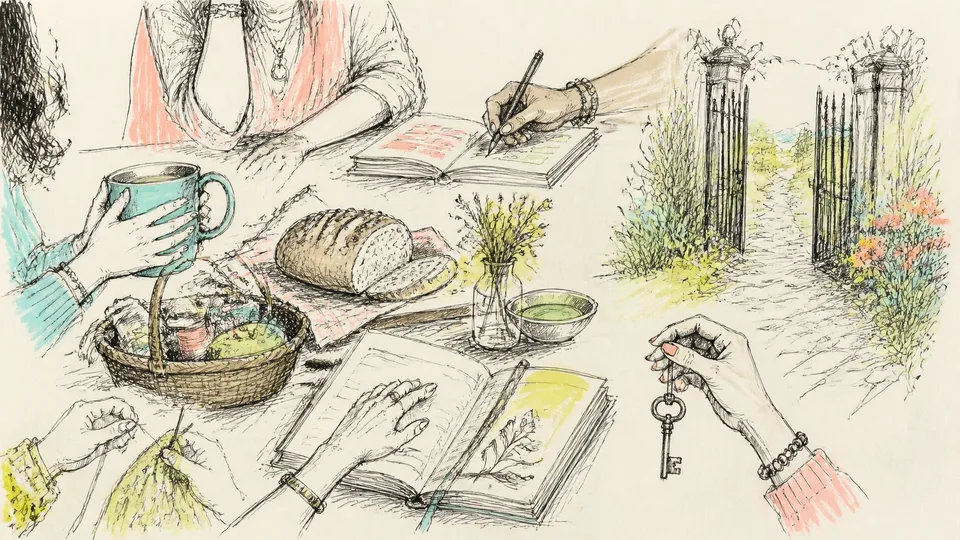
Women are not one story. They are daughters, friends, teachers, makers, neighbors, leaders, caregivers, students, and people whose lives may hold several of those roles at once. A useful poem should leave room for difference instead of asking every woman to represent a single idea.
These poems about women include two sonnets, free verse, a limerick, and a ballad. They are for a celebration, a card, a classroom, a friendship, or a quiet recognition of work that is often noticed only after it has been done.
I have learned from women who made ordinary courage look practical. They carried a meal, opened a book, told the truth, fixed a hem, or sat beside someone who needed company. You may also enjoy these poems celebrating sisterhood and these poems about friends.
Poems About Women
The Woman at the Open Gate
This Shakespearean sonnet uses an ABAB CDCD EFEF GG rhyme pattern. The woman at the gate is not presented as a symbol only. She is a person choosing welcome, boundaries, and her own direction.
The woman at the open gate can see
The road that bends beyond the garden wall,
She knows the work of staying, and is free
To choose the road that calls her when it calls.Her hands have held a book, a child, a key,
Her voice has answered questions in the hall,
She has been praised for giving endlessly,
Yet keeps one room where no one owns it all.She opens wide the gate for those in need,
Then closes it when rest becomes her right,
A generous heart can still refuse a deed
That asks her to become invisible at night.She stands beneath the sky and names her way,
A whole and changing woman in the day.
A Woman's Hands
This free verse poem notices several kinds of work without ranking them. Its short lines leave space for the reader to add the hands that matter in her own life.
A woman's hands
may carry a baby,
a hammer,
a lesson plan,
a paintbrush,
a phone.They may open,
close,
wave,
rest.Do not ask what they are worth
before asking
what they have been asked to hold.
The Wisdom That Keeps Growing
This second sonnet follows an ABBA ABBA octave and a six line resolution. It honors wisdom as something that keeps changing through work, questions, and attention rather than arriving as a finished title.
The wisdom that keeps growing does not shine
Like polished brass displayed above a door,
It listens first, then asks one question more,
And changes shape when facts refuse to align.
It knows that patience is a living line,
That strength can bend and still become a shore,
That one kind word may open someone’s core,
And one clear no can keep a life in time.
I have learned wisdom in a crowded room,
In kitchen steam, in notes beside a bed,
In women making quiet space to bloom,
While carrying the things they never said.
The wisest heart keeps learning how to see,
And leaves another woman room to be.
The Friend Who Brought a Ladder
This limerick uses five lines and an AABBA rhyme pattern. Its friend arrives with a practical ladder and a great deal of confidence, giving the celebration a gentle laugh.
A friend brought a ladder one day,
To hang up a banner in May.
She climbed with a cheer,
Then shouted, “Come near,”
“The top is the best place to stay.”
The Women at the Table
This ballad follows several women sharing a table after a long day. Its song like movement lets their different stories meet without forcing them into one voice.
The women came with weather in their coats,
With papers, bread, and keys.
One spoke of work, one spoke of rain,
One listened to the breeze.They did not share the same old road,
Or want the same next door.
Yet someone poured another cup,
And someone moved a chair.
The evening grew less heavy there,
The stories found their place.
A table can become a kind of strength
When every voice has space.
Room for Many Stories
Writing about women asks for attention to the particular. Celebration is stronger when it names real work, real friendship, and real choices instead of using a single bright adjective for everyone.
Choose The Woman at the Open Gate for a reading about boundaries and direction. A Woman's Hands suits a card or classroom, while The Wisdom That Keeps Growing honors a mentor. The limerick can bring humor to a gathering, and The Women at the Table fits a group celebration.
If you share one of these poems, name the woman or women with care and permission. Include the work, phrase, object, or gesture that truly belongs to them. Specific recognition feels more respectful than a general compliment.
Every woman deserves room to be more than the role a day assigns. Make the table wider, listen for the story beneath the title, and let the person remain larger than the poem that tries to honor her.
Send a little poetry to someone you love.