

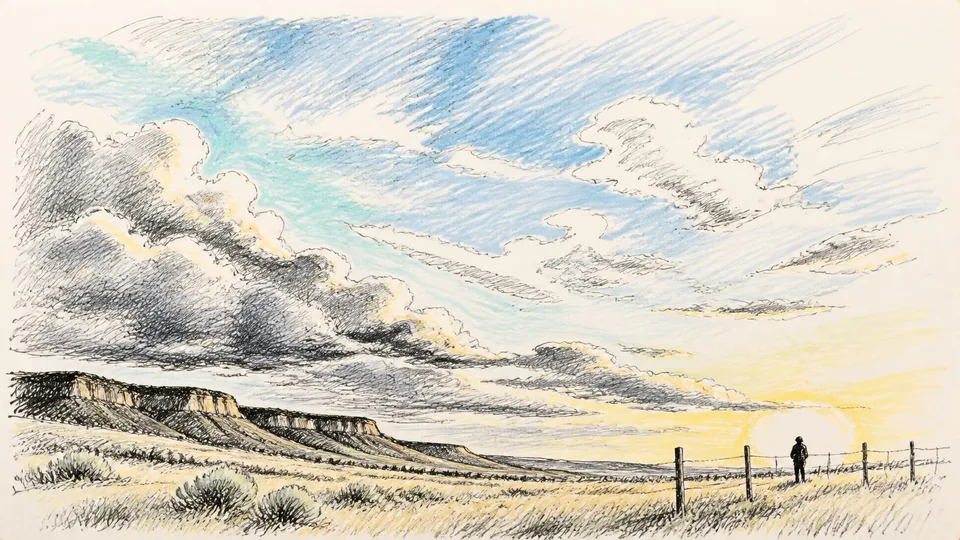
The sky is never one thing for long. It can be blue enough to make a person hopeful, dark enough to ask for patience, or full of moving shapes that give a restless mind somewhere to wander. Looking up does not solve every question, but it can loosen the tightness around one.
These poems about the sky include two sonnets, a haiku, blank verse, and a ballad. Together they consider weather, distance, breathing, and the way a wide horizon can make a private worry feel less crowded. They are gentle words for a journal, a classroom reading, a note to someone under pressure, or a few minutes outside after a long day.
I grew up among hills that folded the distance into layers. Later, under the open Montana sky, I learned that a horizon can feel like a new kind of conversation. Both places taught me to notice the light between clouds and to trust that weather can change without asking permission.
The sky also gives us a way to speak about feelings without forcing them into a single name. A cloud can be a question, a blue opening can be relief, and a sudden wind can be the beginning of movement. If you are searching for a poem to help someone breathe and look a little farther, I hope you find a line here that leaves room.
For another collection shaped by the natural world, you may enjoy these poems about rain and these poems about walking. Read with a window nearby if you can. Sometimes the most helpful thing a poem does is remind us that the view is still changing.
Poems About The Sky and a Wider View
The Sky Makes Room
I love the opening idea that the sky has room for every kind of weather. The speaker’s worry becomes smaller without being dismissed, and that feels like the kind of comfort a real friend offers. This poem may help when you need permission to carry a question while still noticing beauty above it.
Shakespearean sonnet
The sky has room for every changing blue,
For cloud that gathers, thins, and travels on,
For evening’s rose, for morning’s wider view,
For one pale star that waits beyond the dawn.
I carry smaller weather in my chest,
A worry folded like a paper crane,
Yet when I look above, my thoughts can rest,
And leave a little space around the rain.
No roof can hold the questions that I bring,
No fence can make the distant horizon small,
The wind reminds my breathing how to sing,
The light returns without a voice at all.
If I can stand beneath this patient height,
I may come home with more forgiving sight.
Cloud Lesson
The clouds in this haiku do not hurry to explain themselves. I notice the blue opening after rain, and I like the birds crossing it as a sign that movement can return quietly. These few lines might be useful for a child or an adult who needs a small picture of hope that does not make a grand promise.
Haiku
Clouds drift over hills
Blue opens after the rain
Birds cross the quiet
Under the Wide Blue
This poem begins with the body stepping outside, which makes the sky feel close rather than abstract. I enjoy the way the horizon gives questions somewhere to rest, because that is often what a walk does for me. The ending keeps the room small while letting the breathing grow, and that is a gentle kind of freedom.
Blank verse
I step outside and let the morning pass
Across my face before I name the day.
The roofline loosens from the quiet house.
A silver cloud moves slowly toward the hill.
I hear the fence respond to wind and time.
The distance does not ask me to be sure.
It gives my questions somewhere else to rest.
And leaves enough blue for a second thought.
I turn back in with steadier hands.
The room is small, the breathing is not.
The Weather Window
I recognize the waiting in this ballad, especially the moment when someone watches a window and wonders whether the day will open. The small acts inside the house keep the story warm while the weather moves outside. It may be a good poem to read aloud when a family is waiting for a visit, a trip, or a clearer hour.
Ballad
We watched the clouds above the roof,
They gathered dark and slow,
My sister set the kettle on,
And said, “The rain will go.”We folded blankets on the chair,
We checked the garden gate,
We left a lamp beside the steps
For someone coming late.The thunder softened into drops,
The window cleared its face,
A narrow road of silver light
Ran through the quiet place.We opened up the door at last,
The air was washed and new,
The sky had not explained a thing,
Yet somehow we could too.
After the Storm Moves East
The washed leaf beside the garden chair is the detail I want to keep. It shows that a storm can leave evidence without owning the whole story, and I find that honest. Anyone who is waiting for calm after a difficult stretch may find a little steadiness in the poem’s returning light.
Petrarchan sonnet
The storm has left a ribbon on the pane,
The yard holds beads of water in its grass,
A single crow goes calling as clouds pass,
And sun returns without a proud refrain.
The house is still, but not the same again,
A washed leaf shines beside the garden chair,
The lifted air has cleared a place somewhere,
For all the thoughts that tangled in the rain.
I know that calm is not a promise made,
The next dark cloud may cross the open blue,
Yet light can show what weather has remade,
And teach the eyes to welcome wider view.
I breathe until the quiet feels like home,
Then watch the changing sky, and let it roam.
Letting the Horizon Stay Open
The sky offers a useful lesson in emotional patience. We do not have to decide whether a day is good or bad by looking at one cloud. Weather moves, light shifts, and the same horizon can hold rain in the morning and a clear opening by afternoon.
“The Sky Makes Room” is for a person carrying too many thoughts at once. “Cloud Lesson” is brief enough for a note or a classroom reading, while “Under the Wide Blue” suits a walk or a journal page. “The Weather Window” offers a story of waiting, and “After the Storm Moves East” can sit beside a season of recovery.
If you share one of these poems, let the message remain considerate. You do not have to tell someone to cheer up or move on. You can say that you are thinking of them, that there is no hurry to explain, and that you are willing to stand nearby while the weather changes.
I have found that looking at the sky can return a sense of proportion. The problem may still be waiting when I come back indoors, but my thoughts have more air around them. That little difference can be enough to choose the next kind action or make the next honest call.
Before you leave this page, look up if you are able. Notice the color, the wind, and the distance between one cloud and the next. The sky does not need us to solve it. It simply keeps making room, and we can practice doing the same.
Send a little poetry to someone you love.