
Poems about Shakespeare can begin with the moment a page becomes a voice. A reader tries a line, an actor moves a chair, a class discovers that the difficult sentence contains a joke. I like that practical entrance into a writer whose name can sometimes feel larger than the work of reading him.
These five original poems look at rehearsal, performance, and the small marks a reader leaves in a margin. They are poems about encountering Shakespeare, rather than quotations from his plays or attempts to speak in his personal voice.
For the historical background, the Folger Shakespeare Library's biography connects his life with Stratford and his work in London's theater as an actor, playwright, and company partner. It also separates documented information from what remains unknown. The modern classrooms and rehearsals below are imagined.
If you enjoy the private side of reading, the poems about books collection stays with that pleasure. Here, the page has been opened, somebody has taken a breath, and the room is waiting to hear what happens next.
The poems
The First Reading
The class's laughter is the point where this poem comes alive for me. A formidable page becomes something people can hear together, even before every difficulty has been solved.
We approached the page
as if it might test us.Someone read too fast.
Someone lost the place.
A chair scraped loudly
in the important silence.Then a joke found its listener.
The room laughed.We had not solved the whole play.
We had found a door
that opened from our side.
An Empty Stage at Noon
A stage with almost nothing on it is a wonderful invitation. I like the way one voice can begin changing the room before costumes or scenery arrive.
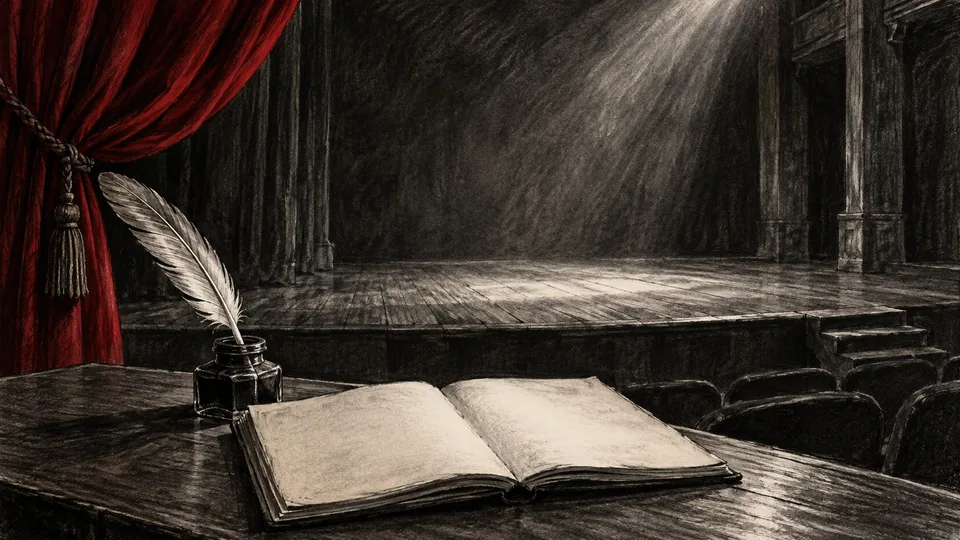
The stage is bare except a wooden chair;
The boards hold dust within their narrow seams.
No painted castle waits to house our dreams;
A single window cuts the noonlit air.
An actor starts a speech with patient care;
The room expands beyond its wooden beams.
A kingdom gathers where the daylight streams,
And leaves a human question standing there.
The page is old, the spoken breath is new;
Each listening face becomes another place
Where words can take a little living room.
We bring our doubt, our laughter, and our view;
The voice goes on at an unhurried pace,
And lets a world arrive before the gloom.
The Smallest Part
I like the performer's discovery that a short entrance still belongs to the whole scene. The borrowed hat gives the rehearsal a little humor and keeps the moment human.
His part was small, his entrance late,
His hat a size too wide.
He waited while the others spoke
And held his notes beside.He missed the cue, then tried again;
The hat fell past his nose.
The room grew kind with sudden laughs;
The patient scene arose.He found his moment, crossed the boards,
And left at just the place
Where someone needed him to move
To give the next voice space.
Before the Entrance
The little breath before the curtain moves feels full of possibility to me. I like giving that unperformed instant a poem of its own.
Curtain, wooden floor.
One breath waits behind the cloth.
Then a footstep sounds.
A Margin Left for Us
The penciled question makes the reader a participant. I like that meeting an older text can include disagreement and curiosity as well as admiration.
I write a question by a printed line;
The margin holds a little crooked mark.
The words are his; the doubt beside them mine,
A small lamp brought into a larger dark.
I need not nod at all the voices say
Or know at once what every phrase has meant.
A page can ask me where I stand today,
And ask how far my present thoughts dissent.
The living reader has a place to sit
Beside the work that traveled through the years.
I bring the life that makes me answer it,
My present laughter and my present fears.
The book stays open, old and also new;
A margin leaves some room for me and you.
A few words to carry with you
An encounter with Shakespeare need not begin with instant understanding. A page can become more approachable when it is read aloud, when a question is allowed to remain in the margin, or when a small part finds its place in the larger scene.
The poems here celebrate that ongoing encounter. They do not borrow his famous lines or supply imagined motives for the historical writer. The Folger biography offers the factual background; the rehearsal rooms and readers belong to these original pieces.
For a short reading, the curtain verse makes a quick opening. The empty stage sonnet has more space for the feeling of a performance beginning. The margin poem may suit a reader who likes to answer a book rather than simply admire it from a distance.
I am especially fond of the hat falling over the actor's nose. It allows the room to laugh and then get on with the work. Sometimes a celebrated writer becomes more accessible when ordinary people remember that making a play has always involved bodies, breath, missed cues, and another try.
Reading Shakespeare himself
Nothing here is needed to enjoy these poems. If these poems send you to the source, this is a handsome way to get there.
These are paid links. As an Amazon Associate I earn from qualifying purchases.
- View on Amazon
The Complete Works of William Shakespeare
Read the plays and sonnets that these poems circle around.
One leather bound book
Send a little poetry to someone you love.