

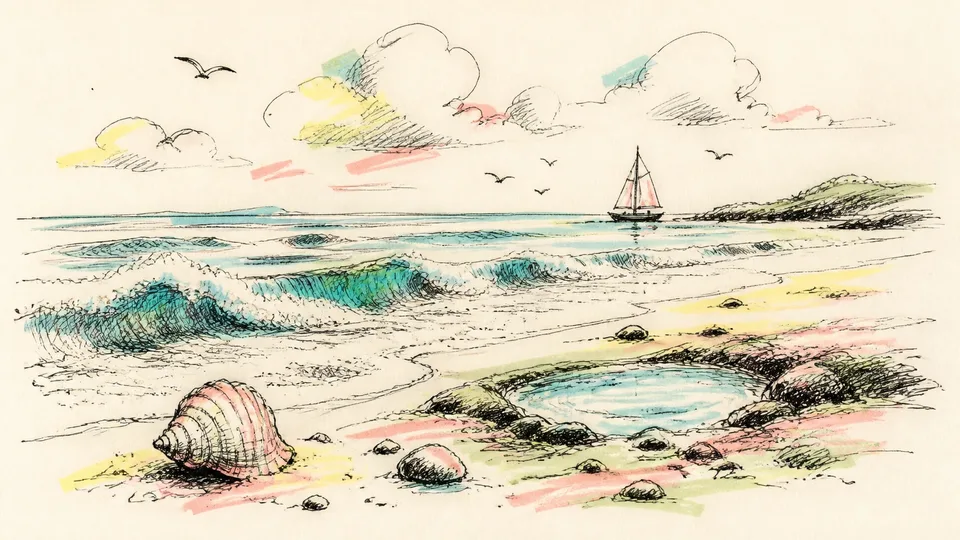
The ocean can make a person feel very small without making that smallness seem unimportant. A tide reaches the shore, withdraws, and returns with no need to explain the pattern. The water holds distance, memory, danger, beauty, and the possibility of a wider view.
These poems about ocean life include two sonnets, blank verse, a limerick, and a ballad. They are for a beach walk, a travel memory, a lesson about weather and water, or a quiet reading when you need the sound of something larger than yourself.
I have always carried shore memories through inland days. A shell in a pocket, salt on a sleeve, or a line of foam can bring back a whole horizon. If you enjoy poems about moving water, you may also like these poems about sailing and these waterfall poems.
Poems About Ocean
The Ocean Keeps Its Promise
This Shakespearean sonnet uses an ABAB CDCD EFEF GG rhyme pattern. Its promise is not that the sea will be gentle, but that it will keep returning and remind the speaker of a world beyond one day's worry.
The ocean keeps its promise to the shore,
It comes, withdraws, and comes again in blue,
It leaves a shining language at the door,
Then takes the words and makes the whole world new.The gulls write circles over ropes and sand,
A child's small tower leans against the foam,
The tide removes the castles from the land,
Yet leaves a place for other hands to roam.I stand where water teaches stone to wait,
And feel my narrow questions lose their weight,
The world is wide enough for more than fate,
The heart can learn a larger kind of state.The tide goes out, but not the hope it brings,
The shore keeps room for all returning things.
The Tide Table
This blank verse poem follows a person reading a tide table before walking the shore. Its unrhymed, measured lines connect careful planning with the freedom to notice what cannot be controlled.
I read the numbers written by the door.
The tide will rise before the afternoon.
I fold the paper, check my shoes, and go.
The shore is wider than the page can say.
A crab leaves commas in the shining sand.
A cloud moves slowly over distant boats.
I keep my watch, but let my eyes grow wide.
The water teaches time by moving time.
I turn toward home before the path is gone.
The sea remains, though I have left its edge.
A Shell in the Pocket
This second sonnet uses an ABBA ABBA octave and a six line resolution. A shell becomes a small container for distance, while the speaker considers what can and cannot be carried home.
A shell rests in the pocket of my coat,
Its spiral holds a whisper of the foam,
I carry it through streets that are not home,
And hear a farther weather in its note.The ocean has no room to stay in a boat,
No hand can hold the horizon in its dome,
Yet one small curve can make a memory roam,
And keep a salt bright afternoon afloat.I do not ask the shell to speak for all,
Or turn the sea into a private sign,
It simply waits beside the keys and call,
A piece of distance resting near the line.Some gifts are small enough to carry far,
And still can point beyond the nearest star.
The Crab with a Plan
This limerick follows five lines and an AABBA rhyme pattern. Its playful crab has an ambitious route and a practical reason to change direction.
There once was a crab with a plan,
To march to the shore like a man.
He turned left at the foam,
Then hurried back home,
And said, “That was grand while it ran.”
The Child and the Horizon
This ballad tells a story about a child who asks where the ocean ends. The song like movement answers with an invitation to keep walking, wondering, and leaving room for what cannot be seen yet.
“Where does the water finish?”
The child asked the evening tide.
The mother said, “It does not tell us,
It keeps the world outside.”They walked beside the foaming line,
They watched the gulls turn white.
The horizon held a road of blue
That disappeared from sight.The child went home with sand in shoes,
And questions in the hand.
Some answers start as distant lines
We learn to understand.
Carrying the Horizon Home
Ocean poems can be about travel, but they can also be about scale. The water reminds us that a life may be one small place inside a larger world, and that being small does not prevent us from belonging to the whole.
Use The Ocean Keeps Its Promise for a beach reading or a note about returning. The Tide Table suits a person balancing plans with uncertainty, while A Shell in the Pocket is made for a travel memory. The limerick can delight a child, and The Child and the Horizon belongs to a family walk.
If you share one of these poems, name the shore you mean without pretending every coast feels the same. Include the color of the water, the sound underfoot, or the weather that met you there. Detail lets distance stay honest.
The horizon will always remain farther than the hand can reach. That is not a disappointment. It is a generous edge, inviting us to keep looking, keep learning, and carry a little more wonder home.
Send a little poetry to someone you love.