

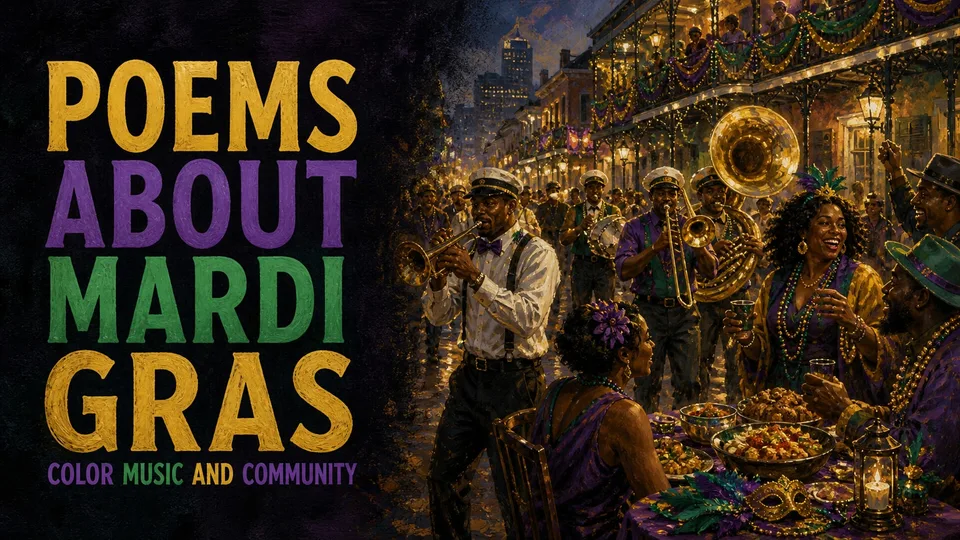
Mardi Gras carries a long Carnival tradition with local New Orleans history. Mardi Gras New Orleans records January 6 as the start of Carnival season and 1857 as the year of the first New Orleans parade. These six original poems use color, music, food, and release without claiming to speak for every community that celebrates.
For another festive collection, you may enjoy poems about St. Patrick’s Day or funny Irish poems. Let local traditions lead the details when you adapt a poem for a parade, party, classroom, or family gathering.
Poems About Mardi Gras
Purple, Green, and Gold
This poem uses familiar Mardi Gras colors as a visual doorway into celebration. It does not make a claim about every local tradition. The colors become a moving landscape of community and joy.
Purple on the evening street,
Green beneath the light.
Gold appears on every face
That turns toward the night.The colors carry laughter,
The music carries far.
A city writes a bright refrain
Beneath a rising star.
The Parade Turns the Corner
This poem captures the moment a parade enters view. It focuses on the crowd’s shared attention. The scene is lively without needing a specific float or organization.
The parade turns the corner,
The drums begin to speak.
A child lifts a paper crown,
A smile appears on every cheek.The street becomes a river,
The windows lean and shine.
A city gathers close enough
To make the moment mine.
Beads in the Air
This poem treats beads as a symbol of connection and playful surprise. It avoids treating the object as more important than the people sharing the day. The final stanza brings the image back to generosity.
Beads rise into the evening,
Red, green, gold, and blue.
A hand reaches, a laugh replies,
A stranger smiles at you.The beads will fade to ordinary,
The night will lose its sound.
But a cheerful gift can leave a heart
More open than it found.
A Table Full of Stories
This poem brings the celebration indoors. It uses food and conversation as a broad image of hospitality. The writer can add a local dish when adapting it.
A table full of stories waits,
With plates and cups and cheer.
The music finds the kitchen first,
Then brings the whole room near.We eat, we talk, we make more room,
We pass the welcome round.
A celebration grows in size
By how much love is found.
The Quiet Before Lent
This poem recognizes the contrast between public revelry and quieter days. It does not prescribe one religious response. The changing sound becomes the central image.
The music will grow softer,
The bright street will grow still.
The night will leave its ribbons on
The windows and the hill.Whatever quiet follows next,
Whatever hearts may learn,
The joy we shared can leave a light
That does not need to burn.
Fat Tuesday Wish
This closing poem offers a simple wish for the celebration. It keeps the tone inclusive and open to different ways of observing Mardi Gras. The final lines encourage joy that can be carried beyond the event.
May Fat Tuesday find you with
A little room to sing.
May music, friends, and open hands
Make ordinary spring.May laughter be your brightest bead,
May kindness be your gold.
May every celebration leave
A story worth retold.
When writing about a cultural celebration, check local history and avoid flattening many traditions into one picture. Let the poem focus on a specific scene, while the introduction gives readers accurate context.
Send a little poetry to someone you love.