

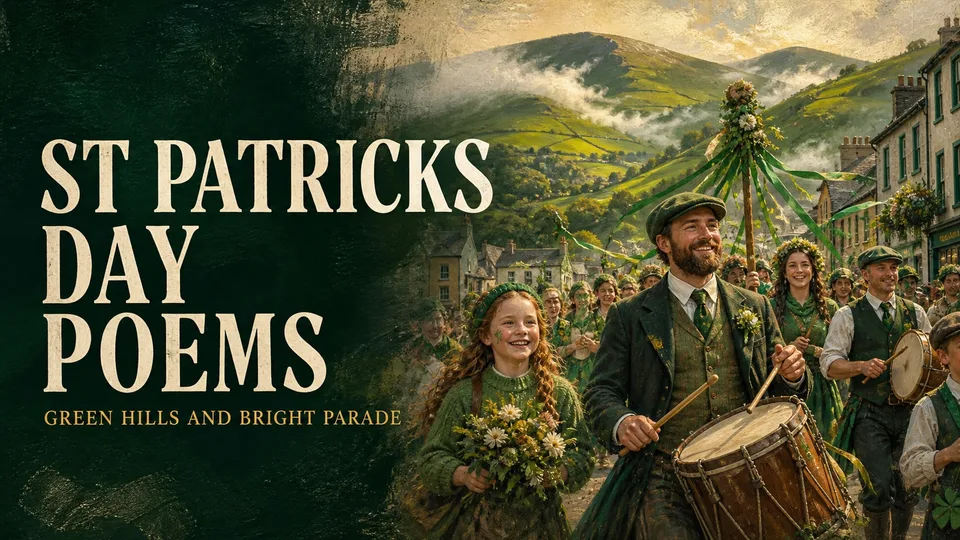
St. Patrick’s Day carries both religious history and Irish American public tradition. The Library of Congress materials on Saint Patrick’s Day document how public celebrations became part of Irish American life in the United States. The eight original poems below use landscape, music, family, and community as imaginative themes without reproducing traditional songs or claiming to speak for every Irish person.
For another lighthearted collection, you may enjoy funny Irish poems or jokes and funny New Year poems. Use these verses for a classroom, card, family gathering, or March celebration.
Poems About St. Patrick’s Day
Green Hills in the Morning
This poem begins with a quiet landscape rather than a parade. It treats green as a color of memory and renewal. The broad setting leaves room for a reader’s own imagined Ireland.
Green hills rise in the morning,
With mist along the stone.
A road bends through the sleeping fields,
Then finds its way back home.The day may bring a brighter crowd,
A drum, a laugh, a song.
But quiet hills can hold a heart
For all the day is long.
A March of Laughter
This poem celebrates the cheerful energy of a parade. It keeps the focus on shared joy rather than a particular historical claim. The lines are suitable for a school or community reading.
The march of laughter fills the street,
With ribbons, bells, and cheer.
A child waves from a neighbor’s porch,
And draws the whole day near.The music turns, the colors rise,
The crowd begins to sway.
A town can find a little spring
Inside a March parade.
The Color of Hope
This poem uses green as a hopeful image. It does not treat luck as a promise. Instead, it connects the color to the patience of growing things.
The color green is hope today,
A leaf, a field, a tree.
It says the earth can start again,
As seasons teach us free.I do not ask for luck alone,
Or roads without a bend.
I ask for courage to begin
And kindness at the end.
A Song Across the Water
This poem imagines music traveling across distance and generations. It avoids using a known lyric. The song is an original picture of connection.
A song moves across the water,
Across the years and rain.
It finds a chair beside the fire,
Then finds a voice again.A family carries melodies
That time cannot erase.
One note can make a distant heart
Remember a familiar place.
The Kindness of a Neighbor
This poem brings the holiday into an ordinary neighborhood. It suggests that welcome is a better form of luck than a charm. The scene can fit any community celebration.
The neighbor leaves a loaf of bread,
A note beside the door.
The holiday is brighter when
We know what neighbors are for.No lucky stone can warm a room
The way a kindness can.
A little care becomes a bridge
Between one heart and one.
A Pocket Full of Green
This poem uses playful imagery for a card or classroom. It keeps the humor gentle. The pocket becomes a place where small good wishes are carried.
I keep a pocket full of green,
A clover, leaf, and thread.
I carry little wishes for
The days that lie ahead.If fortune comes, I will be glad,
If not, I still can sing.
A heart that shares a laugh today
Has found a better thing.
The Evening Parade
This poem follows a celebration toward evening. It captures the point when public excitement softens into memory. The ending is reflective and warm.
The evening parade grows quiet,
The last bright colors fade.
We carry home the laughter and
The friendships that we made.The street returns to ordinary,
The stars appear above.
A day of green has left behind
A little more of love.
St. Patrick’s Day Wish
This closing poem offers a broad wish for the holiday. It avoids claiming one single meaning for the day. The final lines suit a card or celebration toast.
May St. Patrick’s Day bring you
A heart both brave and kind.
May green fields, music, friends, and hope
Leave lonely thoughts behind.May every road you travel find
A welcome at the door.
May kindness be the luck you keep
And share forevermore.
When writing a holiday poem, separate documented history from imaginative language. A small source note can protect accuracy, while the poem itself can remain original, welcoming, and personal.
Send a little poetry to someone you love.