

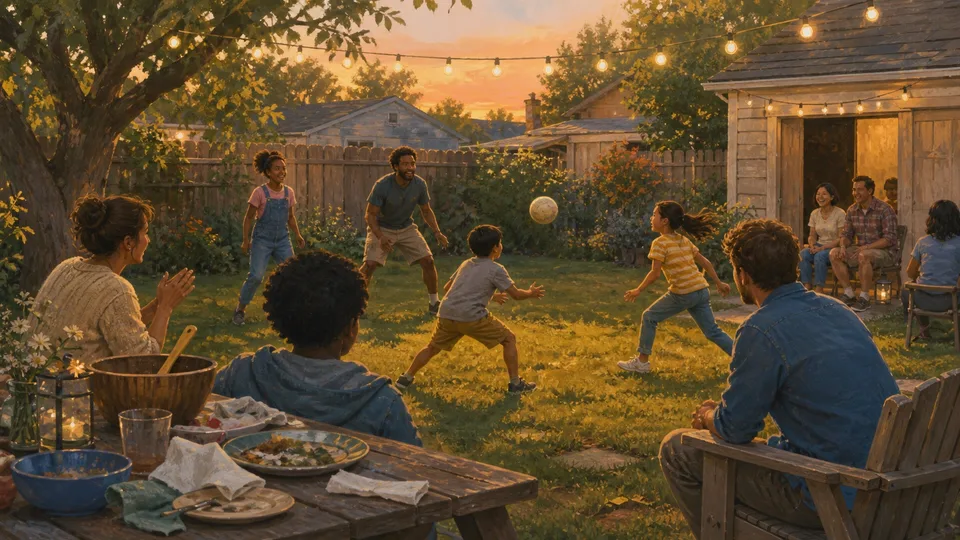
Fun can sound like a grand event, but much of it begins in a smaller way. Someone makes a ridiculous face across the table. A song turns a kitchen into a dance floor. A game lasts longer than expected because no one wants to be the first person to put the pieces away.
These poems about fun are written for the ordinary kinds of joy that make a day feel more spacious. They include two sonnets, a limerick, a ballad, and free verse. The forms change because fun itself changes shape, moving from a private smile to a whole room laughing together.
As a teacher and a grandmother, I have seen that play does not belong to one age. Children make rules for a game and change them halfway through. Adults find a forgotten joke and carry it for years. Even a quiet person may have a bright sense of mischief waiting for a safe room.
If you want to add movement to the collection, these poems about dancing may be a good next step. For a gentler kind of shared happiness, you might also enjoy these poems about friends.
Poems About Fun
The Table After Supper
This Shakespearean sonnet gives a family table a playful afterlife. Its fourteen lines use an ABAB CDCD EFEF GG rhyme pattern. The final couplet suggests that joy often begins after the scheduled part of an evening is over.
The plates are stacked, the kettle gives a sigh,
Yet no one moves to clear the final chair,
A paper napkin makes a paper sky,
And laughter lifts the crumbs into the air.We tell the story wrong on purpose now,
Each person adds a detail out of place,
The youngest claims the dog deserves a bow,
The oldest tries to keep a solemn face.The evening was not planned to last so late,
The clock has wandered past its usual tune,
But joy can find an unlocked garden gate,
And turn a common kitchen into June.We leave the dishes for another hour,
And let a little laughter show its power.
A Lark in the Kitchen
This limerick uses five lines and an AABBA rhyme pattern. It keeps the humor warm and harmless. The spoon becomes an unexpected dance partner.
There once was a cook named Marie,
Who danced with a spoon for glee.
She twirled by the sink,
Gave the saucepan a wink,
And served up a song with her tea.
The Afternoon We Kept
This second sonnet uses an ABBA ABBA opening and a six line resolution. It honors a day that became fun because people stayed curious. The poem is a reminder that a schedule does not have to be full to be memorable.
We thought the afternoon would pass like rain,
A quiet cup, a book, a folded sheet,
Then someone found a ball beneath the seat,
And sent it rolling down the hall again.The chairs became a goal, the rug a field,
The rules grew stranger every time we played,
No winner kept the points that we had made,
No one could tell what counted as a yield.At last the sun leaned low beyond the trees,
Our careful plans had vanished from the floor,
We kept the kind of tired that comes with ease,
And found one laugh still waiting by the door.A day can change when play has room to start,
And leave a bright small echo in the heart.
Rules We Invented
This ballad tells a small story through song like quatrains. It follows a group who invents a game and lets the rules become part of the fun. The repeated phrase makes it easy to read aloud.
We drew a line beside the steps,
We named the porch the sea.
We gave the broom a captain's hat,
And called the mop a tree.The first rule said to never laugh,
Which lasted half a breath.
The second rule was change the rules,
And that one conquered death.By supper time the sea was dry,
The captain lost his shoe.
We packed the game into a box,
To play when skies were blue.
A Small Bright Noise
This free verse poem keeps the irregular shape of sudden delight. Its short lines create pauses between small discoveries. No rhyme is needed because the images carry the movement.
A child finds a bubble
balanced on a leaf.Someone laughs before asking why.
A chair scrapes back.
Two feet begin to shuffle.The whole room changes
by one small bright noise.
Letting Joy Take Up Room
Fun is not a denial of the serious parts of life. It is one way we remember that seriousness is not the only truth. A difficult week can still contain one silly story. A tired person can still enjoy music. A family can carry grief and laugh at the same table without disrespecting either feeling.
The Table After Supper belongs to a gathering that refuses to end on schedule. A Lark in the Kitchen is a quick note for someone who brings motion into a room. The Afternoon We Kept honors improvised play, while Rules We Invented is made for a group that has its own private language. A Small Bright Noise is for the surprise that turns a quiet day.
When you invite fun, keep the invitation generous. Not everyone enjoys crowds or competitions. A walk, a shared recipe, a funny voice, or a game with no winner can offer just as much pleasure as a large event. The point is not to perform happiness. It is to make a little space where delight can arrive naturally.
May these poems remind you that joy does not need a perfect setting. Sometimes it needs only a chair pulled back, a spoon lifted like a baton, or one person willing to change the rules and laugh.
A card game for a shared afternoon
Start with a game your family already likes. This optional choice fits the table games and ordinary laughter in these poems.
These are paid links. As an Amazon Associate I earn from qualifying purchases.
- View on Amazon
UNO card game
Gather 2–10 players ages seven and up for a few hands, making room for younger children to enjoy a different familiar activity.
One card game, for 2–10 players ages 7 and up
Send a little poetry to someone you love.