
Poems about England can begin at a stone wall where a footpath turns out of sight. The walker sees a lake, a piece of hillside, a weathered gate, and then has to decide whether to keep going. I like that modest scale: the view is worth attention before it becomes an emblem of anything larger.
These seven original poems move between an imagined Lake District walk and ordinary streets, with a small repair, a bus journey, and a change of weather along the way. Their speakers and events are fictional. The Lake District National Park's facts and figures establish the English setting and its lakes; the scenes themselves come from the poems.
England is one part of the United Kingdom, and the words are not interchangeable. Nor does this selection of landscapes and errands stand for every English place or experience. Here, a particular wall or window can have its own moment without carrying that whole burden.
The poems offer several reading paces, from a three line pause to two sonnets and a repeating final walk. If the weather catches your attention, the poems about rain linger with that subject. For now, there is a gap in the cloud above the water, and the path has not quite reached its turn.
The poems
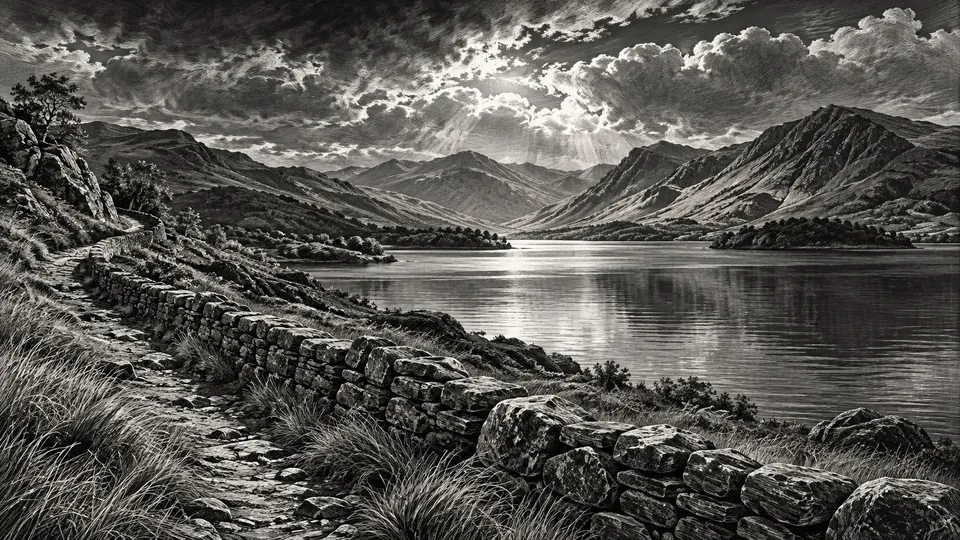
The Wall Above the Water
The small gaps between the stones interest me as much as the line of the wall. I like how something built to be useful can also give the eye a way into the landscape.
The wall goes up the hillside, stone by stone,
And leaves the lake below a silver seam.
A fern has made a little gap its own;
The clouds move through the water like a dream.
I follow where the patient wall has led,
Past grass that holds the morning's fallen rain.
The turn ahead is hidden from my tread;
The lake returns, then slips from sight again.
No single point can gather all the view,
Or make the changing colors stand in place.
A step provides a different green and blue;
A pause allows the smallest thing its space.
I take the path beyond the last gray bend,
And let the wall continue past this end.
The Borrowed Pump
The borrowed bicycle pump turns this from a landscape into a human encounter. I like the story's small exchange and the way the rider has to slow down before moving on.
A bicycle had lost its air
Beside the village store.
The rider pushed it up the slope
And stopped outside the door.A woman fetched a little pump
And set it on the sill.
They watched the thin black rubber tube
Take shape and slowly fill.It held enough to make the turn
And reach the road below.
He brought the pump back with his thanks
And took the next hill slow.
Rain on the Footpath
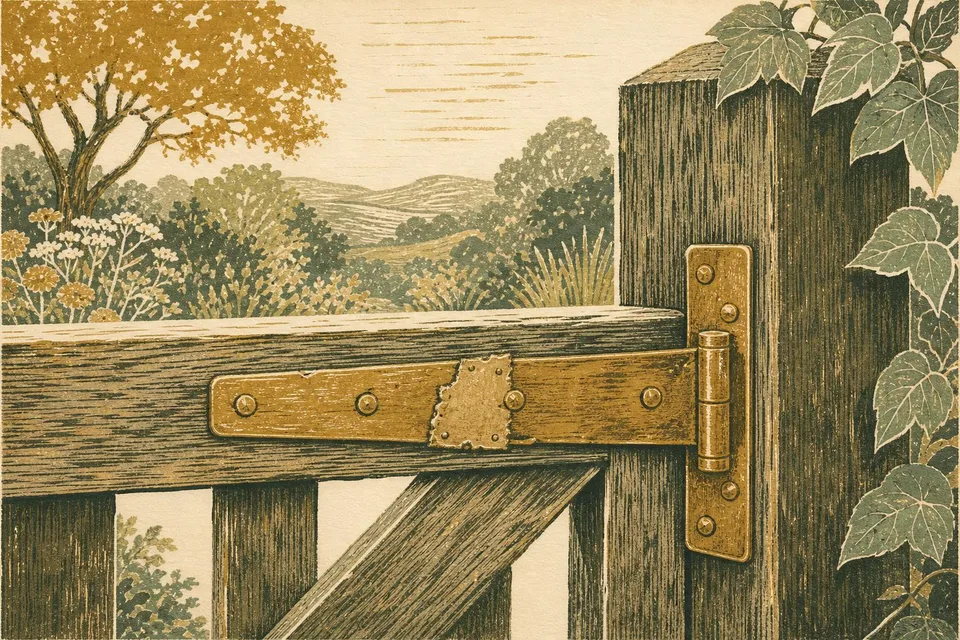
The darkened stones give the rain a visible weight. I enjoy the pause at the gate, where the walker has a reason to look rather than hurry.
Rain darkens the stones.
The gate clicks behind my heel.
A blackbird looks up.
Beyond the Postcard
The drainpipe and the delivery van bring this scene back to an ordinary morning. I like the landscape more when the people who use the street are allowed to have their practical day.
The postcard leaves out the drainpipe,
the van reversing,
the missing lid on the recycling bin.It keeps the lake.
I would keep the lake too.But I want the useful street beside it:
the parcel reaching the right door,
the shop lifting its shutters,
the day beginning
without waiting to be admired.
A Lake Holds Open Sky
The lake cannot keep the sky it reflects, which gives the poem a gentle movement. I like the change from a crisp picture to the wind breaking it open.
The lake holds open sky without a frame;
A cloud lies white upon its darker blue.
The image seems to settle, stay the same,
Until a breeze divides the whole in two.
Then hills grow crooked, branches spread and bend,
And all the perfect picture comes apart.
The ripples do not ask what they must mend;
They make another pattern as they start.
I watched the view as if it might be kept
By standing very still upon the shore.
But even while the quiet water slept,
The changing light was making something more.
A place can be familiar, wide, and new;
The lake moves on beneath the passing view.
The Last Bus Home
The wet shopping bag feels more intimate to me than the broad view through the glass. The poem comes home through a familiar practical detail.
The shopping bag is damp around the fold.
I set it where the window meets my knee.
The bus turns out beyond the little shops;
A field appears, then houses take its place.
Somebody rings the bell a moment late.
The driver stops beside a shining curb.
At home, the bread is dry beneath its wrap.
I put it down and listen to the rain.
The Path Goes On Beyond the View
The returning lines feel like footsteps to me. I like that the walker can stop at the end while the footpath retains its longer life.
The path goes on beyond the view.
A gray wall climbs the folding hill.
The next green turn is something new.The rain has left a deeper blue
Within the little hollows still.
The path goes on beyond the view.A fern grows where the stones withdrew;
Its fronds hold drops that slowly spill.
The next green turn is something new.The clouds move through the lake and through
The broken light upon the mill.
The path goes on beyond the view.I leave the place its changing hue;
No picture asks the wind to still.
The next green turn is something new.My walk will end, as walks must do;
The hill remains a larger hill.
The path goes on beyond the view.
The next green turn is something new.
A few words to carry with you
The borrowed pump may seem a long way from the lake in the opening poem, but both ask the walker to pay attention. One is a view that changes with every step. The other is a small interruption that makes the journey depend on another person's help.
I like a collection that can hold both kinds of noticing. A place is made of useful objects as well as lovely distances: gates that open, tires that need air, bread protected from the rain. Those details keep the scenery connected to a day someone might actually live.
For a short reading, the footpath haiku gives a clear pause. The ballad has a little story to follow, while the sonnets move more slowly through a changing view. The final repeating poem can be read almost at walking pace, with a breath between each return.
The scenes are inventions set against a real geographical background, and the source above is there for the background rather than the fictional errands. Readers with their own knowledge of these places will naturally bring other weather, roads, and memories to the lines.
I would leave the last word with the continuing path. There is pleasure in reaching a viewpoint, and another kind of pleasure in knowing the route has more to show than one afternoon can hold. You can turn home with the bread and still be glad the farther bend remains.
For your journey through England
These poems can take you there from your chair. If you are traveling, these are good to pack.
These are paid links. As an Amazon Associate I earn from qualifying purchases.
- View on Amazon
Essentials Dot Matrix Notebook
Keep notes on footpaths and views beside your favorite line.
One A5 hardcover notebook, 192 dot grid pages, 5¾ × 8¼ inches
- View on Amazon
Our Adventure Book Scrapbook
Bring home photographs and ticket stubs and give them a place to stay.
One scrapbook photo album
Send a little poetry to someone you love.